TRANSLATE, TRADUIRE, ÜBERSETZEN, TRADUCIR, 翻译

Thursday, November 1, 2012

Cappadocia

View overlooking today's town. For centuries people lived in the rock homes.
As always, click on images for larger views.
Sunday, 21 October 2012
3rd day of our small bus group tour


Bird houses.  They carved out spaces to attract birds
inside and then collected the guano for fertilizer. 
The Cappadocia region is geologically unique and beautiful.   The volcano known today as Erciyes Dagi erupted many millennia ago and where once lava flowed valleys now undulate to the horizon in every direction, bordered by stark rocky mountains.  The scenery is remarkable.  The closest I can relate this topography to would be the Grand Canyon combined with The Badlands of South Dakota.  As stated in the Lonely Planet guide, Cappadocia is an ultimate trip.  There are at least 15 villages or cities of these rock homes covering the Cappadocia area.  We visited only a few, probably the most popular ones for tourists since we were in a tour group.


Wild dates.  Really related to olives but taste like dates

As I mentioned previously, there were 14 people in our tour group.  The other 12 people all signed up for the hot air balloon adventure over Cappadocia.  Bill and I opted to abstain.  We have done hot air balloons over Napa Valley in California; and, while we enjoyed the experience very much, having done it once was enough for us.  We could not justify the cost of 145 Euro each to do it again.  Besides, Cappadocia was beautiful enough for us to enjoy the view from ground level.  


Resting on a cliff

Our guide was able to negotiate a somewhat lower price, but Bill and I still opted not to participate in this adventure.  (I remember how difficult it was to climb into that high basket back when I was younger and much more fit than today.)  The others were originally scheduled for their balloon ride on Sunday morning, but the weather was too cloudy so their ride was re-scheduled for very early Monday morning.  

Phallic or mushroom?  You decide.


Cappadocia is known as the Land of Well Bred Horses.  The traditional spelling was Kapadokya.  The Hittites settled Cappadocia from 1800 BC to 1200 BC, although evidence suggests humans lived in the area up to 8,000 years ago.  After the Hittites declined, smaller kingdoms held power in the region.  Then came the Persians, followed by the Romans who established the capital of Caesarea, known today as Kayseri.  
More....(ahem).....mushrooms


More bird houses.  These were everywhere!!
The earliest Christians flocked here to begin new lives, and the area was solidly Christian by the end of the second century A.D.  During the Roman and Byzantine periods, Cappadocia  became a refuge from prosecution for early Christians.  Christianity flourished from the 4th to 11th century.  Most rock churches and monasteries (and the underground cities! Tomorrow's adventure!) date from this period.  Later, under Seljuk and Ottoman rule, Christians were treated with tolerance in the Cappadocia region.  Today, as in all of Turkey, Islam is the dominant religion.


Another view of a town.  I love the home with the yard on the left.

Cappadocia progressively lost its importance in Anatolia after the era of Christianity was replaced by Islam in the region.  It remained known as the supplier of the best horses in Turkey and that was its best-known claim to fame.  The best horses still come from this area. But I don't think there is that great of a market these days for horses.


Its rich past was all but forgotten until a French priest rediscovered the rock-hewn churches in 1907.  The tourist boom in the 1980s kick-started a new era, and now Cappadocia is one of Turkey's most famous and popular destinations.  I am somewhat chagrined to admit that neither Bill nor I knew anything about Cappadocia until we arrived in Turkey and saw tourism posters.  I think every cruiser we have met in Turkey has either visited Cappadocia or says they plan to visit before departing.   


Stone like soft folded curtains


Our group left the hotel around 09:00 for the short drive from Nevsehir (Neveshir).  There was a nice view of the city and the mountains from our 4th floor hotel balcony, but nothing like we had seen on the tourism posters.  What a difference that 15-minute drive made!  As we exited Nevsehir en route to Goreme, the views changed dramatically.


Pay me to take photo of my camel


First stop was beside the road so we could take photos of a camel and of our first glimpses of the rock houses on the hillside.  The sandstone formations off to the left looked like a softly folded curtain.  This was more like what we expected to see......and it only got better and better all day long.


Old man with ancient way of making tea.  We did not
want any tea but felt we should patronize his 'shop' (or
should that be umbrella?) since he was ambitious enough
to go out in the wild and set up for business.


We stopped at Goreme and walked an hour or so through the fairy chimneys and up a slight incline.  Kind of slippery and steep on the rocks and for the first of many times that day I wished that I had brought a walking stick.  But I managed okay without it....slowly.  At the end of our little walk Tas took each of our cameras and snapped a group photo for each of us.  And we snapped a photo of Tas and Berol, our guide and driver.  Nice guys. 


Our tour group after a short hike

Berol the driver and Tas the guide

Cappadocia--Land of Well Bred Horses
Guess you could hire horses here.  Our group walked.


An 'evil eye' tree overlooking a Cappadocia valley


A few minutes farther down the winding road we arrived at the Goreme Open Air Museum.  I have forgotten the number stated, but this area was once home to many thousands of people living in homes carved out of the limestone and sandstone mountainsides.  There are many, many churches also carved out the the stone mountainsides.  Photography was forbidden inside the churches here; not even non-flash photography was allowed.  


Disintegrating fairy chimney 

Several people used their iPads to get good quality photos in the dim lighting and no one stopped them, although there were signs posted all over the place stating no photography allowed.  Guards were posted at the entrance of each of the rock churches and every one of them admonished us upon entry that photographs were strictly forbidden.  First time I have wished we had an iPad so we could have sneaked photos like some of the other tourists.


Somewhere higher up that I did not go to at Goreme


We entered about a half-dozen of the churches; I lost track of the names.  Each one was painted inside differently from the others.  Almost all the images of people had the eyes gouged away.  This was done by vandals during the period that certain Islamic people believed that to depict a human face was sacrilegious and against the teachings of the Prophet.  Such a shame that these images were destroyed in this manner, but that is no different than the very early Christians who destroyed all the Roman and Greek statues and paintings and mosaics that depicted a human face.  Thank goodness mankind is past those type prohibitions (except for the Taliban, of course).


Entrance to Apple Church


We walked through most of the churches in this museum area.  These included Aziz Basil Sapeli, the chapel dedicated to Kayseri-born St. Basil, one of Cappadocia's more revered saints.  The grate covered holes in the floor were the graves of the chapel's architects and financiers; small boxes contained the bones of less affluent folks.  


Ceiling inside Apple Church.  Shhhh! Don't tell anyone!
Above St. Basil's little church is the 12th century Elmali Kilise (Apple Church).  It contains many simple red-ochre daubs that resemble apples and also professionally painted frescoes of biblical scenes.  The Ascension is pictured above the door.  The church's name is thought to derive from an apple tree that grew nearby.  Or possibly from a misinterpretation of the globe held by the Archangel Gabriel located in the third dome of the church.  Remember, all these churches are carved out of stone in the mountainside, so the 'domes' are only appear to be domes when one is inside; there are no exterior indications of domes.


Ceiling inside St. Barbara Church.  Shhh! Photos forbidden.
Also visited were Azize Barbara Sapeli (Chapel of St. Barbara).  Decorations in this church are typical of the iconoclastic period, when images were outlawed -- red ochre was painted on the stone without any images of people or animals.  But there are also images--what the guide book referred to as "mysterious scenes" painted on the ceilings--the Ascension of Christ, St. George and a dragon and 2 crosses.  Just inside the entrance on the left side is a depiction of St. Barbara.

Up the hill was Yilanli Kilise (Snake Church), also called the Church of St. Onuphrius.  The dragon was mistaken for a snake when the church was named.  To add insult to injury, the hermetic hermaphrodite St. Onuphrius is depicted with a palm leaf covering his/her genitalia. Straight ahead from this depiction is Jesus; the small figure next to Jesus is supposedly one of the church's financiers.


The 7-story nunnery at Goreme


Church beside the nunnery


Last church visited inside Goreme Museum
There was also the Azize Katarina Sapeli (Chapel of St. Catherine), which had frescoes of St. George, St. Catherine and the Deesis.  In Byzantine art, a Deesis is a traditional representation of Virgin Mary and St. John the Baptist, imploring Christ for the salvation of man.  

Another was the 13th-century Carikh Kilise (Sandal Church) which is so named for the footprints marked in the floor, representing the last imprints left by Jesus before he ascended to heaven.

I bought a DVD of photos of the churches and other scenes of the area but have not yet looked at it.  I will make another posting soon and add some of those photos.


Long dining table carved from stone

Also there was the Rahibeler Manastiri (Nun's Convent), which was originally several stories high.  All that remains is a large plain dining hall that included a long narrow stone table and benches.  Tas said this table would seat about 40 people. Obvious to us that people were much smaller back then.  We had noted throughout all the churches and rooms that the entrances were quite low and the ceilings not very high, so the people of this area obviously were shorter back then than today. 


Winery carved into stone floor beside dining table
Inside this dining hall along the rear wall were 3 curved large areas that appeared to be where food could have either been cooked or kept warm for serving, although our guide said that the people of that time who lived here rarely cooked their foods. Most foods, other than breads, were eaten raw.  Cut into the stone floor was a large flat area with a raised rim.  Grapes were stomped here and allowed to ferment.  There was a short clay pipe that allowed the fermented grape juice to drain through a grate of sorts into a much smaller circular area with a raised rim.  Basic wine?


Tired husbands---all 'churched' out for the day


The final room we visited up on the mountainside was entered via a ladder or long ramp of steps.  It was another church.  I don't remember what was special about this one.  We had seen so many places that it became a blur.  By the time we reached this room many of the group had tired and opted not to make the effort.  Bill was by now as 'rock churched' out as he earlier had been 'castled' out.


Take a picture of my camel and pay


After exiting the open air museum we walked down the hill and across the road to vist the Tokali Kilise (Buckle Church).  This is the biggest and finest of all the Goreme churches.  It has an underground chapel and fabulous frescoes painted in a narrative cycle (rather than liturgical).  Entry into the big church is via the 10th-century 'old' Tokali Kilise, through a barrel-vaulted chamber with frescoes portraying the life of Christ.  Upstairs from there is the 'new' church, but it was closed off for renovations.  As with the other rock churches, photography was forbidden.  Speaking or any form of noise was also forbidden.  I don't know why.  There were many holes or cut-outs in the floor of the old church.  These once contained tombs, taken by the departing Christians during the population exchange in 1923.


That sign states "For Sale"
You can buy this and open a restaurant
or shop inside the old rock home.
For those not familiar with this historic event, when the Treaty of Lausanne was signed in 1923 and the Republic of Turkey was unanimously supported by the members of the National Assembly and the European powers accepted the new government of Turkey under Ataturk, there occurred a massive population exchange between Greece and Turkey.  The desire to create unified nation states in the Aegean prompted all Greek-speaking communities in Turkey to be shipped to Greece, while Muslim residents of Greece were transferred to Turkey.  These exchanges brought great disruption and the creation of ghost villages.  One such ghost village is near Fethiye and we probably will visit it at some point this winter.  This same population exchange also affected the Armenians.  Approximately 1.5 million Armenians died after Turkey declared that they must return to Armenia.  Armenians say this was genocide; Turks say it was due to disease and starvation during the forced relocations, direct consequences of the chaos during a time of war.  Almost a century later, this sore festers still between Armenians and Turks.


Entrance to Uranus Restaurant
Instrument with 75 strings
Next we went to Uranus Restaurant for lunch.  This was an unusual place.  The restaurant is built into the hillside in some of the natural rock formations like caves.  Ventilation shafts pierce the top of the hillside to allow fresh air into the restaurant.  The entrance proceeds through a long wide tunnel and then spreads out into 5 large seating areas, with a large dome in the center between them.  


The sealed clay urn in which our meal was baked.

There was musical entertainment and great people-watching opportunities as other tour groups came and went.  We enjoyed some type of traditional casserole for lunch, accompanied by lentil soup and other delicacies.  The meat, vegetables and spices were placed inside a very large clay urn.  A top is put in place and sealed well.  The urn is then baked for hours.  The resulting casserole was delicious.  It did not contain a lot of peppers so the British members of our group were happy about that.  Many of them did not like some of the foods we have been served because they felt the foods were too spicy.  I have not found anything too spicy or too hot with peppers or chilies.  But then I am accustomed to Mexican foods served in Texas and we do like our peppers.
A bride and groom.  What wedding photos they will have!

Imagination Valley
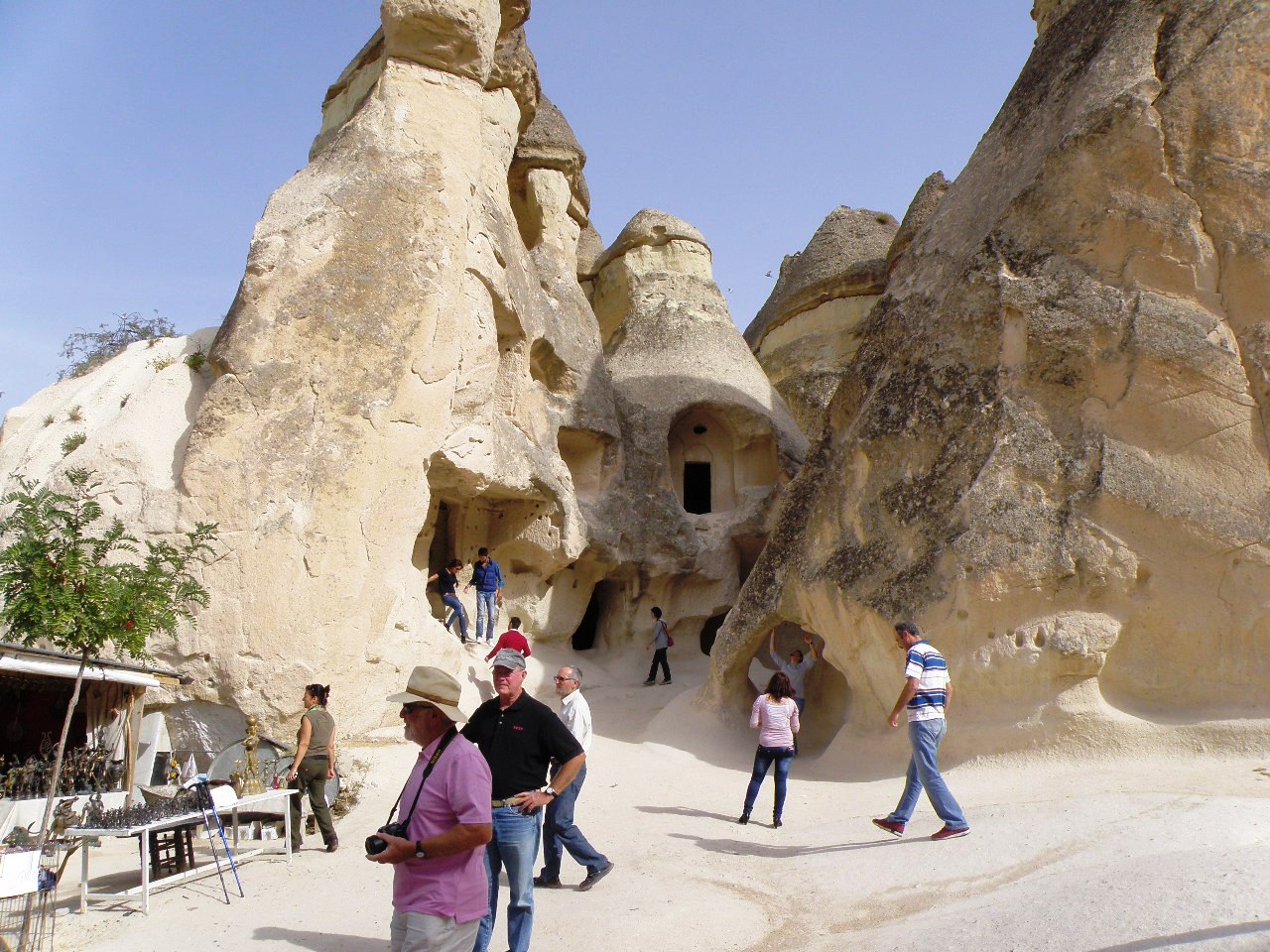
After lunch we drove through Imagination Valley.  The fairy chimneys here are spectacular!   All sorts of shapes and sizes.  Let your imagination run wild and picture in your mind's eye what each could be.  Many of the fairy chimneys have strong phallic resemblance, or outsized mushrooms if that description more appeals to your sensitives.  These structures are formed of sandstone and topped with basalt.   How nature managed this is amazing and forms such an unusual landscape.  However, over time the basalt topping deteriorates.  Once the basalt is penetrated with rainwater, the fairy chimney will collapse.  One can see fairy chimneys in all states of natural deterioration.  Amazingly, new chimneys continue to form still.  
Stone to grind wheat.  A small donkey was used to turn it.
Hard to believe a donkey could fit in that narrow space.

Yet another church in last place visited

Last settlement visited this day.  Once housed over
20,000 people.  Place was huge.  This is just a tiny part.


Old regional dress
Zelve?  I lost track of where we were


En route back to the hotel in Nevsehir we stopped at Avanos Pottery for a demonstration of how the traditional pottery of this region is made.  We were treated to a demonstration of the making of a traditional Hittite wine storage urn.  The pottery-maker sat with the potters wheel between his legs and kicked the wheel with his right foot.  In just moments he had made the 4 parts required for the Hittite wine urn -- a circle, a spout, a base and a handle.  These urns were normally large enough to fit over a man's upper arm and held on his shoulder.  Wine was poured by the man bending forward.  One of the women in our group was a good sport and attempted to make something on the potters wheel.  


  Note the circle shaped wine urn on the left
of the pottery wheel.  Design is thousands years old.
Then we watched a few women hand painting various pottery items.  This is painstaking work!  It takes at least 2 weeks to paint the simplest designs.  Some of the larger and more intricate designs take months of work.  Next were the showrooms of items for sale.  There were so many beautiful designs and pieces that it was easy to be overwhelmed.  We had no plans of buying anything, but after wandering through the showrooms it seemed that it would be such a shame not to purchase something from this unique place.  I forced myself away from the very expensive large vases and moved into the showroom displaying only ancient Hittite designs.  What could be more appropriate as a souvenir of our trip to this region than a handmade and hand painted replica of an 8,000 year old pottery piece!  I selected a square plate.  The design is tiny and this plate represents about 5 months of work.  My splurge for this trip and for memories of Turkey.

Our last stop for the day was at an ATM in Zelve so several of us could replenish wallets after visiting the pottery factory.  Zelve is another open air museum and is Cappadocia's oldest residential area.  The rock homes tower over the village, very high on the mountainside.  There are several hotels where tourists can stay in rock rooms, some of which are accessible only via ladders.  That might be fun if traveling with children, but not exactly our cup of tea.  Tas said that Koral previously booked group tours into some of the rock hotels but no longer do so.  They found that people who enjoy their tours prefer 4-star hotels instead of bare cold rock walls.  He is right about that!
My Hittite design plate.

Sunday, October 28, 2012

Konya -- Home of the Whirling Dervishes

Saturday, October 20, 2012  
Day 2 of our 6-day tour
As always, click on any image for larger view.

This tour followed a schedule that fit me to a "T" because each morning we departed the hotel at 09:00.  This allowed for leisurely coffee and breakfast.  I think all the tour participants were delighted not to have to get up at 06:00 to hurriedly pack and rush off.  We very much enjoyed this leisurely pace.

Day 2 started with a 4-hour drive to Konya -- home of the Whirling Dervishes.  I am not sure that I can really explain the Whirling Dervishes, but here goes.  I am leaving out a lot.

As I hope everyone knows by now, there are several different forms of Islam.  The Sunni and Shia are the 2 most well known, but there are numerous other different practices of Islam.  One of those is the Sufi order.  Some people consider the Sufis to be a cult; some consider them to be a sect of Islam; some consider them mystics.  The Mevlevi order ( Mawlaw'īyya ) is a Sufi order founded in Konya (in present-day Turkey) by the followers of Muhammad Rumi ( Jalal ad-Din Muhammad Balkhi-Rumi ), a 13th -century Persian who was a poet, Islamic jurist and theologian.  These followers are also known as the Whirling Dervishes.  Rumi, BTW, wrote more than 12,000 volumes of poems during his lifetime.  There are other orders of Sufism but this tour focused only on the Mevlevi order, the Order of the Whirling Dervishes.
Whirling Dervishes we saw on Turkish Night

The dervishes perform a 'dance' of whirling as a form of dhikr or remembrance of God.  This is called the Sama or Sema ceremony and the participants are properly known as semazen-s, but commonly called Whirling Dervishes.  The Sema represents a mystical journey of man's spiritual ascent through the mind and love to the "Perfect".  Turning towards the truth, the follower grows through love.  He deserts his ego; finds the truth; and arrives at the "Perfect".  Then he returns from this spiritual journal as a man who has reached maturity and a greater perfection; thus able to love and to be of service to the whole of creation.  In 2005, UNESCO proclaimed the Melvi Sema Ceremony of Turkey to be one of the Masterpieces of the Oral and Intangible Heritage of Humanity.


The Mevlevi order was founded in 1273 by Rumi's followers after his death,  particularly by his successor Husamettin Celebi who built a mausoleum for Rumi and Rumi's son, the Sultan Veled.  Celibi was a Sufi mystic with good organizing skills.  We visited the shrine of Rumi and his son in Konya.  Photos were allowed outside the mausoleum but were prohibited inside the shrine.  The interior was beautiful!  The ceilings were painted in such beautiful patterns and colors.  Shame no photos are allowed in there. 

Per the websites I checked:  The origin and roots of Sufism lie in the life and practices of the Prophet of Islam and the Qu'ran.  Sufism espouses a well-founded and thorough interpretation of Islam which focuses on love, tolerance, worship of God, community development, and personal development through self-discipline and responsibility.  A Sufi's way of life is to love and be of service to people, deserting the ego or false self and all illusion so that one can reach maturity and 'perfection' and finally reach Allah, God.  

The sema or ritual dance consists of several stages with different meanings.  The first stage is a eulogy to the Messenger of Islam and all the Prophets before him, all of whom represent love. (This includes Jesus and Moses and Abraham, etc.)  This eulogy is followed by a drumbeat symbolizing the divine command "Be" for the creation of the entire universe.

This followed by an improvisation on a reed flute.  This expresses the divine breath, which gives life to everything.

Then follows the Sultan Veled procession, accompanied by simple music.  The participants walk in an anti-clockwise circle, proceeding 3 times around the turning space.  At the completion of each circle, each participant bows to the other.  These bowed greetings represent the 3 stages of knowledge: 1) received knowledge, gained from others or through study; 2) knowledge gained by seeing or observing for oneself; and 3) knowledge gained through direct experience.  

Contrary to popular belief the semazen's goal is not to lose consciousness or to fall into a state of ecstasy.  Instead, by revolving in harmony with all things in nature, the semazen testifies to the existence and the majesty of the Creator, thinks of Him, gives thanks to Him, and prays to Him.  By the revolving ritual, the semazen confirms the words of the Qur'an (sura 64:1):  Whatever is in the skies or on earth invokes God.

The semazen begins the sema ritual (dance) wearing a black cloak and entering a darkened room.  After the beating of the drum and the flute sounds, the black cloak is removed revealing a starkly white long-sleeved garment and an ankle length full skirt.  The semazen wears a tall camel's hair hat called a sikke.  The darkness is then lightened somewhat to a low-light level like candlelight, not brightly lit.  

The sikke hat represents the tombstone of his ego.  The wide white skirt represents the ego's shroud.  By removing his black cloak, he is spiritually reborn to truth.  At the beginning of the sema he holds his arms crosswise.  Thus, he appears to represent the number one, testifying to God's unity.  While whirling, his arms are open; his right arm is directed to the sky, ready to receive God's beneficence.  His left hand, upon which his eyes remain fastened, is turned toward the earth.   This is symbolic of bringing God or Allah to the creatures on the earth. Revolving from right to left he embraces all humanity with love.  Rumi had taught:  "All loves are a bridge to Divine love."

Tolerance is central to Mevlevi teachings, as shown in this famous verse:
Come, whoever you may be,
Even if you may be
An infidel, a pagan, or a fire-worshipper, come.
Ours is not a brotherhood of despair.
Even if you have broken
Your vows of repentance a hundred times, 
Come.


(Having been raised in the Baptist religion, that sounds so very much to me like the minister at the close of Sunday services inviting all sinners to come to the front of the church to repent of sins, inviting sinners to repent and be baptized and born again.  The message is the same:  regardless of your sins, come and be saved in the eyes of God.)
Our group at a comfort stop

Shortly after Ataturk formed the new government of Turkey, he banned the Mevlevi Sufis in 1925 because he considered them to be mystics.  Ataturk saw them as an obstacle to advancement for the Turkish people.  But several orders survived on a technicality as religious fraternities (like the Masons?).  The Konya lodge was revived in 1957 as a "cultural association" intended to preserve a historical tradition.


Our group at a comfort stop


We would have the opportunity to see a demonstration of the Whirling Dervishes during Turkish Night at a restaurant a few days later.
Pretty comfort stop en route to Konya


Our group seated on floor cushions for lunch
When we arrived in Konya we first ate lunch in a traditional Turkish restaurant, all seated on cushions on the floor at a long low table.  The meal consisted of the usual pepper spread with bread (too hot for some people in our group, but delicious to me), salad, pide and baklava for dessert.  Pide (pronounced PEE-day) is simple Turkish pizza.  It is oblong with the sides curved up and over the top edge.  It sometimes has cheese and sometimes does not.  There is no tomato pizza sauce.  It is quiet bland.  I like foods with more spice and prefer American style pizza, but pide is okay.  The restaurant staff spoke no English, so our guide translated for us.  
Pide lunch in Konya

They offered a local drink of fermented grape juice and several of us opted to try it.  Bad mistake!  This stuff was disgustingly salty and bitter.  Turned out that there was a mistake and we were served fermented beet juice with wheat instead of the grape juice.  I cannot imagine anyone willingly drinking that ultra-salty stuff!!  Enough sodium to raise blood pressure to stroke levels.


Entry door to Rumi's shrine
 Konya is the Turkish equivalent to America's Bible Belt.  More women are seen covered than anywhere else in Turkey.  Alcohol beverages are almost impossible to find in stores and never sold in restaurants.  The people are not extremists but they do take their practice of Islam very seriously.  To quote the Lonely Planet guidebook:  "Konya treads a delicate path between its historical significance as the home town of the whirling dervish orders and a bastion of Seljuk culture on the one hand, and its modern importance as an economic boom town on the other."


The exit door from Rumi's shrine
Next we visited the shrine for Rumi and his son.  There were lots of people visiting the shrine; very few were foreign tourists.  Most people appeared to be Turkish or of Middle-Eastern heritage.  People watching was good here.  Bill and I were more interested in watching the people than the buildings around the shrine area.  BTW, the mausoleum/shrine had a green minaret so I guess it used to be a mosque.


The green fluted minaret at the shrine for Rumi


Rumi shrine complex


For Muslims, this is a very holy place.  More than 1.5 million people visit the shrine each year, most of them Turkish.  The guidebook states that women should cover their heads and arms and that anyone wearing shorts should not enter.  Our guide said that covering was not needed for women because this is not a mosque, only a shrine.  Most of the women in our group did cover their heads, although only 1 woman also covered her arms.  I did not cover either.  The security guards didn't stop me so I guess our guide was correct.  Several of the men in our tour group were wearing shorts and even they were allowed inside the shrine.  That actually surprised me.


Ablution center for Rumi's shrine


The domes of the shrine and the nearby mosque are fitted with turquoise tiles.  Supposedly, these tiles are very valuable -- about $40,000 for a tile by today's valuations.  BTW, the word turquoise originated in Turkey.  It is a French word for this color that they first encountered when arriving in Turkey centuries ago.  


The old Ottoman mosque that was closed
for renovations


Then we walked over to an old Ottoman mosque, but it was closed for renovations.  I think the name for this mosque was Alaaddin Camil.  It was built for Alaaddin Keykubad I, Sultan of Rum from 1219 to 1231; and was designed by a Damascene architect in Arab style.  The interior has old marble columns surmounted with recycled Roman and Byzantine capitals.  That was a glitch in the tour.  The guide had not known the mosque was closed for renovation.  Frankly, we did not care.  We have seen enough mosques.  This big one with the green trim might have been pretty but we didn't feel that we had missed anything.  

Another 3 hours of driving delivered us to Nevsehir, where we checked into the Peri Tower Hotel, our home for the next 3 nights.  Peri Tower Hotel  Our room overlooked the pool.  Even had a couple of TV channels in English -- BBC and Central China TV (whoa!  talk about propaganda!).  The architect for this hotel must have been on drugs when he conceived this design.  There are towers in various places and the hotel is built into a small hill; so, for example, floor 2 on one side is different from floor 2 on the other side of the hotel.  And walkways slope between several floors.  It would be easy to get lost if you got into the elevator on the wrong side of the hotel lobby or bar levels.  Floor 4A is a different level than Floor 4B.  A drunk would never be able to navigate this hotel.

Dinners and breakfasts are included in this tour, and we were grateful that dinner was served in the hotel restaurant as we were tired from the driving and looked forward to a restful night.  

Tomorrow would be exploring Cappadocia!