TRANSLATE, TRADUIRE, ÜBERSETZEN, TRADUCIR, 翻译

Friday, November 1, 2013

Tour First Day: Gaziantepe -- the Citadel, Zincirli Bedesten, Sirvani Mosque

  As always, click on any image for larger view.
Bins of nuts sold on many sidewalks.  We watch a bird standing on top of
one bin, eating his fill.  We will not be buying from these outdoor bins.
One of the major enjoyments of cruising foreign countries is exploring new areas via land travel. Interesting historical sites are very plentiful in Turkey;  this is a country very rich in history.  Last week we were fortunate to have the opportunity of participating in a small group tour to the Southeastern Anatolia Region.  The tour was organized by Gwen through Koral Travel Agency; Gwen is a longtime resident of Marmaris and a fellow sailor.  Fifteen sailors participated, 7 of whom we already knew either from the tour last year to Cappadocia or had met out sailing somewhere.  This was a 7-day tour originating out of Marmaris, which meant 9 days for us since we started and ended in Fethiye.  We took the bus from Fethiye to Marmaris and stayed overnight with Gwen aboard her boat S/V Kornweld (known to everyone as K.W.) in Netsel Marina.  Enjoyed a lovely dinner at Pineapple; our treat for Gwen as a token gesture for her hospitality.  At the pre-dawn hour of 06:15 we boarded the small Koral Travel bus en route to Izmir where we boarded Pegasus flight to Gaziantep.  At the Gaziantep airport we were met by another driver and small bus.  We were delighted to see that our guide was  again Tas (The 's' should have a squiggly beneath it so is pronounced Tash as in Johnny Cash.  I do not have a Turkish keyboard so cannot use the correct letters.).  Tas was our guide for the Cappadocia trip last year.  He is excellent; intelligent, knowledgeable, funny, speaks several languages and his English is perfect.


An unusual headscarf.


In Turkish the preface 'gazi' to a town name means 'war heros'.  This city was known forever as Antep.  Thousands of Turkish men in Antep were killed fighting the French in 1921 to 1923 during the Turks' struggle under General Ataturk to form a new country from the Ottoman Empire.  To honor these war heroes the name of the city was changed from Antep to Gaziantep.  It is an ancient city; and, like most of the other places we would visit during this trip, was an important part of the old Silk Road.  Merchants have traveled and traded through Gaziantep for millennia.  Gaziantep is among the oldest continuously inhabited cities in the world.


Top of a minaret; no idea which mosque in Gaziantep


After settling into a basic hotel we again boarded the small bus and headed off for a fabulous lunch at a restaurant right next to the Sirvani Mosque, also called Sirvani Mehmet Mosque.  The restaurant was named 'something' çağdaş   That is a coincidence because a good friend in Gocek also has the surname çağdaş.  The squiggly beneath the c and the s means those letters should be pronounced as 'ch' and 'sh' and the symbol over the g means it is silent, so the name is pronounced Chadash.   In 1923 at the formation of the country Turkey from the old Ottoman Empire each person had to choose a surname.  In Turkish the word çağdaş means modern.  A fitting new last name for a man in a 'new' country.


Sirvani Mosque under rennovation
Unfortunately, the Sirvani Mosque currently is undergoing complete restoration.  Scaffolding surrounded the entire building and minaret and entry was forbidden. Frankly, that was okay with us.  We have seen enough mosques to last a lifetime. The date of construction of this mosque is unknown although it is assumed that the mosque was built in 14th or 15th centuries during Dulkadirli or Mameluk periods.  
Sirvani Mosque minaret
The epigraph on the portal shows that the mosque was repaired in 1681 by Seyyid Mehmet Sirvani. During this renovation a water-tank with a fountain was added to the courtyard and the toilets placed beneath the ground floor. The mosque is located in the area to the west of Gaziantep Castle, one of the oldest districts in the city. The location shows that this mosque is one of the oldest buildings in Gaziantep. It is thought to have first been built as a Mevlevi "semahane" (a building where the dervishes perform their whirling spiritual dance).  Since we could not enter the mosque this provided us more time to wander the Zincirli Bedesten, which is located directly across a ultra-narrow street.


Entrance to newer separate section of the bazaar
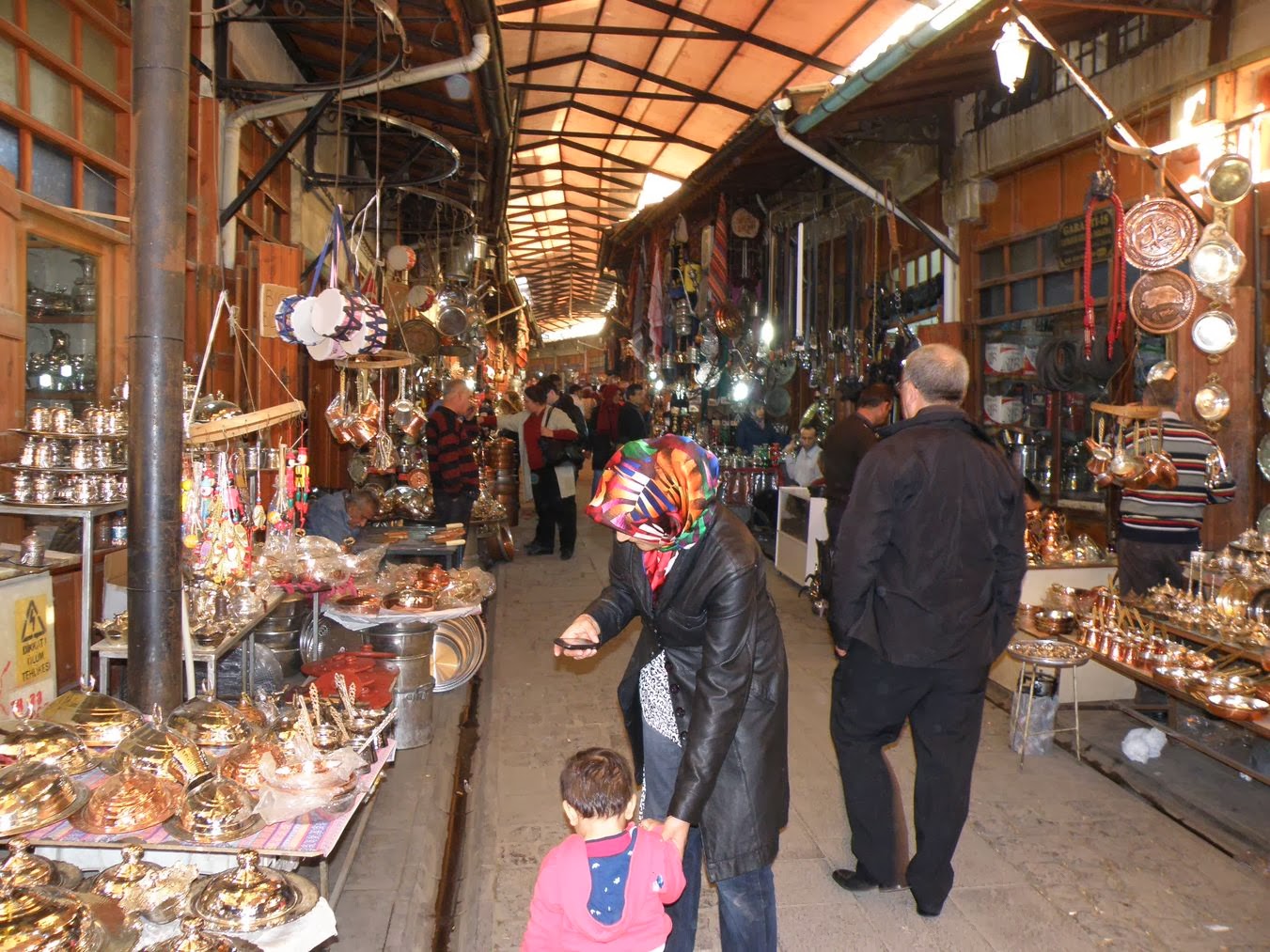
Zincirli Bedesten means 'the chained bazaar' or Coppersmiths Market;  it is also called the Black Stairs Market.  The bazaar was built in 1781 and now is fully restored after being destroyed by fire in 1957.  It is a rambling labyrinthine bazaar.   Five doors enter the bazaar from surrounding streets, almost like spokes of a wheel except the alleys twist and turn once inside the bazaar.  The literature said there were 80 shops inside the Zincirli Bedesten, but I think there were at least double that number of those tiny shops.  The entire bazaar is filled with tap-tap-tap of the metal workers and the makers of handmade shoes and all sorts of items.  It is extremely easy to get lost.  
Inside the old labyrinthe bazaar.


Inside bazaar.


Center, where 5 alleys meet


Making copper pans by hand.


Looking into a shop inside the bazaar that had an old
boombox with a TV in the center of it.  The shop owner
would not let me take a photo of it.


Very old doors to close up shops
at night.  These were on regular
streets in the old city district,
not inside the bazaar.


Dried veggies. The white ones are
dried small squash.

Many shops both inside and outside the bazaar had the typical mini-mountains of multi-colored spices and graceful garlands of various dried chiles and other dried vegetables.  We saw these strings of dried vegetables everywhere we visited on this trip.  
The long light green ones are okra; black are eggplant; the
red ones are tomatoes and sweet & hot peppers.


Many, if not most, of the homes have no refrigeration.  Millenia ago the people of this region learned how to dry most vegetables and see no reason to switch to processed vegetables in cans or jars.  These dried vegetables are rehydrated when desired and then cooked as usual.  We have been told that these are very good and closely resemble fresh veggies.  There also were many shops selling baklava as this region of Turkey is the pistachio growing area.   Iran is the world's largest producer of pistachios, followed by the USA, and Turkey is third.  Pistachio trees covered the countryside of this region. 


These metal serving dishes were so pretty I wanted to buy
some.  Then realized these would never get used, so didn't.


Right in the heart of the bazaar is a quaint kahvehane (coffeehouse) set in a restored caravanserai.  A caravanserai was a large inn enclosing a courtyard providing accommodation for caravans during the old years of camel caravan merchants.  After our huge lunch we were not tempted by coffee and baklava, although many others in our group enjoyed the delicacies.  We got a kick out of one particular member of our group.  He loved baklava but had the oddest way of pronouncing this word.  Our neighbor in Houston for many years was a Greek who had immigrated to the USA.  His mother made the best baklava, but using walnuts rather than pistachios. 
Walking sticks, heavily inlaid; beautiful work.  Thought
about buying one for Bill's brother as a Christmas present
but did not.  (Sorry, John; you won't be getting a new
fancy walking stick for Christmas this year.)


Lamps and trinkets made from
silver and other metals


I do not eat pistachios, so this Turkish baklava was of no interest to me whatsoever.  But a British man in our group loved the Turkish baklava made from pistachios.  He pronounced it bah-CLAV-ah instead of BAHK-lah-vah.  Everytime he said bah-CLAV-ah I thought he was talking about a headscarf worn by a Russian woman.  
Heard this many times daily for a week and never did get accustomed to this strange pronunciation.  If he reads this blog posting, I submit this link for him (and some of the other Brits)  to hear how the name of this pastry should be correctly pronounced:

Correct pronunciation of baklava


Chess set; Crusaders vs. Muslims


Adjacent to the Zincirli Bedesten but not part of the labyrinthe was another section of the bazaar that was more brightly lit and with wider aisles for shopping.  This section has more items of interest to tourists.  One of our group members purchased a chess set with teams of players of the Crusaders vs. the Muslims.  Also available were teams of players such as the Egyptians vs. the Romans.  The Turks have long memories.  


Typical coat, all year long.
Another year-round coat.
I have mentioned in previous blogs that a common form of dress in Turkey is for women to wear a long coat over their clothing.  It usually looks like a raincoat and often is tight-fitting.  These are worn both winter and summer.  This area gets up to 48C in summer; that is 118F and these women still wear these coats in that heat.  


More year-round coats.  Everywhere.


The coats are worn OVER long pants or skirts AND long-sleeved tops, along with the usual tradition headscarves.  I do not see how they can tolerate that in such heat.  Don't tell me that they are used to it and don't feel the heat like we do. I have seen women stand up and their entire backs and legs are drenched with sweat, with the coat saturated.  
The inaccessible Citadel


Next we walked a few blocks to the Gaziantep Citadel.  Our guide had heard from local people that the bridge had collapsed and the citadel was closed, but we all wanted to see for ourselves that it really was closed to visitors.  It was.  The 250-year-old wooden pedestrian bridge at the entrance had collapsed just a few days prior to our visit.  There was no way to enter the castle.  I was glad that it had collapsed BEFORE we arrived rather than collapsing while we were on it.


Tower at entrance of Citadel

Gaziantep Citadel is a castle, located in the center of the city.  The history of castle is a mystery.  As a result of the relatively recent excavations conducted there, bronze age settlement layers have been found beneath the castle section existing on the surface of the soil. The original castle is next to and beneath the current old castle.  The current castle was built as an observation tower during the Roman Period and was enlarged over the course of time. It achieved its present appearance after undergoing restoration work during the period of the Byzantine Emperor Justinian I in the 6th century AD.  It is approximately 325 feet in diameter and 3,900 feet in width.  The castle incorporates 12 towers and bastions today; but during its heyday this castle was much, much larger.  At one time it had 36 towers.  It looks quite large with just the 12 towers; I can only imagine how large it must have been when it had 36 towers.

Excavation project of the old original castle which is both
adjacent and BENEATH the Citadel sitting so high up.
The glass panels allow visitors to see the ancient site
but entry is forbidden.  

The ditch around the castle is about 33 feet deep.  Access to castle is possible only via that collapsed wooden pedestrian bridge.  According to the tourist information, inside the castle are remains of Roman baths, cisterns, masjid and various other constructions. On the basement level are halls, galleries and corridors constructed in order to provide support for the upper sections of the castle.  There is also a water source under the main block.  This citadel could have housed and protected a great many people for a very long time if a siege had occurred.


Here is a link for images and info on the Gaziantep Citadel which we were unable to enter:

Gaziantep Citadel info in first section of this link

Freshly harvested olives for sale.  People like to process
their own fresh olive oil as well as cooking the olives that
we are familiar with in jars.  Special spices to individual taste.


Next we walked through a different section of the old city area with yet even more small shops of every description.  Olives are now being harvested and there were bins and bags and barrels of olives for sale along the streets and sidewalks. 


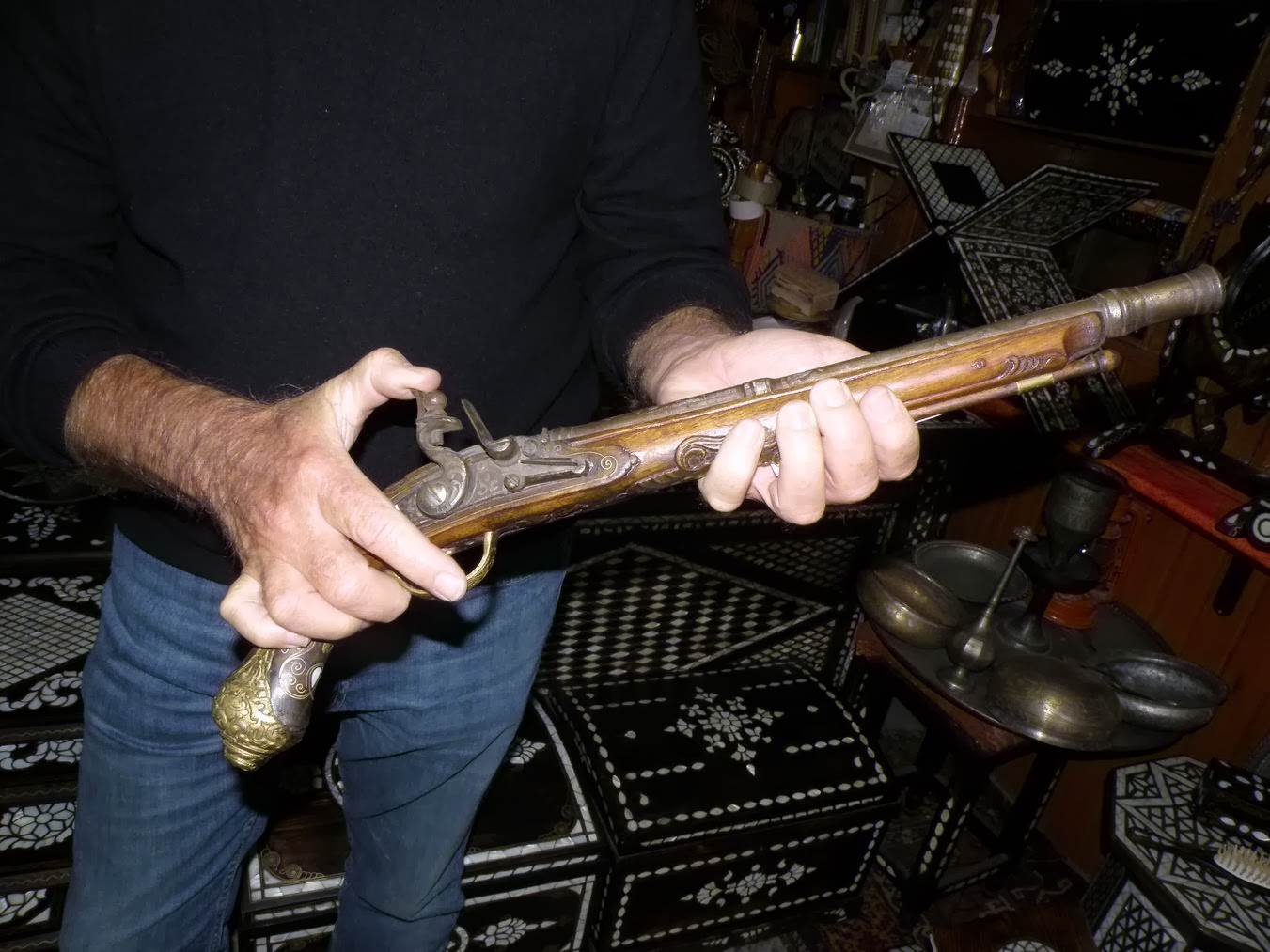
Intricate metal work and inlays on old knives, swords & guns.


Bill liked this old gun


A sword and gun shop caught our attention. The metal work was gorgeous.


Handanbey Mosque


Our destination was yet another mosque.  I have forgotten the name of this one but it hold great meaning to the Turkish people because over 1,000 men were killed inside this mosque by the French during the fighting of 1921 to 1923.  The French would line up the men and shoot them inside the mosque.  I did not go inside but others of our group did and they spoke of the bullet holes still visible on the interior walls.


This was enough for our first day of this group tour.  It had been a long day of travel and sightseeing after a too-early rising this morning.  We were all more than ready to return to the hotel and relax.

On the bus this day one person was slightly ill and sneezed several times. A few of our group spoke a little Turkish said something each time she sneezed.  I cannot remember the Turkish words but the translations go like this:

Person sneezes and instead of "God Bless You" one says: "Long Life."

Instead of saying "Thank You" the person who sneezed says:  "May you live to see it."

Isn't that a nice exchange of expressions.


Here is a short video of men baking bread in a small shop in Gaziantep.  There were lots of these small bakeries.


Friday, October 11, 2013

Sailing season is over for this year. At least for us. We don't do cold.


We are enjoying doing nothing.  Weather is gorgeous.  Just absolutely gorgeous.  Very cool at night and warm during the day.  Occasionally some wind but mostly very calm.  It is to the point that we are running the generator mostly to run the water heater because the days of wanting cold showers are over for this year.


The Big Boys are in town!
In Gocek recently; 83 meters length.
That is 270 feet long!
After our last update we returned to Gocek and again docked at Skopea Marina.   Thought we would be there one or two nights but ended up staying there five days.  Bill wanted Emek Marine to check our our generator because he thought there was a coolant leak.  Nope, no coolant leak; it was just some spilled coolant that had collected beneath the generator and then rolled out onto the engine room floor when we sailed down to Kas.  Heeling over has a way of making fluids move about on a boat.  Once that coolant was thoroughly cleaned up there was no further drips to be found.  But the diesel mechanic did find that the heat exchanger on the generator either needed to be cleaned or replaced.  Bill opted to have them clean it first and then decide if it really needed replacement.  The cleaning worked, thank goodness!  We have paid for enough boat maintenance already this year.

One night while docked in Gocek a bit of wild weather passed through for a few hours.  Boats were dancing all over the place!  There were some drunk Russians on a large catamaran docked on our port side that caused us some worry, but they got sorted out and then proceeded to party for hours.  The drunk chunky young Russian blonde woman with over-done enhancements pole dancing on the rear patio of the catamaran was entertainment for our end of the dock.  Mostly, people were afraid she was going to fall overboard.  Drunks on boats in bad weather = a bad combination.  We tired of listening to their loud Russian rap music and were glad they departed early the following morning.


Charter catamaran not properly attended to by charter "captain" during
rough weather.  Chewed up the stern against concrete dock.
According to a captain on one of the mega-yachts the wind was 45-50 knots that evening.  Worst part was not the wind but the surging seas against the concrete dock.  A chartered catamaran just down the dock from us ground into the concrete dock and was badly damaged.  The charter "captain" was inside the boat and never bothered to attend to fenders and bow lines or anything.  He never even started the engines to keep away from the dock.  In fact, he was not even aware that his boat stern was being chewed to pieces until another guy jumped onto the cat and banged on the door to get the "captain" to come outside and tend to the boat. Just another person who had no business being turned loose with a yacht when he obviously did not know how to take care of it.  The stern of the port hull was chewed up by the concrete dock and the surging sea filled the gaping hole.  A representative for the charter company arrived the next morning and Bill overheard his phone call stating that the steering was also damaged.  Guess something to do with steering was located down in that port hull and got damaged by the sea water ingress.  We know from our experience with a Sunsail charter boat last year that the insurance does not pay in this situation.  It is considered negligence and therefore not covered by insurance.  That "captain" is personally liable for repair costs to that catamaran.  And it is not going to be an inexpensive repair.

We hung around another night at the dock because high winds were forecast.  I do not want to be anchored somewhere with a stern line tied ashore and chance getting cross-beam high winds.  I just hate that!  So we stayed docked until wind forecast improved.  Glad we did.

On the fifth day, with generator heat exchanger nicely cleaned and reinstalled and no coolant leak, we departed Gocek and motored over to Fethiye to meet up with Tom and Fran on S/V Hamamas.  They had just returned from sailing the Greek isles over the summer and stopped in Fethiye en route to their winter berth in Finicke.  We enjoyed drinks with them a couple of times and lunched one day in town.  It was nice to catch up with them again.  They also will be on the group land tour with us in a few weeks.  Turns out we know 5 of the 15 people in that group tour.

We also caught up with Peter and Sue aboard S/V Rockhopper of Lune here in the anchorage in Fethiye.  Very nice people and we enjoy their company.  They had hoped to dock for the winter at Yacht Classic but could not get in.  Eventually they got a contract at Yat Marin in Marmaris for a very shortened winter period.  Glad they found a spot for this winter.  For some reason the docks here in Turkey are very full this season and several boats have been turned away from multiple marinas.


We call this boat Kon Tiki.
Yesterday we saw a boat we call Kon Tiki.  I have no idea of the real name of this boat because I cannot find a name painted on it anywhere.  We saw this boat back in the South Pacific in 2008 and have seen it several times here in Turkey this summer.  It flies a German flag and there are two older men aboard.  I admire these guys.  They are enjoying life.  This is the most bare-boat imaginable.  It is a hodge-podge of parts and most things on the boat look like they are barely holding together.  With a threadbare shredded tarp used as a shade awning.  And pieces of chain holding rigging together.  And two old men who are enjoying sailing around in this crappy thing that I hesitate to call a yacht.  Good for them!


Bubble-butt boat for sale in Gocek.  Very nice!
Another boat I have noticed several times is a British flagged bubble-butt boat.  It has a sign stating that it is for sale.  This is a beautiful boat.  Don't know anything about it but I do like it.

Four more days until we are supposed to dock for the winter.  We are still at anchor in Fethiye, but at a different location in the bay than usual for us.  Rather than anchoring between Yacht Classic Hotel and the coast guard dock, we are anchored way across the bay near a small beach.  And six people were actually swimming at that beach yesterday.  Must be from very northern climes.  There is nothing that could entice me into that cold water!

We thought about sailing to Wall Bay and then over to Gemelier to see the ruins on that tiny island.  But instead we are both perfectly content to sit right here at anchor.  The thought of moving just to go see more ruins simply does not appeal at the moment.  Rather, enjoying lunch ashore sounds more fun.  IMO, sailing is done for this season.


The ugliest boat ever built.  The scale on this monstrosity in totally wrong in every way.  Docked nearby.


Saturday, September 28, 2013

Megisti, a/k/a Meis, a/k/a Kastellorizo or Castellorizo

 As always, click on any image for larger view.
Kas old harbor, opposite side peninsula from marina
We have spent the past month mostly just sailing back and forth in the big bay between Fethiye and Gocek; not doing anything particularly interesting so difficult to get enthused about writing a blog; spending some time in Tomb Bay in Skopea Limani on the western side of that big bay.  Tomb Bay seems to be our favorite anchorage, so far, of those places that require a stern line ashore.  I continue to hate dealing with that stern line, although I do understand why it is necessary in so many places.  Our favorite swing anchorage is behind the tiny island of Fethiye Adasi.  Usually we are the only boat anchored there.  It is too far to dinghy into Fethiye and there are no restaurants ashore, so most yachties do not see the attractiveness of that anchorage.  The isolation, calmness, and clearer water is exactly why we do prefer that spot over the more crowded usual anchorage near the Coast Guard dock in Fethiye.


Note Coca-Cola advertising
Fold down Coca-Cola ad and you
get a nice bench.  These are all over
the place in Turkey.  Great idea!
But one morning we made a spur-of-the-moment decision to sail down to Kas.  Well, not really.  We decided to sail to Gemelier, a small island filled with ruins that is about 1/3 of the way towards Kas from Fethiye.  When we got to the turning point to head to Gemelier, we decided there were too many charter boats in the area and we would simply continue onward to Kas and maybe stop at Gemelier on the way back.  Or sail to Gemelier during the second week of October when there might be fewer charter boats filling the small anchorage there.

Soon afterward we put out the pole on the port side and enjoyed a great day of downwind sailing all the way to Kas.  We had hoped to swing anchor near the Kas Marina.  This would have been possible except for 2 gulets that arrived just before us and anchored with stern lines ashore.  That ended our hopes for a swing anchor so we hailed the marina and asked for a berth.  We had previously emailed the marina to inquire if they were still offering the 'pay for 1 day and get 1 day free' promotion that they had the last time we were here in May 2012.  That promotion is no longer offered but since we had stayed there last year under that promotion the marina manager kindly offered us a deal of pay for 2 days and get 1 day free.  Okay; we'll gladly accept that offer.

When we first arrived in Kas Marina near sunset that day conditions were perfectly calm.  It was easy to see why someone might consider this a good place to winter.  It has everything one might want and is less than a mile walk into the town.  Even a mid-sized Migros Supermarket right inside the marina.  Every amenity one might want.  But the last time we were here winds exceeded 25 knots and the docks were 'snaking' terribly.  Boats had to be placed 3 meters from the docks.  People were having to get into their dinghies in order to get onto the docks.  I felt that walking on the snaking dock was not safe.  We decided then that there was no way we would winter in the water at Kas Marina.  

The second day on this visit the same thing happened.  Winds were only 22 knots but it was rough enough to make the docks snake.  Very glad we were staying put for another 2 days to let the weather system move through and conditions calm down.


Kastellorizo, viewed from hillside while walking up to museum 
The main reason for going to Kas was that I wanted to visit the Greek island of Kastellorizo.  Almost every yachtie we have spoken with has simply sailed their own boat or their charter boat over to Kastellorizo -- without legally clearing out of Turkey and clearing into Greece.  Everyone -- literally, everyone -- says that this is okay.  That Kastellorizo is so off the beaten track of Greek isles that the officials both in Kas (Turkey) and in Kastellorizo (Greece) turn a blind eye to 
Harbor statue.  Really fitting for the place.
the violators.  They simply remove the Turkish courtesy flag and put up a Greek courtesy flag.  Being the strict law-abiding Americans that we are, we could not do this.  With our luck we would be the one boat that got checked either by the Turkish coast guard or the Greek police.  They could fine us 500 Euro each plus 2,000 Euro for the boat......and they could legally confiscate our boat.  Consider that this is the same as being an illegal immigrant.  Just not worth the remote chance of that happening for us to knowingly violate the law.  Especially when it is so easy to simply take the ferry over for the day and do everything legally.  Which is exactly what we did.


Approaching harbor at Kastellorizo


Kastellorizo, or Castellorizo, is the name of this island on our navigational charts.  In Kas, the ferry line advertises trips to Meis, which appears to be the currently favored name in Turkey for this island.  The ancient name was Megisti or Megiste.  It is darn near impossible to keep all these names straight and know that these all refer to the same place.  


And a closer view as we arrived
The Meis Express ferry leaves the old tiny Kas harbor (not the Kas Marina area) each day at 10:00.  You must book the ferry on the previous day and surrender your passport to the ferry company.  They take all passenger passports to the Harbour Master's office and you are stamped exiting Turkey.  Once on the ferry your passport is returned to you.  Upon arrival in Kastellorizo you once again surrender your passport to the Greek Immigration Police; they do not stamp the passport, but they do look at each person and confirm that the passport photo matches.  The ferry departs Kastellorizo at 16:00. 
Hey wait!  Is this Greece?  Looks sort of Dutch.

The ferry company collects the passports from the Greek Immigration Police; upon arrival back in Kas the passports are again taken to the Harbour Master and stamped back into Turkey on the same visa.  One does not have to pay for another Turkish visa.  Thirty minutes or so after arriving back in Kas, you go to the ferry office and collect your passport, now legally cleared back into Turkey.  Cost of the round-trip ferry was 50 TL on the day we visited, about $25 each.


Greek flag painted on mountain.
Reminded me of Cyprus.

Many of the ferry passengers very obviously made this trip just to visit the Duty-Free Shop in Kastellorizo so they could purchase less expensive liquor, wine and tobacco.  Turkey considers those items to be luxury items and taxes heavily.  Much less expensive in Greece.  We did not bother to visit the Duty-Free Shop.  We don't drink enough liquor or wine to make it worthwhile to haul bags back from Greece.

It is also possible to continue onward to other Greek islands if one is traveling in that direction.  A 3X weekly ferry connects with Rhodes, where one can connect either via ferry or flight to just about anywhere desired.


Mosque minaret entering harbor
Kastellorizo is a simple Greek fishing village.  The main businesses appeared to be tiny restaurants crowding the narrow sidewalk around the harbor.  It is very picturesque.  As we motored into the entrance I was somewhat surprised to see the minaret of a mosque on the left hand side of the harbor.  Several Orthodox churches could be seen strewn about on both sides of the harbor and up the mountainside, but I was surprised to see a mosque.  I don't remember ever seeing a mosque on any other Greek island.


Could this look more Greek?  I think not.
BTW, Kastellorizo enjoys an especially close relationship with the nearby Turkish town of Kas.  Kastellorizo is situated fairly distant from all the other Greek isles in the Aegean, and is very close to the Turkish coast.  In fact, Kastellorizo does not rate a mention neither in our Greek tourist guide nor in our sailing guide for Greece.  Information on Kastellorizo is provided in both our Lonely Planet guide for Turkey as well as our sailing guide for Turkey.  A note in our sailing guide states that Kastellorizo had a population of 8,800 at the end of WWII, but that a few years ago the inhabitants numbered only 200.  Supposedly, there is an agreement that if the population drops to 85 inhabitants then the island will revert to Turkey.  The population has increased slightly very recently and numbered 495 in the 2011 census.  There is a lot of renovation going on at the moment.  I like out-of-the-way places.  But I would go stark-raving insane living in that small place, regardless of how picturesque.

A perfectly Greek tiny harbor.


There is sufficient room for possibly 5 yachts to anchor in the small harbor without crowding the ferries.  There also is a town quay that accommodates maybe 15 yachts docked stern-to.  I did not notice any electrical shore power pedestals, so probably all you get is just a spot to dock for easy access to the restaurants.


The old and the newly renovated old.


And, boy!, do they have restaurants.   Small cafes with sidewalk tables right on the water's edge lined all the way around the harbor.  All looked so good it was difficult to choose which one for lunch.


This is a street.  Believe it or not.  Bill is
standing in front of the 'supermarket'
and those are store displays in the street.
The narrow alleyways are really the streets.
I brought along our insulated cold-bag in hopes we might find pork.  We sought out the 'supermarket' and were sorely disappointed.  It was tinier than the smallest convenience store imaginable.  There was some frozen meat but we could not read Greek and I could not positively identify anything in its frozen state and wrappings, so we returned empty handed.  Much later I read in our Lonely Planet guide for Turkey that it is possible to purchase pork in the Duty-Free Shop in Kastellorizo.  That seems more than a little weird to me and I question the validity of that advice.
Love the doors here.  The top sections
open for ventilation while the
bottom sections provide privacy
from passers-by looking into home.


Man coming out of his home doorway.  Close only the
lower sections and leave top sections open for
ventilation.  Passers-by cannot see inside home.


We walked all around the harbor and enjoyed wandering the very narrow walkways between the very crowded buildings.  There were several old churches that most of the tourists were visiting, but none heightened interest in either Bill or me; so we gave that a miss.


Getting energy to hike up the hill


We settled on a comfy wicker sofa to soak up the setting and people-watch, always good entertainment.  Bill downed a Mythos beer (those are so large!) while I enjoyed a freshly squeezed orange juice.  We needed to bolster our energy level for the walk uphill to the museum.   


Castle ruins; not worth the hike up, IMHO.


The steps up the hillside were not too bad to navigate.  The continual slope upwards after we reached the top of the steps were another matter!  These uphill slopes do not bother Bill at all, but my mitral valve problem makes my heart pound like it is going to pop out of my chest.  We stopped a couple of times to snap photos of the harbor below, and for me to catch my breath.  It was only a short distance to the museum, thank goodness.  I decided to forego walking farther up the hillside to visit the ruins of the castle.  It did not look like much was left standing up there.


First of the steps up the hill to the museum and castle
Very old planes in harbor.  Many more buildings then,.
Inside the museum were old aerial photographs of the harbor during WWII.  I do not know why this particular island would have been of any strategical significance during WWII, but apparently it was.  The old photographs show many more buildings back then than remain today.  There is still evidence of bombing in some of the partial remains of old buildings still standing here and there.  I honestly cannot understand why this tiny harbor would of been of any importance.  But this place was heavily bombed, nevertheless.


Memorial to those who drowned
Near the largest church (near where we soaked up sunshine, fresh orange juice, and Mythos beer) there stood a small monument.  The plaque stated that this was a memorial.  Shortly after WWII 497 Kastellorizons boarded a ship in Port Said, Egypt, to return to their island home in the Aegean.  That ship sank, and 85 Kastellorizons, mostly women and children, lost their lives.  The monument lists the names of those killed, along with the simple words, "Lest we forget."


Byzantine plates
Byzantine plate
The museum was not very large.  It held the typical things -- Roman artifacts; Lycian artifacts; early Christian artifacts; plus a large collection of pottery which had been recovered from a Byzantine shipwreck at the opposite end of the island.  Hey, I found a new set of dishes for BeBe!  If only.


Old jewelry from older coin
The museum had only 1 old coin.  That is surprising.  Usually there are a bunch of old coins covering many time periods and cultures.  This particular coin was from the era of emperors Heraclius and Heraclius-Constantine, 613-638 A.D.  It had 'more recently' (as in about 1000 A.D.) been used as dress ornament, hence the wide embossed silver encircling the coin.


Looking back toward Turkey


From the museum there were great views looking eastward to Turkey.  Tiny white caps were still topping the wind-driven waves out there in the area not sheltered by the island.  Glad we were doing a land-based activity today and not having to sail.  Would have had salt splashed all over the boat!


Frescoes
Next area of the museum contained a few frescoes.  The frescoes came from the Church of St. Nickolas at Mourmouria, which is near the castle farther up the mountainside.  That church dates to 1460 A.D.; the frescoes date to sometime in the 1600s.  The church was severely damaged by bombs during WWII.  The frescoes were detached from the old church in 1976, and later brought to this museum.  The frescoes depict the book of Genesis and some of the individual saints.  


Frescoes


As was the style in the 1600s, these frescoes are very dark and black.  


Traditional female dress

Dangerous stairway
Another room of the museum displayed traditional manners of dress for this island.  No dates were provided.  Certainly no one here dresses like this anymore!

We retraced our footsteps and found a stairway back down to the museum entrance.  They had at least installed a handrail on the wall side of the steps.  This would never be allowed back home.  Way too easy for someone to fall on those uneven and steep stone stairs.  


Hardy oleander growing in stone

The stairs led to a courtyard filled with all sorts of things; nothing special.  But I was impressed with a small oleander plant growing right out of the stone floor.  No dirt; just right out of the stone.  Oleanders are native to Turkey and I am sometimes amazed at how hardy these plants are.  No wonder these grow so well in Galveston, Texas.


Old method of sponge fishing


Tucked in a back area on the ground floor of the museum was a display of the traditional sponge fishermen.  Somehow I don't think this is done anymore.  This island was once known for its sponge fishermen.


Lighthouse light covering.  Would reflect lots of light.

Also back there was a top section for a lighthouse.  I was glad to see this, even if it was not an old thing.  When we sailed from Fethiye to Kas we had passed Patara.  Patara was once a HUGE port in Roman times but is completely silted in now.  In fact, the silted in area forms the longest stretch of sandy beach that can be found anywhere along the Turkish coastline -- 18 kilometers or 10.8 miles.  We could easily identify the ancient lighthouse, which supposedly is the oldest lighthouse in the world discovered to date.  We had discussed what might have been used in that ancient lighthouse to reflect the flame out to sea.  Bill speculated that hammered tin or copper could have been used; along with soot slaves to keep that metal gleaming.  Here is a link explaining the Patara Lighthouse.  
 Patara Lighthouse  


A smaller "morning fish" at another sidewalk cafe
We visited Patara in May or June 2012 with Chay, Katie and Jaimie of S/V Esprit.  And we will be visiting Patara again with a group of cruisers in early November.  A most impressive site.  BTW, on our return passage to Fethiye we could not see the lighthouse.  Guess the sunlight must be just right for it to show up when a half-mile or more at sea.


Biggest fish we have seen since arriving in the Med.
Each floor tile is over 12" so that should give viewers
an estimate of the size of this amberjack.


After the museum we walked back to town and selected a place for lunch.  We chose the place that had the largest "morning fish" that day.  That is what the menu called the huge amberjack that had been caught by the fisherman for this restaurant that day.  BTW, amberjack is called kingfish locally.

Our table was literally right on the water.  To the point that I had to be careful to keep my chair legs on the stone pavement!  Kept thinking that any second I would knock the camera or my knife or something into the water.  Did manage to get through lunch without that happening.  


Our lunch spot
We enjoyed a combination of 3 starters as our lunch -- fried calamari, french fries, and a local speciality of small fried mashed balls made from chickpeas.  I could not understand the Greek name for the chickpea balls.  The waitress said these were the local delicacy and were quite tasty.  Yeah.....well....not so much to me.  These were rather tasteless.  Would have been barely okay if we had tzatziki to dip them into.  So, fried....fried...and fried for lunch.  Healthy, huh?


Castle in the distance up there.
Then we walked some more.  Ran into some charterers who docked on the town quay while we were eating.  They were mostly Germans with 2 Americans, on 2 charter boats.  They had been at Kas for the past 2 nights across the dock from us.  They did what I described earlier -- just switched flags and sailed on over.  Not their boat so they weren't worried about it being in Greece illegally.  Not to mention themselves.  The Germans would not have a problem because Greece is EU; but the Americans could.  I know; I know.  'Everyone' does it.  Don't worry about it.


Television interview for travel series
Farther down the harbor sidewalk we stopped for baklava and coffee since we still had 3 hours to while away before the ferry return trip to Kas.   Normally neither of us eats baklava.  It is way too sweet.  But this baklava was like nothing like the baklava with which I am familiar.  It was as tall as a 2-layer American style cake.  With a nut filling more than an inch thick.  And no honey visible.  It was excellent!  Great with black coffee to offset the sweetness.  Good thing that is not available often because I would indulge too frequently!


Interview in background right
While enjoying coffee and dessert  a woman reporter and camera man arrived to interview one of the restaurant owners.  His shirt displayed the name of his tour company.  So I assume she was doing a travel segment for some television station and they were featuring Kastellorizo as a destination.  People kept walking right between the camera man and the reporter doing the interview.  Not like they had a lot of choice; that sidewalk was pretty narrow.  Finally the owner of the restaurant started diverting people to walk around the building.  Most people listened but a few kept right on walking between the camera and the interview.  Bet that tape will be difficult to edit.

Finally it was time to board the ferry back to Kas.  A quick trip back across to the old harbor; a thirty minute wait for our passports to be processed; and a slow walk back through town and down to the marina.  What the heck!   Just another mile or 2; we could do it!  


View of the mosque, right next to the bar, as we motored
out of tiny Kastellorizo harbor towards Kas.
The next morning the wind had died.  Perfect for motoring back to Fethiye.  Once again we thought about stopping at Gemelier and even sailed close by.  But, once again, decided there were too many charter boats.  We will do that another time.

We returned to the main anchorage at Fethiye.  Visited the private hospital one day for Bill to have a follow-up blood test that his doctor at MD Anderson in Houston had requested.  Lab results show that Bill remains cancer free!  Wonderful news!  I think they will continue follow-up blood tests for several years.  We fully expect the results to remain so positive -- or, actually, negative.  Negative lab tests are what we want.  All in all, life is great!

Nights are much cooler now.  Autumn has arrived.  This is the most perfect time for sailing the coast of Turkey.  It is blissful and we are loving it!