TRANSLATE, TRADUIRE, ÜBERSETZEN, TRADUCIR, 翻译

Saturday, November 9, 2013

Day #5 of Land Tour continued: Mardin; Sultan Isa Medrese; Ulu Cami

Leaving the Saffron Monastery we had a short drive down the hillside and then steeply up a small mountain to the old city of Mardin.  Towering even higher than the old city are the ruins of of the very old Mahdin Castle.  That is not a typo.  The word Mardin derived from the castle name of Mahdin -- all an extremely long time ago. 


Mahdin Castle on top of the mountain
The Sumerians and Babylonians passed through here.  That gives one an idea of just how long ago this city was established.  It is a typical Syriac town.


Mardin is known for the Artuqid architecture of its old city. The Artuqid people were forerunners to the current Turkish population of this region.  The Artuqids also settled in Hasankeyf, a place we would visit the following day.   http://en.wikipedia.org/wiki/Artuqids


Tiny part of Mahdin Castle
Mardin is also known for its strategic location on a rocky hill near the Tigris River that rises steeply over the flat plains of the Tur-abdin (Lands of the Servants of God).    Mardin is one of the oldest settled areas of Upper Mesopotamia.  Remains have been discovered dating back to 4,000 BC.  Wikipedia can provide more information if interested.   http://en.wikipedia.org/wiki/Mardin

Looking from Maturity Institute level up towards the old castle
I did not write a lot of notes about what the guide said while we were walking around Mardin.  I was  having too much difficulty trying to keep up with the group on the hundreds of steep stone steps and the steep uneven stone 'streets' and alleyways and walkways.  

This link tells just about everything might want to know about Mardin sights:
Virtual Tourist - Mardin

Door to medrese, no longer accessible


My notes indicate that Taş told us that we were seeing a 12th century madrese (school) that had just been fully restored, but I did not note the name of this place.  This was very high up above the city of Mardin.  The only 12th century medrese that I found info about is the Sitti Radviyye Medrese which was built in honor of someone's wife and supposedly has footprint that is claimed to be that of the Prophet Muhammad (pbuh).  


Taken at level of highest madrese we visited

The madrese we saw was very nicely restored but parts were locked, to the dismay of our guide; so we did not see this special footprint.  I opted not to enter the areas which required removal of shoes.  When you get my age removing laced-up sneakers without a place to sit down becomes a comfort issue.  Unless there is really something special to see, I'm not doing it.  So possibly I missed out on seeing some things.  Bill missed out too; he can easily slip his shoes off and on but he simply was not interested.  He appreciated the view looking down on the old city and the Tur-abdin more than whatever was inside those "no shoes" areas.

Almost at eye level with the minaret
for the Great Mosque


On a slightly lower level was the Sultan Isa Medrese, also known as the Zinciriye Medrese.  This one was constructed in 1385 and is part of a complex that includes a mosque and the tomb of Najm ad-din Isa (whoever he was).  The highlight of this complex is the imposing recessed doorway.  At and below this level are the only Turkic buildings in Mardin.  Turkic does not mean Turkish; Turkic is Seljuk.


Learning about the school
Also on a lower level but still higher than the city stands the first Maturity Institute established by Ataturk in the last century.  This institute is in some of the completely renovated ancient buildings of the medrese.  
Bill in front of the Maturity Institute
This is an adult education complex dedicated to teaching people how to continue the historical craftsmanship of weaving carpets, making pottery the old ways, and the spinning of silk.  There are now several of these Maturity Institutes located throughout Turkey.  We have visited a few and it is interesting to watch these people work in their various crafts.  The resulting products are beautiful.  Last year I purchased a Hittite designed plate that was handmade at one of these places.  Our group did not enter this institute as we had a schedule to follow and there was not time.  But all of us had visited at least one institute elsewhere and they all have the same type products.

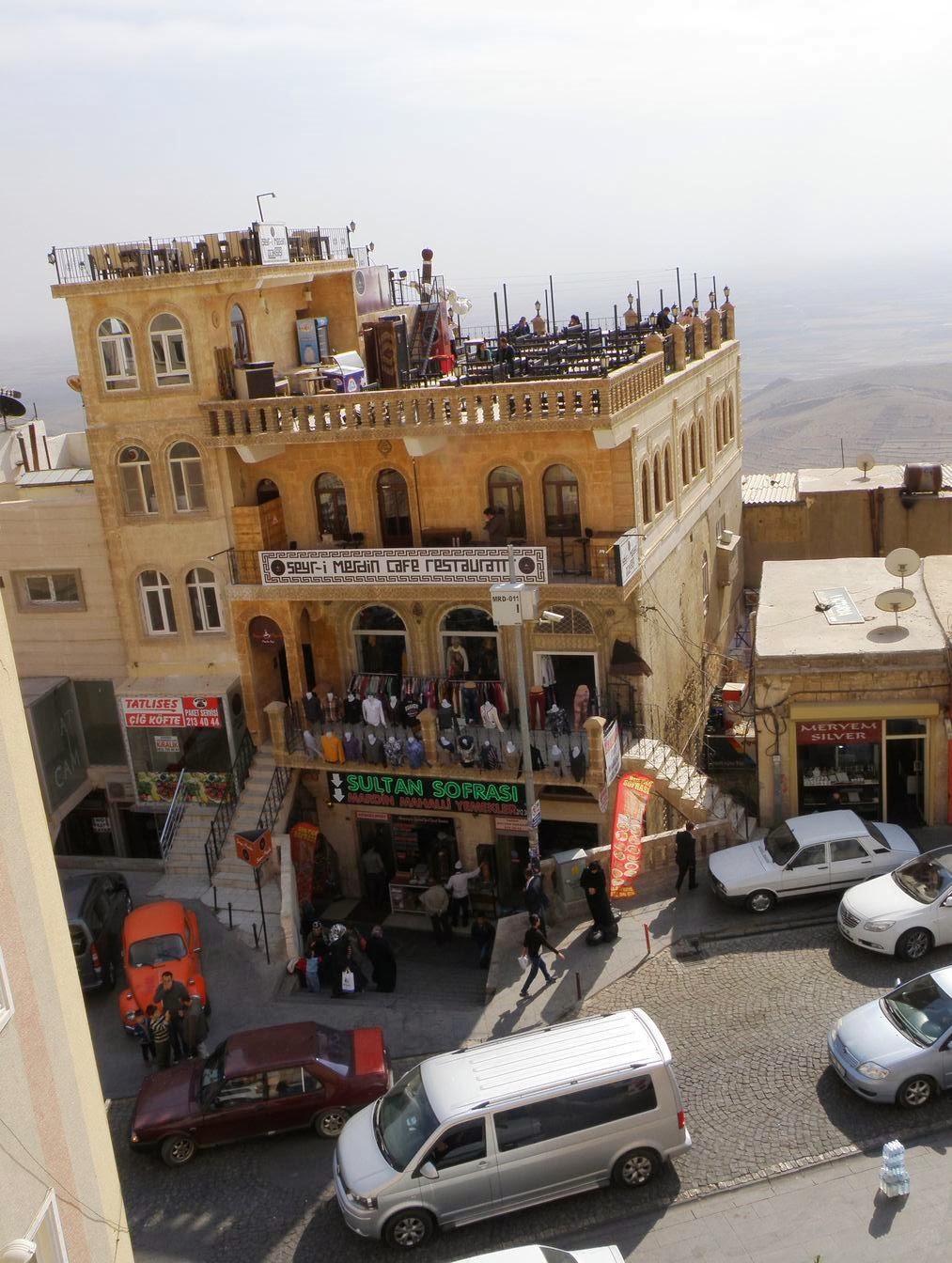
Tea on the rooftop anyone?
We opted to eat at ground level at
the place with the green sign.
Even with this level, but I do not think attached to it, was a rooftop restaurant.  The view was gorgeous and our group discussed having lunch up there.  But when we checked the menu later we opted for a street level cafe instead.  Only a couple of people wanted the food served on that rooftop; the rest wanted simpler fare.  Which translates to lower cost.  


Also from this level was a good view of the very tall minaret of the Ulu Cami.  

The minaret as seen from level of
the Ulu Cami, Great Mosque
Ulucami means "Great Mosque" in Turkish.  It is also called Cami-i Kebir in Arabic (الجامع الكبير) and is a name originally given to the grandest Friday mosque of a Turkish city. Sometimes more recent mosques are even grander. But still the traditional name is kept. Historically the Muslim prayer on Friday was only performed at one mosque in a city; however, this is not the case anymore. The Ulucami was the largest mosque of a city, where the citizens gathered to pray the Friday Prayers.

By the way, a 'c' in Turkish (without a squiggly beneath it) is pronounced like a soft 'g' or a 'j'.  So Cami is pronounced Jami or Jahmi.  As I had only read this word before this trip and not heard it, I had formed a completely different pronunciation in my mind.  Took days of hearing the correct pronunciation for me to finally mentally accept it.


Taş and Gwen posing


The Great Mosque was constructed in the 12th century by the ruler of the Artuqid Turks.  It has a ribbed dome and a minaret that soars above the city.  There were originally two minarets but one collapsed many centuries ago.  The remaining minaret actually soars above everything in and around Mardin.  It is visible from just about everywhere except down in the dark narrow alleys or the souk.

Taş & Gwen posing
Next, Taş led our group down the many steps and even farther down through the souk.  He asked Bill to make sure the whole group stayed together and not to let any stragglers get separated and left behind.  Maybe it was my imagination, but the look in his eyes told me that it was not safe for westerners or tourists to be wandering alone down in these very enclosed and meandering alleyways.  Whether he was concerned we might get robbed or if he was concerned that we might get lost, I cannot say.  At any rate, we made it a point to keep everyone together.  Not an easy task since many wanted to souvenir shop as we tried to hurry them along.


Bill in Kurdish headscarf
At one spot down in the depths of the souk we all stopped to purchase headscarves.  The guys operating this stall were good.  They had grabbed the first couple of people and within 2 seconds had headscarves wound around their heads.  Once that scarf is on your head, how are you not going to buy it?  They managed to get one on Bill's head, so we bought it even though we did not want it.  This was on our way to see the Great Mosque.  While down there (with us again remaining outside because of the removing shoe thing), we learned the color-coding for the headscarves.


Local boy riding donkey -- right down steep steps!
The color and sometimes pattern of the headscarves identify a person, especially men but also sometimes women although Turkish and Arab women in Turkey wear very colorful headscarves that have no identifying characteristics.  But in this area of Turkey the headscarf color means who or what you are.  

Orange means you are Turkish.
Red means you are Arab.
Black means you are Kurdish.
Purple means you are modern and do not wish to be identified as Kurdish, Arab or Turkish.
Peach or Orange with crosses means you are Syriac.
Could not believe he rode that donkey
down all those steps!  Easy as pie!


Well, heck, now I did not want the headscarf that had been placed on Bill's head and that we had bought.  On our way back we stopped again at that shop and asked to trade it for a Syriac patterned scarf.  
Taş with Judy in Syriac headscarf


This will be gifted to our daughter-in-law who is religious.  I think that is sort of a special gift for her.  It is large and can be worn as a scarf rather than a headscarf.  Or she can use it as a decoration in her home.  The shop owner wound the scarf around my head; that did not stay on long.


Girl at the ablutions at the Great Mosque


While waiting for the others at the Great Mosque I enjoyed watching a little girl at the ablution spigots.  She had come to fill a small water bottle.  Pretty little thing.


We exited the souk and stopped for lunch at a small cafe.  Outside in the back alleyway exiting the souk were pans of animal entrails which had obviously belonged to the kitchen of this restaurant.  That bothered some of our group members but not me.  Chickens don't naturally come on styrofoam trays wrapped in plastic.  They must be killed and cleaned first.  This did not affect mine or Bill's appetites.  Lunch was great for us.  


The home on the second level of this building is
used to film most of the soap operas in Turkey.
Then our group went our separate ways for a couple of hours.  We opted to go to the big museum.  We were quite tired of walking so when we happened upon a room where videos were being shown, we sat ourselves down and enjoyed the videos.  Did not matter that they were in Turkish.  It was a comfortable place to sit.  


Mardin is also famous for silver
working.  These are small purses
made from silver filigree.


Soon more of our group members arrived and the attendant changed the videos to play in English.  For the life of me, I cannot remember a thing about the video now other than it was good.  So, if you are ever in Mardin, it is worth a stop at the museum to watch the video presentation.


Sign at Virgin Mary Church


Also right at the museum is the 6th century Virgin Mary Church, known to the Syriacs as the Yoldath Aloho Church.  The epigraph over the entrance door written in Aramaic states:  "What an imposing place this is!  This place is the home of God!  The gate of heaven is this!"  Tekvin: 28:17
Does your Bible contain a Book of Tekvin?  Mine does not.  Guess it should not surprise anyone that the Syriac Bible might be a bit different than other Christian Bibles; certainly different from the St. James version used by most Protestants. It is now possible to obtain a copy of the Bible translated directly from ancient Aramaic to English.  I would be interested in reading this to compare to the St. James version upon which I was raised.  I have always felt that much must have been lost in translating from Aramaic to Hebrew to Greek to Latin to English.   Here is a link to translations by Dr. George Lamsa:  Direct Aramaic to English translation of Bible


Sign on the St. Hirmiz Chaldean Church
The Virgin Mary Church is today open only on Sundays for ritual purposes and is closed to visitors.  The church depends on funding from the Roman Catholic Church and upon Moran Mor Ignatius Joseph III Younah, Patriarch of Antioch and All of the East of the Syriacs, who is living in Beirut, Lebanon.  The Patriarch had moved to Damascus, Syria, but because of the current unrest in that country has moved to Beirut.  The Patriarch has appealed to the west to not support the insurgents in Syria, claiming that the Syrian situation is not a civil war but is insurgents who are also against the Eastern Christians.  Fortunately, he was not in the village where 39 Christians were killed by the insurgents in Syria last month.


Door to St. Hirmiz Church
Carvings at St. Hirmiz Chaldean Church
There are a number of Christian churches in Mardin, all of which are very old.  Another one we passed on a main street was the St. Hirmiz Chaldean Church, built here in 397 A.D.  And still in use today.  It was locked as we were there on a Saturday but it was obvious that this building is still in use today.  The carvings on the right side of the entrance appeared to be in different languages.  Really a neat place and wish we could have seen the interior.


Very potent coffee drink
It was still not yet time to board the bus for the ride back to Midyat, so we stopped at a coffee shop next to the only parking lot in Mardin.  One of our group members opted to sample a special coffee drink; I don't remember the name of it.  The coffee was the texture of molasses.  It was served in a tiny, tiny 'cup' and had enough caffeine to blow off the top of your head.  I tasted a miniscule amount on my fingertip.  WHOA!!! 


Had to get a photo of this dress.
Can you imagine!


Back in Midyat for our last night there, the hotel owner treated our group to dinner at a restaurant across the street rather than in the hotel restaurant.  As in most hotels in Turkey the evening meal and breakfast are included in the room price.  We have found this to be true all over Turkey except in Istanbul.  This was a nice treat and the food was good.

Friday, November 8, 2013

Fifth Day of land tour, part 1: Saffron Monastery

 
Above the monastery.  Looks like old rock dwellings
This particular blog posting must be prefaced by acknowledging that I am not a particularly religious person.....as evidenced by my profile basic information on Facebook which states that I am Christian with Buddhist leanings.  Personally, I think historically more people have been killed in the name of religion than for any other reason.  Does not matter which religion; all have been responsible for killing people because of religion.   Anything taken to extreme can be bad. All that said, this posting will likely upset some of my Baptist relatives who believe that their interpretation of their St. James version Bible is the only true Christian religion.  Because this posting is about the original and still active Christians -- the Syriac Christians.

I venture to guess that most people have never even heard of the Syriac Christians.   We had not heard of them until we arrived in Turkey.  Like others who first learn of the Syriacs, our first response was, "Syriac?  What is that?  Is it the same as Syrian?"

And the answer to that is a resounding, NO.


Over the entryway into the monastery.
Aramaic language. No idea what it says.
There is a difference between Assyrians and Syrians and Syriacs.  The Assyrians were an ancient people who dominated a large region of this part of the world a very long time ago.  The original country of Assyria was in what is now northern Iraq, but spread to include a much larger region.  Syrians are simply people who live or have lived in the country currently known as Syria.  Syriacs trace their lineage back to the Assyrians, but this has nothing to do with the country currently known as Syria.  Syriacs might or might not have been born or lived in that country.


According to Wikipedia:
"The use of the word Syriac (which originally referred to the Syrian language, a dialect of Middle Aramaic which arose in Assyria) instead of Syrian became common after the establishment of the modern nation of Syria after World War I. The word 'Syrian' has become ambiguous in English since it can refer now to a citizen of Syria regardless of ethnicity. In Arabic, however, the word for a 'citizen of Syria' has a different form (سوري sūrī) from the traditional word for an ethnic Syrian (سُرياني suryānī)."

Confused yet?  I know my head was spinning when trying to discern who was what.  I gave up; anyone who wants more information can do their own research.  I did learn that there is such a thing as Assyrian Continuity and that the Syriac Christians can make the claim that they descend from the Assyrians and this has been supported by genetic testing today. 

Our first stop this day was the Saffron Monastery just outside the old city of Mardin.  This is called the Deyrulzafaran Monastery by the Turks.  Here is a link to one of the websites providing information about this monastery:    Link:  Saffron Monastery


Exterior; entrance to first level.
The monastery assigned us a guide.  The Syriac Christians speak a dialect of ancient Aramaic, the same language supposedly spoken by Jesus Christ.  This young man had such a smooth and soothing voice.  Several of us noted that we could have listened to him speak all day.  He spoke with our guide, Taş; and Taş translated to English for us.  Taş said that the young man spoke Turkish with a very strange accent.  Guess so, if his normal language is Aramaic.  The young man provided us with the information cited below.

Walking up to interior entrance at higher level


The monks still speak among themselves only in Aramaic, which they call the Syriac language.  This language is far older than Arabic or any other language known today.  If Jesus were alive today, any of the monks could converse with Him easily.  There were 3 ancient languages: Georgian, Armenian and Syriac (Aramaic).  These pre-date Greek or Arabic or any other known language.

Aramaic translation for Water Closet


Today they are allowed only to study the language here.  They are not allowed to teach theology.  There are a number of small children who are sent to the monastery to study the language.  The details of their religion must be learned at home or they must be sent to the Syriac Orthodox schools in Damascus, Syria.


(Taş interrupted at this point to explain to our group about the law in Turkey concerning this.  It seems that back while Ataturk was governing the new country of Turkey in 1924 that he became very concerned with the radical Islamic medreses, or schools, some of which were teaching radical Islamic ideas.  He could not ban just those radical Islamic schools so he banned ALL religious schools.  It is illegal to teach any form of religion anywhere in Turkey.  Religion can be taught by parents within their own homes but the mosques and churches cannot teach any form of religion.  This law remains in effect today.  That is very different from other Islamic countries.  Remember, the population of Turkey is 98% to 99% Muslim but Turkey is officially a secular country, meaning separation of religion from government.)

Main chapel
The Saffron Monastery had been constantly in operation from 1130 A.D. to 1932 A.D. as the Seat of the Patriarch of the Syriac Orthodox church.    In 1932 the Seat of the Patriarch was moved to Damascus.  The church was officially founded in 93 A.D., making them the oldest Christians in the world.  St. Peter's Church in Hatay, Turkey (ancient Antioch) is the first Christian church and was established in 32 A.D.  There is a structural division between the Western Syriac Orthodox and the Eastern Syriac Orthodox.  The church in Antioch belongs to the Western Syriacs; this Saffron Monastery belongs to the Eastern Syriacs.

There are 365 rooms in the monastery, one for each day of the year; and the first room was built in 400 A.D.  This was the first room we visited.

Did not take photos of the tombs. Seemed sacreligious.
 Here are some old grinding wheels instead.
Inside were 7 tombs, each facing East.   Christ's Ascension was to the East, so all burials are faced East.  A religious ceremony is held in this room each Sunday. These 7 tombs contain the remains of 52 people who lived and died at different times.  The final person placed in one of these tombs was a priest named Filaksinos who lived 1885 to 1969.  The remains of each person are placed into urns and the urns are placed into the tombs. No soil is used during burial; only natural deterioration is allowed, no embalming.  The word sarcophagus in ancient Greek meant flesh eating tomb.  After Fr. Filaksinos was interred the tombs were sealed.  

At this point I got a bit confused as the young man talked about the very ancient God of the Sun called Shems.  Shems also came to be known as the God of Fire.  Persians worshipped Fire and Sun (both apparently called Shems) long, long before the ancient Greeks began worshipping Fire.  This has been verified by findings around Mardin dating to at least 12,000 B.C.

Wedged stone construction of low ceiling
Next we visited an old room that was used for animal sacrifices back in the day when such things were done.  It was at a lower level and the ceiling was quite low.  It was a bit of a contortionist act getting down the steps to gain access to this room.  The stone construction of the ceiling was unusual.  
Hole in stone to tie animals
to be sacrificed
The big stones were shaped and wedged into place and were self-supporting.  But along each long side of the rectangular shaped room was placed a thin long piece of flat stone.  If either of those long pieces were removed, then the ceiling would collapse. We noted a couple of places where a small hole had been chipped through the stones on corners.  This was where they would tie an animal that was to be sacrificed.

1600-yr-old mural.
Flash not allowed so not a good photo.


The third room we visited was a chapel or church.  Services are held in this chapel on Mondays, Wednesdays and Fridays.  Mormar is the title for a saint, abbreviated to Mor.  The oldest mural at the monastery is located in this chapel and is 1600 years old.  Wow! Photography flash was not allowed for this old mural, so our photo is not that great.


Bible in the church.  But not the 1600-yr-old Bible.
The monks chant hymns and read from the Bible on Wednesday services.  On Fridays they unroll a special carpet and then kneel and rise 40 times, signifying the 40 lashes to Christ at crucifixion.  The young man demonstrated the movements of their way of kneeling and rising and crossing themselves as is done for this weekly service.  All I can say is I hope none of them develop arthritis.  I certainly could not mimic his movements.


The prize of this monastery is a 1600 year old Bible.  It is written on a parchment made from gazelles and is ornamented with gold and silver on the cover.  As visitors, we, of course, were not allowed to view this prized and very valuable Bible.

The buildings in the monastery have very little, if any, ornamentation.  The buildings are very plain, like Islamic buildings.

The next building we visited was the Virgin Mary Church.  This chapel or church is used only on August 15 each year to celebrate the Ascension of the Virgin Mary.

The prized old printing press


In 1874 the first printing press was brought to the monastery.  Before that, the Ottoman Empire was afraid of the masses learning.  They did not want an educated populace, either Islamic or Christian.  This printing press is today housed in a corner of the Virgin Mary Church.


Bill asked a religious technical question of this young man.  In the Roman Catholic religion confession is considered a sacrament.  Bill asked if confession is considered a sacrament by the Syriacs.  The answer is no.  In the Syriac Orthodox religion, confession is considered between the penitent and God.  The penitent confesses face-to-face with a priest and this confession is not a sacrament.  The priest is there only to advise and counsel the penitent, but the confession is directly between the person and his God.

Tiny cup of Syriac coffee & delicious purple almonds
That was the end of our short tour.  The guide took us only to 3 of the 365 rooms of this huge monastery.  Then he left to do his regular jobs and our group retired to the coffee shop and souvenir shop.  I tried Syriac coffee, which I liked much better than the traditional Turkish coffee.  It was slightly sweetened and very thick but not nearly as powdery mud as the Turkish coffee.  Much less grounds residue in the cup after drinking the liquid part of the coffee.  It was served with some bluish/purplish coated almonds.  These were fabulous!  I am still kicking myself for not buying several bags of those almonds.  Cannot find them around Fethiye, but will continue to search.  I did sample something called Gorek which were like soft folded cookies filled with dates, and bought a small bag to bring home.  Even Bill likes the Gorek and he hates dates.

Windblown!!! Taken at monastery overlooking Tur Abdin
By the way, the Saffon Monastery is half-way up a high hill (mountain?) overlooking the Tur-abdin (pronounced Tour ahb DEEN).  Tur-abdin means the 'Land of the Servants of God' and is the fertile plains below the old city of Mardin.  Mardin was our next destination for this day.  

More information about Tur-abdin can be found here:   http://turabdin.info/

I thought this link was worth reading as I had never heard of this place.

And here is a YouTube video about the Saffron Monastery; the last bit of which shows parts of Mardin.   I did not make this video; just found it online.


 YouTube Video of Saffron Monastery & Mardin

Lighting another candle for brother John


Final photo is Bill lighting yet another candle for his brother, Fr. John.  Bill does this at every old Orthodox or Roman Catholic church we visit as we travel around the world.

John should be getting some good karma by now. 

 (Don't yell at me....told you I was not very religious.  Plus, being raised Protestant, I really don't get the candle lighting thing.)

Wednesday, November 6, 2013

Fourth Day of Tour, Part 2: Gobekli Tepe

This blog posting was difficult to compose for a number of reasons.  Photos have not yet been well placed within the blog.  Having internet connection troubles today.  


Larger view of dig showing layers
This was the reason I has signed us up for this trip!  The other sites we visited were interesting and we enjoyed everything, but Gobekli Tepe was the sole reason we came to this area.

Gobekli Tepe is known locally as Pot Belly Hill.  This site has been excavated under the direction of Klaus Schmidt and he has stated that this site will be his entire life's work.  It is one of the most significant archaeological finds anywhere in the world to date.  This site is simply overwhelming.

Gobekli pre-dates Stonehenge by more than 7,000 years.  
Take a moment to let that sink in.


Large fat birds?  2-legged animals?


Gobekli is believed to be the first form of sanctuary or place of religious worship in the world.  It was built while mankind was still hunter-gatherers not yet living in permanent clusters which were later called villages or towns.  Archaeologists believe that men gathered at this site annually or bi-annually or some set period of time in groups before men established permanent communal living areas.  


Reptile or cat with enlarged penis.
Fertility of both man and animals was very important.


The hill is the highest in the area and commands a view that is spectacular.  Yet ancient man added soil to make it even higher.  The enormous stones were moved here from distant sites.  

Why? 

How?


Numerous birds, one with many legs

Partial view of dig, different layers


Note 6 birds on edge of base

Carvings on side; but most interesting is the groove
carved on top.  Several monoliths had this groove.
What fitted into that groove?


Bowl indention in base stone supporting a monolith.
The only time I have seen these bowl depressions at
other sites has been for sacrifice.


Where the workers/artists lived nearby.
Identified but not yet excavated.

Many animal carvings.  Why the hole?

Sign showing aerial view of level with 'terrazzo' floor.
Note the circular placement of the monoliths.


Baskets? and more birds


DVD - A little later in the Dig, different levels

DVD--Note the circular placement as dug up


DVD -- Is that an 'H' or 2 people holding hands?
The lower symbol is for fertility

DVD -- Intricately carved alligator

DVD -- Intricately carved bull

DVD -- Bull on top, hyena center, bird on bottom

DVD -- Very intricately carved insects & designs

DVD -- A simulation of how the stones are arranged
on lowest level excavated thus far
Bill is now re-reading 'The Source' by James Michener, a novel which traces the history of monotheism quite literally to its source back to the era of cavemen.  The night before we visited Gobekli Bill had just reached the part in this book when descendants of the family of Ur had begun carving the monoliths up on the hill.  Gobekli was exactly as Michener had described this in his novel which was written years before the discovery of Gobekli.


DVD -- Dig getting interesting


What is strange is that after all the T-shaped monoliths (believed to represent gods) were carved and placed in circles, the people hauled in tons upon tons of soil to bury them.  Then they would start a new layer or higher level of T-shaped monoliths placed in more circles.


I cannot do justice to Gobekli by describing what we saw.  Here are a few links that provide information:

Link: The Smithsonian info    
Symbol of fertility, more 'H' symbols


Link: National Geographic info -- particularly interesting

Link:  Gobekli info from Turkey

DVD--Overhead view of Dig showing circles of placement


DVD--Ground penetrating radar has found 16 more sites


An interesting tidbit told to us by the guide is that there are 16 other sites situated in the relative vicinity that have been identified by the ground penetrating radar used in archaeology today to determine what should be excavated.  Excavation has not yet begun on any of those 16 other sites.  There are still more layers to excavate here at Gobekli.  


DVD - Fairly early in the Dig


Each layer excavated takes father back in history.  Carbon dating verifies the dates that these stones were carved and placed at the various levels.  Also, each level has been found to have a well constructed stone floor.  One of the floors is concrete-like and has been described as water-proof terrazzo. 


DVD--The Dig getting more complicated


The websites that I linked above state that the site is dated back to 10,000 B.C. but that is no longer true.  The most recent excavations are dated back to 16,000 B.C.  That is impossible for me to get my mind wrapped around.  To imagine that men were carving stones and moving this megaliths long distances and up tall hills that long ago is beyond my comprehension. 


DVD -- Crude carvings of animals


Everything I have read previously about early man is now challenged by this new information!

We bought a DVD at the site that provides great information about what they have learned thus far.  It is absolutely amazing.


DVD -- Several birds, one with many legs


Bill captured some of the images off that DVD and I am including a few of those on this blog; these are labeled as "DVD--whatever".  My own photos are also included but mine do not have proper lighting and the angles are limited to where I could stand on the scaffolding both within and surrounding the dig.


Male reptile.


According to the signs at the dig site, thus far they have unearthed stones with carvings of griseus (elongated carnivorous fish with tough skin covered with toothlike scales), various reptiles, wild boars, common crane, white stork, fox, gazelle, wild donkey, snakes, scorpions, wild sheep, lion, spiders and humans without heads.


DVD -- A flint tool.
How did they build this with such crude tools!

Above the dig is a lonely tree at the top of the hill.  This is a Wish Tree.  Several people had placed pieces of paper tucked into the tree bark stating their wishes, usually these are women wishing for a baby.  Beneath the tree were 2 very old Islamic graves.

There are pieces of flint all over the hillside, just laying right on top of the soil.  The flint so common on this hill provided tools for the ancient artists to carve the monoliths and images.


Arab women at the Wish Tree on top of site


While we were at Gobekli the busload of Arab women arrived who had been at Harran earlier that morning.  Again, they were full of smiles and laughter.  One woman kept touching her face and eyes and pointing to my face and saying something.  I could not understand what she was trying to convey.  Finally, a young girl came up and told me that the woman thought I was beautiful.  Well, thanks, but I do not meet the definition of beautiful.  In the traditional Arab culture a heavy woman is considered a good thing; it means her husbands provides well for her.  Well, okay.  I will agree that Bill has done a great job of providing for me.


Caretaker living quarter with satellite TV & solar panels


Walking back to the bus Bill noticed the caretakers' living quarters.  These few men are living inside a shipping container which has a bunch of solar panels to provide their energy needs.  And, of course, there were satellite TV dishes and other satellite dishes mounted on top of that shipping container.  They are very isolated out here but no reason not to have some modern day conveniences.


Looking down on dig site from top of hill


After Gobekli we stopped for lunch and then had a very long drive to Midyat, arriving well after dark.  This was our longest day of touring and traveling.  Gwen noted that an airport is under construction in Mardin.  She plans to change future itineraries for this trip once that airport opens and there will be less distance driving required.