TRANSLATE, TRADUIRE, ÜBERSETZEN, TRADUCIR, 翻译

Sunday, May 2, 2010

The Summer Palace

They cook something in Beijing that stinks to high heaven. We cannot identify the smell, but have noticed it every time we have walked through a residential area or street food vendor area. It reeks so much it makes my stomach do flip flops. Probably don't want to know what they are eating that is causing this noxious odor.

Today we decided to set off on our own to explore the Summer Palace. According to information I found online, we should be able to take the subway from the nearby Jishuitan station on Line 2 westward to the Xizhimen station and switch to Line 4 heading northwest; exiting at the Xiyuan station at exit C2 and walk westward. We waited until morning rush hour should be over and ventured out. The Beijing subway is different from other subways we have used elsewhere. Normally one buys tickets between specific stations; the cost of the ticket depends on how far one is traveling. Not true in Beijing. Here one buys a ticket and that ticket is good for wherever one goes on the subway system. The ticket is scanned upon entry; you can change lines as many times as you want; and the ticket is taken by the machine as you exit, wherever you decide to exit. Cost is the same whether you are going only one stop or 30 stops. The ticket costs one set price regardless of where you are going. Makes it a lot easier for tourists to purchase tickets from the station clerks who speak only Chinese. Just hold up your fingers for 1 or 2 tickets and hand over the money. Doesn't matter where you are going. We followed this routine and made it to our destination without incident. At the entrance of the Summer Palace a twenty-ish local girl presented herself as a licensed English-speaking guide and offered her services for 150 RMB. We settled on 140 RMB. We wouldn't have understood anything we were looking at if we had not enjoyed the benefit of her explanations. She is a student at the University of Beijing and hopes to graduate with a degree in English in June.

By the way, the people of Beijing speak only Chinese. In Shanghai probably one-third of the people spoke at least some English. In Beijing no one speaks any English except hotel desk clerks and licensed English-speaking guides. Even in restaurants frequented by tourists the employees do not speak any English. Nor are there any menus or display boards in restaurants written in English style letters, only in Chinese stick characters. So we can only frequent places with pictures of food to point to or a vendor where we can point to the actual item we want. To go anywhere by taxi in either Shanghai or Beijing, you must have directions written in Chinese stick characters. Never leave your hotel without return directions written in Chinese.

The weather here has improved dramatically since our arrival. It was sunny and bright the morning we arrived, but cold as heck and very windy. Yesterday it was sunny and bright with high temperature of about 87F. Today is predicted to be the same. This is great.
The Summer Palace is about 10 miles from The Forbidden City. It was built during the Jin Dynasty (1115-1234) and additions were made during the Qing Dynasty (1644-1911). The emperor and royal family resided at the Summer Palace from April to October each year to escape the heat of central Beijing. The Summer Palace is dedicated to Longevity and Benevolence. And all the houses and halls are called various names dealing with those either longevity or benevolence. Kunming Lake is located next to the Summer Palace. It was originally just a pond, but the Empress Dowager ordered that the pond be deepened and enlarged. The emperor watched navy exercises in the lake. Today there are peddle-boats and tourist boats plying the lake waters.

Originally the land around the palace and gardens was relatively flat. When Kunming Lake was enlarged, the dirt removed from the lake area was used to construct hills at the palace. There are several royal structures built on those hills. One of the major structures is a hall that houses a hundred hand Buddha. This is where the Empress Dowager worshiped. We did not walk up the hill to see the Buddha, so have no idea what a hundred hand Buddha looks like. Supposedly there is the one located here and another one in India.

Like most of the gardens of Beijing, the royal garden and summer home did not elude the rampages of the Anglo-French allied forces and were destroyed by fire during their attacks. In 1888 Empress Dowager Cixi took funds from the navy and ordered the palace to be reconstructed, changing the name to Summer Palace (Yiheyuan). The Empress Dowager spent most of her later years there, dealing with state affairs and entertaining. In 1900 the palace again was ransacked by the Eight-Power Allied Forces. After the successful 1911 peoples revolution, the Summer Palace was opened to the public.

Side note: Bill and I enjoy history, but neither of us knew anything about any Eight-Power Allied Forces (including the USA) attacking China around 1900. The guide had no idea why we attacked China at that time. Later back at our hotel, an internet search provided an answer that both Bill and I were familiar with --- The Boxer Rebellion. The US version of the Boxer Rebellion is that the Chinese impounded all foreign legations and dignitaries and embassy employees in Beijing and Allied Forces entered Beijing and freed our people. The Chinese version of this incident is another instance of history being written by the ultimate victors. In China today, students are taught the following: "September 7, 2001 marks a special day for China and even some developed countries. On this day one century ago, namely, September 7, 1901, the Eight Power Allied Forces formed by Britain, the United States, France, Germany, Japan, Russia, Austria and Italy forced the Chinese Qing Government to sign the most insolent and unequal Protocol in human civilization. That year was the Year of Xinchou in Chinese lunar calendar, so the Protocol, officially the Protocol of 1901, is historically known as the Protocol of Xinchou." The Chinese are taught about atrocities committed by the Allied Forces during this invasion of their homeland. You can read their version of this part of history at http://www.china.org.cn/e-8guo/index.htm Sorry, you will need to copy and paste that into a browser; I cannot make that into a link because this is being posted via email text only. End of side note.

The Summer Palace consists of over 3,000 structures including pavilions, towers, bridges and corridors. It holds the world's longest corridor, which is 728 meters long (2366 feet).

The emperor liked to walk the corridor as he felt it was good for his health. It was very crowded the day we visited, but we did manage to walk the entire length to the marble boat area. We opted to walk outside on our return to the entrance because the grounds were less crowded outside the corridor.


Each of the more than 250 beams in the corridor is painted with a different garden scene. Actually, each SIDE of each beam is painted with a different garden scene. Bill did a quick math calculation and announced that there must be 684 painted garden scenes inside this corridor. And each one is different!

At all national parks in China the very old trees are marked with small plaques. A red plaque means the tree is more than 500 years old. A green plaque means the tree is more than 300 years old. There is a pine tree (of all things!!) in the Summer Palace that is more than 500 years old. The top was chopped off and it was trained to resemble the tail of a pheasant. This is an extremely unusual tree because pines just don't live that long. It is not an attractive tree, but it is unique.

There were hundreds of magnolia trees in bloom on the day we visited, covered in small pink blossoms. In Houston, these are often called tulip trees. Should be called Chinese magnolias, which could never be confused with our southern magnolias with their huge white blossoms.

Empress Dowager Cixi was known as the Dragon Lady. Her son became emperor at the age of 3. She would sit behind a screen behind the throne and tell the emperor what to do. So, in effect, she acted as emperor for 48 years. Her natural son died at the age of 19 and her adopted son was placed on the throne as emperor. She followed the same screen routine with that son.

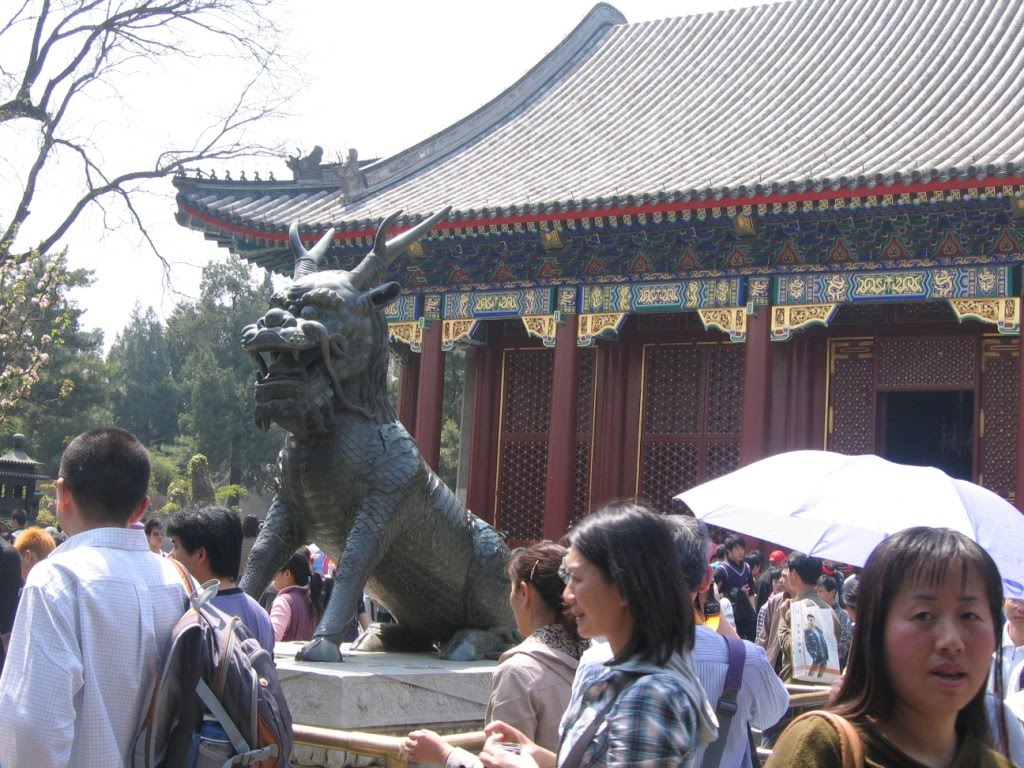
Outside the front of one of the main buildings are bronze statues --- one of a mythical dragon creature and one of a stork. The dragon represents the emperor (man) and the stork represents the empress (woman). Normally the statues would be placed with the dragon closest to the entry door since the emperor was the most important person. However, at the Summer Palace the statue positions are switched by order of the Empress Dowager. A subtle reminder that she was in charge of the country, not her son.

The empress enjoyed opium. Her son did not want opium in China; that was the whole point of the opium wars. Near the end of the second opium war she ordered that the emperor be placed under house arrest at the Summer Palace. She ordered that the doorway that would be used by the emperor be sealed so that the emperor could not escape. He remained under house arrest for 10 years. This was some mean lady to do this to her own son.

Also at the Summer Palace is a large marble boat. Probably the only such boat in the world. The marble boat is tied to a dock and has never moved, but it is floating. The Empress Dowager liked to sit on the upper level of this boat in front of a large mirror. She enjoyed admiring her reflection while sitting in the cool marble on the lake during the heat of summer. Look closely and you will see that mirror still in place. The side of the boat facing away from the shore was damaged during the battle when the Eight-Power Allied Forces "attacked" Beijing, and that side has been repaired with wood. But the entire boat originally was constructed of white marble.

Another place of interest was the replica of the Marco Polo Bridge which connects to the smaller South Island in Kunming Lake. The original Marco Polo Bridge was across a small branch of a river on the south side of Beijing. This bridge was constructed to honor Marco Polo shortly after his visit to China 700 years ago. The replica Marco Polo Bridge is actually larger than the original. The replica has 17 arches, with the center arch being slightly larger than the others. This is because 9 is the mystical supreme number reserved for the emperor. Anyone even saying the number 9 was instantly put to death; this number was reserved strictly for the emperor. If you count the arches from either the left or the right, you arrive at the number 9 as the center arch.

When we arrived at the entrance to the Summer Palace it was extremely crowded. May 1st is an important national holiday (celebrating the birth of communism). It is also called Labor Day and everyone is off work for 3 days. I swear half of Beijing was at the Summer Palace today, and the other half was down riding the subways. The subways were even more packed today than yesterday morning during rush hour.
On the return trip we thought about stopping at the Beijing Zoo and seeing the famous pandas. But the subway train did not stop at that station. So we got off at the National Library station and caught a train back towards the zoo. That train did not stop either. Our only explanation for this is that the zoo was either closed on this important national holiday. Or the zoo was filled to capacity and they weren't letting any more people in the gates so they weren't letting the subway stop there any more today. At any rate, we missed seeing the pandas.

Tomorrow morning we were supposed to have an English-speaking guide take us to see the Great Wall. But the hotel desk clerk said tonight that it would be extremely crowded tomorrow, so I asked that the guide be rescheduled for Monday morning. We plan for a relaxing day tomorrow. My feet and legs ache from walking up and down stone steps all day long for the past 2 days. Really wish I had brought gel inserts for my normally comfortable shoes. Marble stairs are hard on the legs and feet.

Friday, April 30, 2010

The Forbidden City, Tienanmen Square and Hutong

Hiring the private guide for today's touring was absolutely the best way to go. The guide filled us in on so much history and many facts. Without the guide we would have just been looking at places without understanding their significance, except for the few facts listed in the guide books. Today was a bit expensive but still the best way to see the things we wanted to see. The private English-speaking guide was 400 RMB, 180 RMB for transportation and various admission tickets, 136 RMB for lunch, and 440 RMB for entry and touring of the Hutong area, plus 100 RMB tip to the guide. That totals about $190 USD, which is a tad expensive for one day for tourists in China. We could have done all this on our own and saved about one-half the cost, but wouldn't have gotten nearly as much from the experience.

Our guide's name was William. We left the hotel at 0800 and tried to hail a taxi on the nearest main street. That wasn't working out so well, so I suggested we take the subway. We wanted to scope out how the Beijing subway works anyway, and what better time to do this than when a local person could show us. It was a longer hike to the subway station than we had thought …..and the subway was far more crowded than one could imagine. Just like in Shanghai, all bags are screened upon entry to the subway. William bought our tickets to get to Tienanmen Square, and we packed into the first subway car like sardines. Made one interchange and packed like sardines into the second subway car. You could get claustrophobic in the Beijing subway because people are packed so tightly together. No way one could ride this subway wearing backpacks or having even the smallest luggage…..at least not during morning rush hour. I snapped this photo just as we were boarding. At least a dozen more people crammed their way into this car after I took the photo.

Tienanmen Square was exactly as I expected it to be. At the south end of the huge square is the mausoleum of Chairman Mao. There were several thousand people standing in line to enter the mausoleum. We did not even try because neither bags nor cameras are allowed inside, and I had both. In front of Mao's mausoleum was a tall monument to the Heroes of the People, which means everyone who died during the revolutionary movement between 1898 through 1949.

In front of the monument to the Heroes there were 2 very wide daylight-viewable video screens, separated by a large portrait of Sun Yat-Sen, the guy who led the revolution in 1911 that toppled the Qing Dynasty and ended emperors forever in China. Sun Yat-Sen is called "The Father of the Revolution" in China. A good source of information about this period of Chinese history is http://www.wsu.edu/~dee/MODCHINA/REV.HTM We were most impressed with the quality of this video screen on this bright sunny day. These 2 screens each were about 300 feet long.

On the west side of Tienanmen Square stands the enormous Hall of the People. On the second floor of this hall is a banquet hall that seats 5,000 people. A banquet of just such size was held in this room when Richard Nixon visited Beijing in 1972.

On the east side of the square is the National Museum. One could spend weeks in this museum. One day doesn't give you enough time to even walk briskly through the building and cover all the floors, much less take time to appreciate any of the exhibits.

On the north side of the square, across a wide busy street with underground walkway, stands The Gate of Heavenly Peace, which is the first structure you pass through on your way into The Forbidden City. The gate is not what we would call a gate. It looks like a regular building except it has 3 arched openings going through the very thick main wall. The emperor was the only person allowed to walk through the center opening. Even kings from other countries were not allowed this privilege; they had to walk through one of the 2 outer entries on either side. (I usually have a very good sense of direction....that is why Bill wants me to navigate the boat most of the time and why he relies on me to get us around in strange new area and cities.....but I had utmost difficulty with north and south the entire time we were in Beijing. Everything seemed opposite of what it really was. On cloudy days with no sun visible I was repeatedly getting north wrong.) There is a large courtyard inside The Gate of Heavenly Peace before you reach the actual entrance to The Forbidden City. The entrance to The Forbidden City has rectangular openings which one walks through; again, the center opening was reserved strictly for the emperor.

The Forbidden City was built in 1420. It contains 9,999 rooms. Nine is the lucky number and was reserved strictly for the emperor. Having 9,999 rooms ensured good luck and fortune for the emperor. Almost immediately after construction of The Forbidden City was completed, it was destroyed by fire supposedly caused by lightning. The emperor ordered that the city be rebuilt. The Forbidden City covers more than 720,000 square meters. This is another place that can take days to see everything, so we had to choose which areas to explore on our one day here. (Note: I took over 130 photos inside The Forbidden City and it was difficult to decide which photos to post on this site. Will try to add more photos to our Picassa albums.)

The first wall is really not a wall of The Forbidden City, but it sure looks like it is. Outside this wall are several tall white marble land posts dating back more than 1,000 years. There are several entrances through the wall. The middle entrance was reserved strictly for the emperor. In this middle entranceway lies the first meridian established for measurements of longitude. (If you look closely at the ground in the photo on the right, you can see this meridian marking in the stone. This meridian is marked as one progresses through The Forbidden City, oftentimes with elaborate stone carvings.)

The Chinese established the prime meridian to lie precisely in the center of The Forbidden City in Beijing. This was at least 500 years before the British established the prime meridian in Greenwich, England that is used today. As the Chinese fleets sailed around the world, they measured longitudes east and west from Beijing. There have been books written explaining how the Chinese could ascertain longitudes correctly centuries before the Europeans mastered this process. The only people who would care about this are probably sailors. The Beijing prime meridian is marked by a stone walkway through the center of The Forbidden City and only the emperor was allowed to walk on it. Immediate death was the penalty for anyone else who dared to step onto the stones marking the meridian.

At various parts of The Forbidden City this walkway has elaborate stone carvings. One such carving at the rear of the city is 1.7 meters thick and about 20 meters long and about 3.5 meters wide. This particular piece of stone was quarried 70 kilometers south of Beijing. It took 10,000 men and 1,000 horses a full year to transport the solid piece of stone to The Forbidden City.

In the city where the meridian line passed through there was a throne for the emperor inside each building. Each throne was situated precisely on the meridian line. Each building served a different purpose. One large building was used only for the emperor to change clothes before important ceremonies.

We had no sooner entered the main entrance before a bunch of soldiers and police started forcing people to move back and they erected a silk cord barricade to cordon off the middle of the entrance area. Soon limousines arrived and many people got out of the cars. They appeared to be officials of some kind, who knows from where. One man was wearing a gray-tan uniform with lots of gold trimming and looked like someone out of the French Foreign Legion. Everyone else was wearing a normal business suit. Our guide asked one of the policemen who these people were and learned they were foreign dignitaries or a foreign delegation. We never learned what countries they were from. They headed off through the center of The Forbidden City. We noticed the limos moving away and deduced that the dignitaries would be exiting elsewhere and figured the area would be reopened to the public as soon as they had moved on. We weren't on a schedule, so we just waited until they left before continuing our tour of the city. A little excitement to make our visit even more memorable.

I am very glad we did not make this trip 5 years ago. Much of The Forbidden City was refurbished prior to the Olympics being held in Beijing in summer 2008. It was really cool to see the refurbished sections compared to the areas that were last refurbished in 1760. Heck, even the parts last touched in 1760 still looked pretty darn good.


In several areas of the city there were triple level courtyards made from white marble. These had over a thousand dragon heads sticking out from the walls. When it rains, the water flows to the courtyards and pours from the mouths of the dragon heads. This is one place that would be neat to visit during a heavy rain.

Off to the right was another area of the city that requires a separate admittance ticket. On one wall were 9 dragons made from tubular tiles. The emperor who ordered these dragons built had declared that the work must be completed by a specific date or the craftsmen would be beheaded. The craftsmen realized they would not be able to finish on schedule, so they decided to make one of the dragons from heavily painted wood carvings. When the emperor inspected the wall, he was pleased with the results. The wall passed his inspection and he did not know that one of the dragons was made from painted wood instead of from tubular glazed tiles. The craftsmen kept their heads. The wooden carving is the third one from the left side.

Next were buildings of treasures. Various things made from gold and precious gems and pearls and jade. There were too many things for me to remember them all. After all, these were emperors and had wealth beyond our wildest imaginations. There are a few things that stand out in my memory. There were some huge pearls.....certainly the largest pearls I have ever seen. They were larger than grape tomatoes. Also, the emperors had 25 seals. Each very large seal was made from different precious metals and jades. These seals were used with ink to stamp official documents. There were 25 seals because of the special numbers. Certain odd numbers hold special significance to the Chinese. The Harmony Number Code is 1+3+5+7+9=25.

Another place of special interest was the Dowager Empress' theater. The empress loved Beijing theater so much that in 1766 she had a theater built inside The Forbidden City. This theater had trap doors to allow characters to rise up from the floor; and trap doors in the ceilings to allow actors to drop down or float down on supporting ropes. There were water wells used for special effects, and there were empty wells used for sound effects. In another nearby building we found a cut-away miniature replica of the theater that illustrated many of the special construction methods to allow the actors to do the special effects. It was very clever for the times.

Beyond the theater were some residential buildings; looked very similar to the emperor's formal buildings except at a lower level. One building was for concubines and behind it was a well covered by a stone. The Concubine Zhen, concubine of Emperor Guangxu, who supported the emperor's views on constitutional reform and modernization had lived in this building. The Empress Dowager Cixi (the Dragon Lady) ordered Concubine Zhen thrown down this well and drowned when the Allied Eight Powers attacked in 1900.

The last thing I will mention at The Forbidden City is the sundial. This is the first time either of us had seen a real sundial. It is made from white marble and had graduations on both sides. The gnomons are made of iron. The dial is mounted on a base that is positioned parallel with the equator. The dial is tilted with the gnomons pointing to the north and south poles, respectively. One uses front of the dial for telling time during the winter months and the reverse side of the dial for telling time during the summer months. Our photo was taken at 11:55 a.m., and you can tell that this sundial still reflects accurate time.


After The Forbidden City we grabbed a taxi and visited the Hutong. Frankly, we had never heard of Hutong until we started reading about things to see in Beijing. The word hutong literally means alley; but the Hutong actually came from the word meaning water, which sounds very similar to the word meaning alley. Guess you could expect mix-ups like that when a language is tonal and the same sound pronounced 1 of 4 different ways means 4 entirely different things. About 700 years ago Mongols moved into a particular area of Beijing. The emperors allowed them to dig water wells and to live around those wells; hence, the word hutong meaning water. These settlements of Mongols soon became known as Hutong villages and were located in what is central Beijing today. During relatively recent years as Beijing grew, most of the Hutong were torn down in the name of 'progress.' Today there is only one Hutong remaining and it is not too far from The Forbidden City.

The people who live in the remaining Hutong are a very close-knit group. They tend to remain in the Hutong area all their lives if possible. So your childhood friend most likely will remain your lifelong friend. But the Hutong community is slowed being diluted for economic reasons. Because the Hutong is so centrally located in a city of estimated 30 million population, it is an attractive place for the wealthy people to live. The homes are tiny and streets are not much more than alleyways, but it is still such a geographically desirable location that the wealthy are crowding out the traditional inhabitants. Today there is a mix of younger wealthy residents and the older families who refuse to move out regardless of the money offered.

Our local Hutong guide was a girl named Eleven. Yeah, pronounced just like the number. Eleven loaded us into bicycle rickshaws and gave us a tour through her neighborhood. She talked very fast and had a great sense of humor. Eleven explained how the end cross-sections of exposed beams over doorways indicated the status of the family living inside. In The Forbidden City there were always 12 exposed beam ends over doorways. Only the emperors were allowed to have 12 beams. The number of beams decreased as the occupants' status decreased. In the Hutong the highest ranking person could have 4 beams. The lowest ranking person would have no beams. Eleven said she was a no beam girl.

The doorways with the higher number of beams would also have the highest threshold. In The Forbidden City the thresholds were well more than a foot high. One would have to raise the foot very high to step over the threshold, causing the knee to bend about 90 degrees. This was symbolic of kneeling to the occupant of the household. One would never step on a threshold; one always steps over a threshold. The threshold of a 4-beam house in the Hutong would be less than a foot high, but still high enough to cause the knee to distinctly bend. A 3-beam house would have a lower threshold and a no-beam house might have no threshold at all or one only a few inches high. The height of the threshold also serves another purpose – to hold good luck inside the home. Luck might pour out of a house like water. A threshold would hold the water (luck) inside the house. The higher the threshold, the more water (luck) that would be held inside the house. So, even most no-beam houses have at least some height threshold.

Doors in the Hutong also have a few more distinctive characteristics. All 4-beam houses, 3-beam houses and most 2-beam houses also have door pillows. Door pillows are made from marble or carved stone. There are always 2 door pillows, 1 on either side of the door, placed on the outside of the threshold. Door pillows were normally about 18-inches tall. The shape of the door pillows indicated the occupation of the house occupant. Books are basically square, so square door pillows would mean the occupant was a scholar or an official dealing with paperwork. Round shaped door pillows indicated military.

Inside the exterior door there would be a screen or wall. One would enter the actual house by going to the right or left of the wall or screen. The reasoning for the placement of this screen or wall was to keep out evil spirits. The old Chinese believed that evil spirits could only go straight. So if an evil spirit came straight through the exterior doorway, the spirit still would not be able to enter the house because it could not negotiate the turns required to get around the screen or blocking wall.

While in the Hutong we were treated to a visit to a family's home. It turned out that our host is a well-known martial arts expert. He is older now and no longer performs Kung Fu, but he is a sought-after teacher. He had a most impressive display of ancient swords and various evil looking weapons on long poles. These weapons are no longer used in teaching Kung Fu. Today only a sword is used in the advanced Kung Fu classes. His eldest son was the number one Kung Fu expert in all of China a few years ago and is now living in Houston, Texas. The son teaches Kung Fu at a place on South Rice Avenue in Houston. What an incredibly small world!!! That was about 3 miles from where we lived in Houston before moving onto the boat. We will try to remember to look up his son when we next visit Houston.

Next we climbed 72 very steep high steps to the top of a drum tower. There were only a few drum towers built in Beijing during the times of the emperors. There were bells inside The Forbidden City that were rung at 05:00 each morning to awaken the peasants and let them know it was time to start working. Then, at 19:00 each evening the drums were beaten high inside the drum towers to let the people know it was the end of the workday and for them to go home. The general populace had no way of knowing what time it was. But inside the drum tower and also inside The Forbidden City there were water clocks. The water clock was invented by the Chinese in 80 B.C. (The Europeans did not develop an accurate method of keeping time until about 1700 years later.) There was a water clock replica in the top of the drum tower.

The drum ceremony is performed several times each day for the tourists. The ceremony lasts only about 5 minutes each time. I am glad I huffed and puffed all the way up those steep steps to see this ceremony. Those guys really know how to beat those drums. Today, all the drums used are copies; but there is one very dilapidated drum in the top of the tower that is 700 years old. The views of the city from the top of the drum tower were also worth the climb.

William wanted to take us to see a performance of Chinese acrobatics and to eat a traditional Beijing dinner, but we declined. This was enough sight-seeing for one day. We grabbed a taxi back to the hotel and William retrieved his bicycle to pedal an hour back home. We got the hotel desk clerk to call for pizza for us. No more walking today for us, not even to go down the street for a decent dinner.

Will add photos once we get outside the Great Firewall of China.

Thursday, April 29, 2010

Train to Beijing

Buying train tickets from Shanghai to Beijing can be difficult. The tickets sell out almost as quickly as they are released for sale. You cannot purchase or reserve train tickets online; you must purchase tickets in person at the Shanghai Railway Station. And buying Deluxe Soft Sleeper accommodations on the T trains is virtually impossible (this is what we had on the Hong Kong to Shanghai train last week). I had contacted a girl in Shanghai several weeks ago and made arrangements for her to purchase our train tickets as soon as the tickets were released for sale. We told her that if it was not possible to buy Deluxe Soft Sleeper tickets on the T trains, then we would take any overnight D train. D trains have 4 berths per cabin room and no private toilets. There are communal toilets at each end of each car. She sent the tickets to our hotel via courier. It was going to be the D322 train departing Shanghai Railway Station at 21:35 on Wednesday night, with scheduled arrival at Beijing South station at 07:25 on Thursday morning.

We arrived at the Shanghai Railway Station early. This gave us plenty of time to sit outside and watch all the crowds. And, wow, does this station get crowded! We spotted a Burger King down the street and treated ourselves to Whoppers for dinner, before entering the station and waiting for several hours until it was time to board the train. Bags are screened and you pass through metal detectors, just like any airport. Once behind security there are a few convenience store shops and a few other shops of no interest to us. We entered the very crowded departure waiting area and stood around until a couple of seats became available. Nothing to do now but wait another 2 hours.

The numbers for departing trains are displayed in red lights in each departure waiting area. About 20 minutes before departure, the lights change to green. The instant the lights change to green everyone who wants to board that train rushes and crowds en mass to the departure gate. People are all pushing and shoving to get there first. Remember…..it is alien to the Chinese culture to form a queue or stand in a line for anything. And you have to get right in the middle of this crowd and push your way forward too, or you will miss the train. Five minutes before departure, the lights change from green to white and they stop screening tickets at the departure gate entry. You had better be down on the loading platform or already in the train by then. We were.

This time we were in coach number 13, berths 21 and 23. The girl in Shanghai did the right thing when she bought our tickets. We were in the 2 lower berths in this cabin. The top 2 berths were occupied by a young Chinese couple. They never said one word to either Bill or me. They weren't unfriendly. They just did not know how to communicate with the 2 old white people, so they ignored us other than to give us a few smiles.

The bottom berths are more comfortable and convenient than having to climb up top. The lower berths cost more than the upper berths. Each of the 4 beds has its own monitor, private sound system with headphones and a reading light. But obviously it is easier to get up and down from the lower berths. Plus the bottom berths have more storage room for luggage because things can be pushed beneath the beds. I was very pleased to see that one of the toilets at the end of our car was a normal western style toilet. The others were the Asian squat toilets that I avoid like the plague. Truly cannot imagine an old woman squatting over one of those floor toilets with nothing to hold onto on a moving train, even a very smooth riding train. Men have it much easier.

The D trains are the newest trains in China. They travel very fast. This train was going over 200 kilometers per hour (over 120 mph) when I turned off the monitor to go to sleep. The distance from Shanghai to Beijing is approximately 1500 kilometers. The D trains cover this distance in about 10 hours. The D trains are very smooth riding and we slept well and arrived right on schedule into a bright sunny cold Beijing morning.

The signs at the train station were wrong. We followed the signs to the taxis and found nothing except an empty underground parking area. The 50 of us turned and followed yet more signs to where taxis supposedly would be located. That area turned out to be crowded with hundreds of people and no taxis. We decided to follow whichever Chinese person appeared to be the smartest. We decided that person would be a man with his wife and son. They walked away from the crowds and headed toward the north bus exit. We followed. About a half-block away they found a row of taxis and everyone was soon on their respective ways.

Two hours in bumper-to-bumper traffic to reach our hotel. The taxi driver went round in circles a few times within a block of this hotel, asking directions from locals every few minutes.

Finally he found the right alleyway and stopped the car. We unloaded our bags and walked down the alleyway until we found Michael's House of Beijing. This tiny hotel was rated number 1 on Tripadviser. It costs about $100 USD per night and is built in the old traditional Hutong manner, which means it faces a narrow alley and is a courtyard style house. Once inside the front alleyway doors, it is a nice little hotel. From the alley it looks like a hovel. Our room is very nice, with a sofa sitting room and computer table area separate from the bedroom area. And, wonder of all wonders, this room has an actual mattress!!!! That is a true rarity in China. Almost all mattresses here are hard as the floor.

We walked the neighborhood this afternoon. The hotel neighborhood in Shanghai was much better. This part of Beijing is not at all impressive. But I will reserve judgment of this city until we have seen more of it.

We have hired a private guide for a couple of days. He has no car and we will be getting around the city on buses or subways. Tomorrow morning we will go to either the Great Wall or the Forbidden City.