TRANSLATE, TRADUIRE, ÜBERSETZEN, TRADUCIR, 翻译

Sunday, February 20, 2011

Fort Kochi & the Chinese fishing nets

One day this past week Linda & Michael on S/V B'Sheret joined us for a day excursion to Fort Kochi.  We wanted to see the Chinese fishing nets.  And to visit the recommended Seagull Hotel restaurant for lunch.  Time to get off the boat and wander around for a few hours.

Fort Kochi is the "happening" area of Cochin.  Especially for tourists.  And Cochin does get its fair share of tourists, both international and domestic.   Millions of people in the interior and mountainous areas of India have never even seen the ocean.  And Cochin is a popular place for them to visit.  International tourists to this area come mainly from Europe.   I don't want to give a blow-by-blow, century-by-century description of the history of Fort Kochi, but here is a very brief synopsis.

Since 3000 B.C.  this area has been important for trade.  First came Mesopotamians, the Greeks and Romans and established spice trading.  Then the Arabians who brought the many spices up to Europe.  Many centuries later they were followed by the Portuguese, then the Dutch, and finally the British.  This area is also referred to as the Malabar Coast and is one of the wettest areas of India.  Fortunately for us, all this rain falls during a 3 month period annually during the strong SW monsoon.  Then it is dry for the rest of the year.  We are here during the NE monsoon and have been told that it will not rain a drop during our visit.  That has been true thus far.

Written documents reflect that by around 600 A.D. there was a large community of people of various religions living peacefully in this area -- Hindus, Christians, Muslims and a Jewish minority.  There is a Jewish synagogue built near Fort Kochi that still stands today.  I do not know the year of construction, but it looks pretty darn old.  In 1341, the natural harbor of Kochi was created by a flood which also destroyed the harbor of the town Kodungallur. Kochi developed into one of the most important harbors on the west coast of India and concentrated on the spice trade with China and the Middle East.  The 1500s found Portuguese ships landing at Kochi.  Explorers Vasco da Gama and Pedro Alvarez Cabral visited.   Vasco da Gama was once buried here at St. Francis Church Fort Kochi.  His remains were returned to Portugal in 1539. The body of Vasco da Gama was re-interred in Vidigueira, Portugal in a casket decorated with gold and jewels. 

The Majaraja of Kochi felt threatened by King Zamorin of Calicut (Calcutta) and thought that the Portuguese would help defend him, so he opened the port to the Portuguese and they established their first trading center in Kochi.  Guess he put a bit too much trust in the Portuguese because they soon took over.  The Majaraja lost most of his power and Kochi became the first European colony in India.

The Portuguese wanted everyone to convert to Catholicism.  They pressured the small Jewish community and the Syrian Christians, who had lived here for hundreds of years.  The Portuguese tried to merge the Syrian Christian Church with the Roman Catholic Church which consisted of people converted by the Portuguese. This created conflicts with the caste system, because the Syrian Christians believed that they belonged to a higher caste than the converted Catholics who consisted mainly of poor fishermen from the coast.  Hard times for all of them.

The Dutch came to Kochi at the invitation of a deposed prince of the Cochin Royal Family and the hereditary Prime Minister of Cochin with the active and open support of the local Syrian Christians.  The Dutch conquered Kochi in 1653. The town now belonged to the worldwide trading network of the Netherlands East India Company.The Dutch also destroyed many Catholic institutions in Kochi (later called Cochin).  The Dutch also established themselves in Sri Lanka, as well as all throughout Indonesia where spices were also grown.  The Netherlands East India Company had the spice trade locked up for a long time.

Around 1790 the British arrived with their ever-expanding policy of world-wide colonization .  In 1814, Kochi became a part of the Madras Presidency and became a part of the British colonial empire. The British shaped the country until the 20th century,  As the clearance process for yachts can attest to this day, the British taught the Indians well when it came to bureaucracy and needless paperwork.

In 1947 India finally gained independence.  In 1956 the first free elections were held and the Communist Party formed the first government of Kerala (the state in which Cochin is located), the first freely elected communist government in the world.  Today India is a parliamentary democracy.

One of the main tourist attractions at Fort Kochi is the area of Chinese fishing nets.  Why these are called Chinese, I have no clue.  We did not see anything like this in China.


These are nets suspended from bent tree trunks.   There are large rocks tied with hanging ropes on the land side of these structures that are used to pull up the tree trunks & nets.  To submerge the nets, a man walks out to the far end of one of the tree trunks.  It is all a balancing art.  I must assume that weight is removed on the land side while the man is standing out near the center of the net structure; otherwise, it would seem to me that the net would rise again as the man walks back to land, which it obviously does not.

The nets are allowed to remain submerged for a  brief time -- maybe 5 minutes or so.  Then a group of men pull on the hanging ropes laced with large rocks and raise the nets out of the water.

Next a couple of the men go back out on the platform near the tree trunks and start shaking the net.  They do not go as far out as the man who walked out to cause the nets to submerge; they remain closer in and cause no effect on the balancing of the structure.

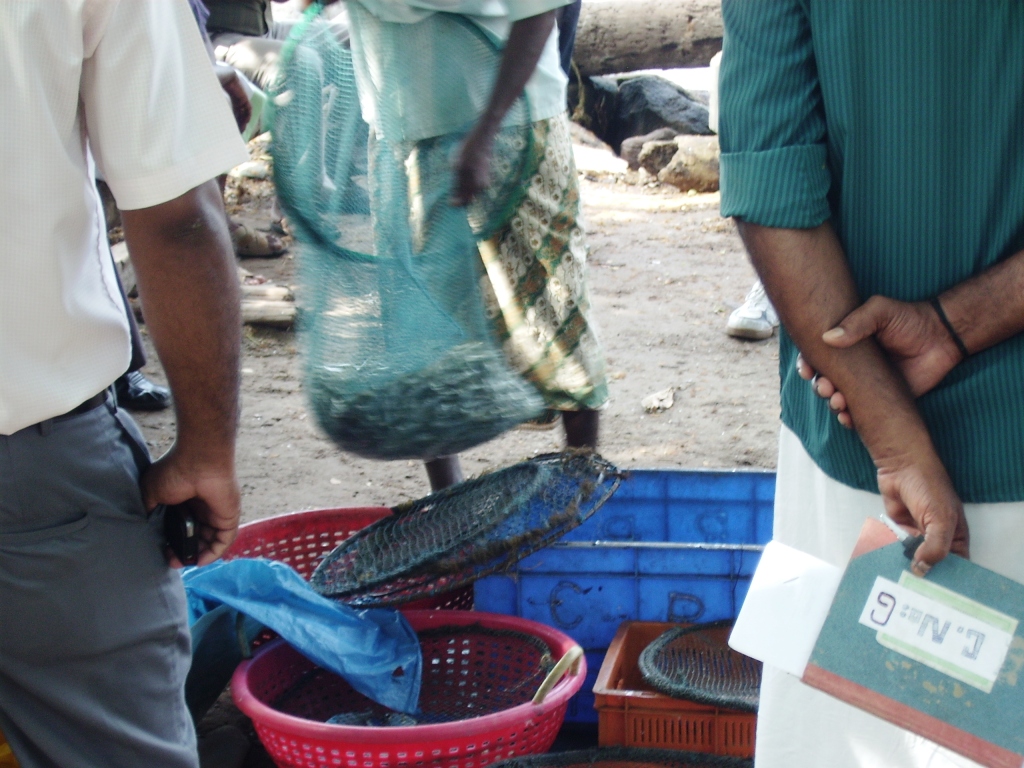
As they shake the large net, any fish fall toward an off-center "pocket" where a smaller net is attached.  The men still on land pull the ropes & rocks a bit more, causing the net to rise higher.  This allows the man or men out on the tree trunks to reach the smaller net where the fish have been accumulated.  There is some kind of drawstring type opening in the smaller net that allows the fish to be poured out.  These are collected and brought to containers ashore, where they are sold to waiting customers.

These photos should make the process fairly clear.


The only fish we saw being caught were very small.  We wouldn't bother with anything that small, but both in Sri Lanka and here in Cochin the locals like to eat these tiny fish.  Cannot imagine why.  Give me a nice thick fish fillet any time, no bones please, instead of these tiny fish.

Michael walked farther down the row of Chinese fishing nets -- there are at least a dozen along this part of the shore; and many more elsewhere around Cochin.  Michael said the men farther down had caught larger fish.  He saw decent sized snapper and large prawns for sale.  And those were actually being kept on ice -- a practice we have not seen anywhere else here.  Usually fish are just laying on plain wood and are not refrigerated; sold on the side of the street.  As you can guess, this is yet another place where we are not buying seafood.   

Hardly seems worth the effort, although there is little effort involved.  This is the simplest method of fishing imaginable. 


The 4 of us got a tiny surprise when we entered the restaurant at the Seagull Hotel.  There are at least 2 entrances to get into the restaurant.  We chose the first one we came to on the street and followed the signs.  I noticed a "Family" sign that diverted to the right, but did not snap as to what that sign meant.  We followed the sign straight ahead of us that said "Restaurant."  When we entered through the low doorway, it was immediately obvious to me that we had chosen wrong.   The entire place was filled with men -- no women present.  They looked at us and got a little loud and we could see anger in some of their eyes.  Oh crap!  We screwed up.  I knew what was going on here because my brother and sister-in-law had lived in Saudi Arabia for years and had explained this custom.  We had walked into a restaurant for men only -- a normal Muslim custom.  That "Family" sign back up the walkway a bit was where we needed to go.  Linda was confused by all this because she and Michael had never heard of segregated male/female dining.  Bill and I knew about it but had never run into this before.  We all quickly backtracked and soon were seated in the comfortable family section and enjoyed a delicious lunch.

For people not familiar with this custom, it is normal in stricter Muslim societies for women to be barred from entering restaurants unless the restaurant offers a separate "family" section.  This includes McDonald's or KFC or any type eating establishment.  We had not encountered this custom in either Indonesia or Malaysia or even Sri Lanka.  The percentage of Muslim population here in the Cochin area is far, far less than in Indonesia or Malaysia; but here in Cochin they follow this male/female separation idea more commonly.  After our mistake, when we later walked around town we noticed more signs segregating the regular "restaurant" from the "family" area.  We assume that if a group of women are dining that they would be allowed to enter the "family" area -- even though not accompanied by any males.  But we have not yet seen than happen.

Cochin doings

Hard to believe that we have been in Cochin for 17 days.  Time has seemed to fly.  And we have done just about nothing.  One nice dinner out with a large group of friends; one lunch with friends; invited friends for dinner on our boat a few times; had dinner with other friends on their boat once.  Sounds like all we do is eat, doesn't it?  We did spend one day walking around Fort Kochi and I will write a separate blog for that excursion.

So here are a few observations about India and some photos. 

India assaults the senses.  This is true in every meaning of that statement.  Everything is too much.  The crowds walking in the streets are too much.  The vehicle traffic is too much.  The smells are too much.  The closeness of the buildings and narrowness of the streets are too much.  The spiciness level of the foods is too much (most of the time).  And the filth is way too much.  One feels as if all senses are assaulted at once.  I don't mean this as a negative statement.  It simply is the way it is.

And, for the most part, we enjoy it very much.   

Could do without the filth, but the rest of those things mentioned above add to the total experience and make India be India.

It is over-populated and the people are pushy.  Personal space does not exist.  At the grocery store yesterday I had all our purchases already on the counter and the cashier was ringing them up when a man pushed his way around me and thrust his items under the cashier's nose and insisted she take care of him before continuing to ring up my stuff.   His intent did not appear to be rude to me, but simply that he wanted to be taken care of NOW.  It is like that when standing in queue to buy a ferry ticket or trying to pay the vegetable man or anywhere one might be buying something.  Everywhere one is brushed aside as a more demanding person gets his way to be taken care of first.  Always the "me first" attitude -- much like we saw in China where queuing or waiting one's turn is not a cultural norm.  If you patiently wait your turn to be served then you will never buy anything here.

The smells are pungent and pervading.  One cannot get away from the smells.  Your olfactory senses adjust, I suppose; because after only a couple of weeks we don't notice smells nearly as much as during our first days here.  Much of the pervading smells are caused by the sidewalk food vendors on almost every street.  They are frying up all kinds of foods everywhere.  We have tried a few of the fried vegetarian samosas which are pretty darn good.  And there is a small strip of pepper that is dipped into an egg batter and deep fried; served with a dollop of spicy sauce -- very tasty.  We cannot understand what the sellers are saying so have no idea what these delicious little treats are called.  Just point and smile and pay.  We have seen many more foods that I would like to try but Bill has such a delicate stomach he refuses most things.   Almost all our time is spent together, and I don't want to stand there eating alone; so I have only enjoyed the samosas and pepper strip things twice when friends have joined us on walks.  My favorite dishes in restaurants thus far are mushroom masala and chicken briyani.  Surprise, surprise.  Same things I enjoyed in the Little India section of Singapore.  But served a lot more spicy here.

Almost daily a family floats past the marina in multiple small round boats.  I guess you would call these boats.  They look like a large round shallow basket that is lined with something white that appears to act as waterproofing.  The grandparents will be in one bowl-boat.  The parents are in another bowl-boat.  Then the kids float or paddle by in 3 more bowl-boats, usually 2 children in each one.  It appears that they float past on the current, fish with very lightweight hand fishing gear and nets for awhile somewhere nearby the marina, then paddle back to their home in the other direction.  They usually wait for the tide change so the current is flowing in the right direction.  Paddling those bowl-boats against the strong current looks very difficult and tricky.  The fish caught and some rice would be their meal of the day.  They are not catching fish to sell but to provide for their family.

Here is a shot of my favorite vegetable vendor.  He does not speak a syllable of English and never smiles, but he has good quality produce at cheap prices.  One day I bought enough green beans for 3 meals, eggplant for 1 meal, carrots for 2 meals, broccoli for 2 meals, several potatoes, 4 red onions (they only sell red onions here, no other kind) and 10 tomatoes.  Total cost was about $2 USD.  Produce is very, very inexpensive here and always very fresh.  Bad side of that is that there is very limited selection of variety of vegetables.  Pretty much just green beans, eggplant (called brinjal here), carrots, cucumbers, tomatoes and okra.  Occasionally we find broccoli or potatoes.  Yesterday we saw cabbage and hard winter squash.  Lettuce is not sold here at all.   Apparently Indians do not ever eat lettuce of any kind.  What's up with that?


There are lots of Muslims in Kerala, the state where Cochin in located.  There are also lots of Hindi and more than a few Christians.  I have seen less than an half-dozen women dressed in the all-black abaya and hijab or whatever that head covering is called.  But it is very common to see a women dressed in a version of the traditional Indian sari (though a modest version) with her head covered in a long black scarf of some sort in the traditional Muslim manner.  Behind the woman in the white sari in this photo there was a group of 8 Muslim women.  Each was dressed in a brightly colored and sequin-trimmed Indian style dress, with the traditional Muslim black headscarf wrapped tightly covering all hair and neck.  We have never seen women dress in this manner before.  Usually it is either all black or the headscarf matches the dress.  But this black headscarf is fairly common in the Cochin area.

Bill loves these old Morris Minor cars.   They are everywhere on the streets of Cochin.  And always white.  Apparently these were manufactured for a long time in India.  I do not know if these are still in production, but kind of doubt it.  These must run forever without a lot of maintenance.   Bill says this is what he wants to buy when we eventually move back to Texas.  But I don't think he is going to find one there.  (ADDED LATER:  According to Wikipedia, the Morris Minor is still being produced in India today, but under a different name.  Bill also checked eBay and found one for sale in Missouri at the moment.  But it is a convertible and I would not want to own another convertible of any kind.)

One day we took a different ferry from Vypin Island to Kochi Island.  This ferry accommodates a few cars and a lot of motorcycles -- while with passengers standing right amongst these vehicles.   Quite safe, I am sure.   I was particularly intrigued by the tiny bright yellow delivery "truck" that rode on the ferry with us.  That was the tiniest "truck" that I have ever seen.  It had 2 wheels in back and 1 in front, like a tricycle, all enclosed to handle deliveries of some product.  Never seen anything like this thing.

While waiting for the ferry to arrive I noticed these 2 men and snapped a photo to illustrate how the men wear their skirts here.  They probably do not call these skirts, but I don't know what else to call this garment.  If the weather is cooler, the men leave the skirt long -- almost to their ankles.  But if they get hot or if they are doing any physical labor that might be hindered by the long skirt, then they can easily shorten it.  They simply reach down and grab the hem with both hands; flip the hem up to their waists and tuck it in.  This leaves  the skirt at a length just above their knees.  They can do this so quickly it looks like a single movement.  Simply release the tucked-in part at the waist and it drops down to the ankles again.  BTW, this is sort of like the Scottish kilt thing -- do they wear anything underneath that skirt?  Here the answer is pretty obvious.  Nope; they do not.  This is readily evidenced when a man just stops on the side of the street and whips it out to pee on the side of a building.  Doesn't happen that often in the crowds, but does get the attention of us westerners because it seems so immodest.  Just normal behavior around here.
Waiting for the ferry in this photo.  Behind the lady in the white sari are Linda & Michael of S/V B'Sheret.  Bill is standing to the right of them.

Yesterday another American yacht departed the Cochin marina en route to Salalah.  We will keep them in our thoughts and prayers.  And will worry about them until they are safely well up the Red Sea.  In fact, I will worry about them until they pop out of the Suez Canal into the Med.  We met Chay, Katie and their son Jaime aboard S/V Espirit in Australia during summer 2009 when our grandson Zachary was visiting us.  Jaime and Zachary fished together in their dinghy, enjoying some time away from all the adults.  We went separate paths and timetables but chanced to meet up again at Christmas 2010 in Phuket.   Here is a photo of Katie and me on one of the passenger ferries here in Cochin recently.  Please send out positive thoughts (or prayers if you are so inclined) for their safe passage through the dangerous waters ahead of them.

Right now there are 5 boats of good friends transiting the pirate infested waters of the Indian Ocean.  Plus we are acquaintances with about 2 dozen other boats out there.  We listen to the SSB net each morning to track their progress, and also receive emailed position reports from our closest friends.   I worry about all of them every waking moment.   I am so glad we have decided to ship S/V BeBe through this danger zone.  We have decided not to do any land/air travel in India.  We had inquired about a tour flying to Delhi and touring Agra to see the Taj Mahal and the Red Forts in that area; then driving to Jaipur to see the Pink City and the big bazaar and Red Forts in that area.  But now our hearts are just not into it.  After learning about S/V Quest being captured by Somali pirates, we have lost all interest in doing any travel here.  Our minds are now focused on getting down to Male to await the transport ship.  We are watching the weather and waiting for a good weather window to sail south to Male.  It should be a 3 day passage.  The transport ship is scheduled to arrive in Male between March 15 - 25.  Once we clear in at Male ($680 USD fees!!!) we will be allowed only 30 days.  Anything longer than 30 days will require an expensive extension fee.  So we hope to depart Cochin around March 1 and arrive Male around March 4.  Hopefully the transport ship will arrive and get us loaded before April 3.  At least, that is today's plan.

As always, you can click on any photo for a larger image.


Saturday, February 19, 2011

Somali pirates seize American yacht crew off Oman

 We met these people here in Cochin, India about 2 weeks ago...The following is reported by BBC News:

Four Americans sailing on a yacht off the coast of Oman have been taken hostage by Somali pirates.
The S/V Quest, owned by a retired couple, was hijacked 240 nautical miles (275 miles) off Oman on Friday afternoon.  The yacht was en route from Cochin, India to Salalah, Oman.

While pirates usually attack cargo ships, they have hijacked a number of yachts in recent years.
The S/V Quest had been reported by both its sources and by Nato's anti-piracy operation, Ocean Shield. Nato could not be reached immediately for comment.
Jean and Scott Adam, the yacht's owners, have been sailing it around the world since 2002, according to their website.

The couple wrote on the site that they had taken on two new crew members last year.

Mapping out their sailing plans for this year, they said they planned to sail from Sri Lanka to Crete in the Mediterranean, via the Suez Canal, making stops in India, Oman and Djibouti.

Sunday, February 13, 2011

Shipping S/V BeBe to Turkey

Quite a few people have let us know that they applaud our decision to ship S/V BeBe to the Med.  But a few have also questioned this decision.  One person thought it was just too much money when we could sail it ourselves.  This person means well, but is not a sailor and has no conception of the realities of sailing up the Red Sea and the toll it takes on a yacht.  Experienced sailors estimate that wear and tear on a yacht our size sailing up the Red Sea would be approximately $5,000 USD -- sails,rigging, engine and all other things considered.  And he has no conception of the realities of recent pirate activity, which I elaborate below.  The other couple of folks who think we are over-reacting to the piracy and to the problems in Egypt are basing their logic on years past -- not on the current situation either of piracy activity or of what is happening in Egypt.  I think these folks are ill-informed.

While I don't feel we need to justify our decision to ship the boat to anyone, I did want address this idea that the piracy situation is the same as it has been for the past few years.   Oh, no; it most certainly is not.

As mentioned in a previous posting, we have been tracking pirate attacks since sometime in March 2009 when we were in New Zealand.  That was well before we changed our plans and decided to go to the Med rather than to South Africa.  At the time we were concerned about pirate attacks between the Seychelles and Madagascar, but Bill entered all reported attacks into his files.  The information was obtained through the international piracy website.  They have come to know Bill well through his frequent email contact with them.  Later, information also was obtained from MARLO.

Last month there was a NATO statement issued warning all ship traffic (commercial ships and pleasure vessels like us)  to go the South African route.  The NATO statement said that they could not provide safety to any ships continuing on the Red Sea route.  MARLO also issued a statement that basically said:  "DON'T COME."

As the official policy has always been "Don't Come" most of us wondered if this was the same old "Don't Come" or if it was a new "SERIOUSLY.  REALLY DON'T COME!!"  After further analysis of the piracy data, we now believe it to be the latter.

During the same "season" period last year (Oct 2009 to 10 Feb 2010)  there were 7 piracy attacks in the Gulf of Aden.  This "season" for Oct 2010 to 10 Feb 2011 there were 10 piracy attacks in the Gulf of Aden.  That is not much of an increase.  Probably because the attacks have moved farther up into the Red Sea and also much father out into the Indian Ocean.

However, last year between Oct 2009 to 10 Feb 2010 there were 6 piracy attacks in the Northern Indian Ocean (outside the Gulf of Aden).  This year between Oct 2010 and 10 Feb 2011 there were  78 piracy attacks in the Northern Indian Ocean.  I had assumed that the piracy had quadrupled this year, but I was way off.  It has increased thirteen-fold.  The latest information we have received from MARLO is that there currently are 5 cargo ships being used as mother ships by the pirates, and many captured fishing boats also being used as mother ships.  The pirates have blanketed the entire Northern Indian Ocean this season.

Yes, no pleasure yacht has been attacked in 6 years, except 2 south of Somalia who were in areas they had no business being in. ( Kind of stupid to put yourself right off the coast of southern Somalia.)   

The pirates out in the Indian Ocean are the more dangerous ones -- per MARLO -- than the pirates closer in towards shore in the Gulf of Aden.  The pirates go far out to sea without adequate provisions and water.  These are not rational people by our western ideas.  They have grown up knowing nothing but violence and lawlessness.  They chew qat to relieve hunger and thirst.  So you have hungry, thirsty, drugged up pirates farther out from Somalia.  Imagine how they would react if a pleasure yacht happens by after they have had a failed attack on a container ship.  Or if a pleasure yacht happens by when they have reached their physical limits of hunger and thirst.  They know there is plenty of food and water on that pleasure yacht and it would require almost no effort on their part to get it.  


If the piracy activity were the same now as it was last year or the year before, we would have no qualms about sailing through the Northern Indian Ocean.  Frankly, we have never been concerned about the Gulf of Aden.  It is the pirates farther out to sea that have worried us; and now there are just too many of them and they are too organized.  The ones in the Gulf of Aden (a/k/a pirate alley) have their picking of hundreds of cargo ships in a tiny area daily.  They are far less likely to be the slightest bit interested in pleasure yachts.


There are 2 other problems this year that have not been present in years past.  One is Al Queda.  There is now a very strong Al Queda presence in Yemen in the area west of Al Mukala, Yemen.  There is strong anti-USA sentiment among the villagers because of perceived USA drone activity in the region.  Supposedly (according to the Yemeni newspapers) the CIA has been quietly helping the Yemeni government rid the area of Al Queda camps during the past year.  Whether that is true or not, who knows.  But truth does not change the feelings of those on the ground in the area being affected.  Al Queda would like to kill any Americans; and some of the local villagers are pissed off with America and likely not to be so welcoming either.  There are nice welcoming Yemenis; there are also many who would like nothing better than for all Americans to die.


The other problem are the human traffickers.  More than 70,000 people were smuggled from Somalia up into Yemen during 2010.  Would not be pleasant to cross paths with them either.


I won't even go into the problems in Egypt.  The US news media is playing this up as being all about democracy.  We think it is all about jobs and money.  So Mubarak has stepped down.  The military is in control.  For how long?  And who will be in control next?  We prefer to give Egypt a very wide berth at this stage of their political and social change.


We regret that we won't be able to sail parts of the Red Sea -- we have heard some of it is unequaled anywhere.  But we are very happy with our decision to ship the boat to Turkey.

Thursday, February 10, 2011

Update on plans to ship BeBe to the Med

It is looking as if the shipping idea might actually happen.  But from Male instead of from Cochin.

Bill announced on the morning SSB net for Indian Ocean cruisers that we were researching transporting our yacht to Turkey via SevenStar Yacht Transport.  He also posted that info on Noonsite.com.  That fueled interest by some of the boats that are anchored in Uligan (or Uligama, depending on your chart) in the northernmost tip of the Maldives.  At least 1 of those boats immediately wrote a contract to be picked up in Male by SevenStar.  This will be an unscheduled stop for this route.  

The ship originally was supposed to sail from Hong Kong to Genoa, with scheduled stops in Singapore and Marmaris.   We were dealing with an agent who said there were 2 yachts in Sri Lanka that had expressed interest but had not yet written a contract to be picked up by this ship, so there was a possibility of an unscheduled stop in Sri Lanka.  The agent thought that if there were enough confirmed yachts for transport in Cochin that he could arrange another unscheduled stop in Cochin.  If not, we could sail back to Sri Lanka and be loaded there.  Sailing in that direction should have been easier than our passage up here because the seas would be moving in a better direction.  We would have preferred to be loaded in Cochin, but Sri Lanka would be okay too.

After Bill made the announcement of what we were contemplating, that unscheduled stop by the transport ship was relocated from Sri Lanka or Cochin to Male.  Makes perfect sense.  The port fees for the transport ship will be less in Male and that ship certainly is not going to stop more than once in this general area.  Boats in Sri Lanka or Cochin can sail to Male; and boats in Uligan can sail to Male.  None of those passages are a great distance.  It is less than 400 NM from Cochin to Male, a couple of nights at sea and likely an easy downwind sail.

The transport ship should arrive in Male between 15 March and 25 March.  We probably will hang around India until around 1 March, maybe do a bit of land travel.   Although I must say that neither one of us is the slightest bit interested in visiting the Taj Mahal.  But maybe a drive into the mountains might be nice for a change of pace.

Everything is set for the transport ship.  We have agreed on the cost quoted and are just awaiting the formal paperwork and wire transfer instructions.  Hopefully this will  happen.  The ongoing problems in Egypt don't look as if that will be settled quickly, and that was our biggest worry.

Now we need to research the Maldives.  We never planned to go there and know little about the place except that it costs about $600 USD to clear into Male and that they let you stay 30 days, which can be extended for some period of time with an additional per diem fee.  Supposed to be beautiful atolls and islands.