TRANSLATE, TRADUIRE, ÜBERSETZEN, TRADUCIR, 翻译

Friday, July 20, 2012

Cleopatra's Pool, Hierapolis and Pamukkale


After touring Ephesus we boarded the bus for the ride to Pamukkale.  All we knew about Pamukkale was that there were supposed to be some shallow pools to walk in.  This is a very popular tourist destination and a unique place.  We arrived at the hotel around 9 p.m. and watched sunset from the restaurant roof terrace.  We were exhausted after getting at 5 a.m., riding several hundred miles in a bus and walking through the ruins of Ephesus in the very hot sun.  There were no English speaking programs on the hotel room television, but we were so tired it didn't matter.  We wanted a quick dinner, a good shower and and early bedtime.
Hierapolis theater ruins in background


Right side exterior of theater
The next day we had an early breakfast and were back on the tour bus by 7:30 for the short ride up the mountainside to Pamukkale.  Inside the entrance gate the first thing to visit is the ancient city of Hierapolis, a/k/a Herapolis.  Neither Zachary nor Elisabeth nor Bill could be enticed to get interested in touring the ruins of this ancient city.  Ephesus had been enough for them.  (for me, too; if I am going to be honest about it)


Hierapolis was an ancient city in the mountains that was naturally well protected on 3 sides.  The remaining side overlooked a fertile valley.  It was the perfect location for a city; not high enough altitude to get snow but high enough to provide relief from the notoriously hot summers of this part of the world.  Visitors came from the areas now known as Africa, the Middle East, Europe and the Black Sea countries to partake of the healing qualities of the 17 thermal springs in Hierapolis.


Partially excavated ancient road; probably really an agora judging by the
columns along either side.  There would have been merchant shops
along each side of this city roadway.
As we walked from the entrance gate to the Pamukkale pools the closest Hierapolis ruins were the usual theater and a very large bath complex that has been converted to a museum.  There were many outlying building ruins but none of us wanted to walk around in the sun any more just to see these old stones.  The one thing that was good for the kids to see was a partially excavated roadway that we walked past on our way to Cleopatra's Pool.  It was an excellent example of how dirt has covered ancient places over the past 2,000+ years.


Rather than write about this ancient city that we were not particularly interested in, I will provide a couple of links in case any reader wants more information.  
Everything you might want to know about Hierapolis:  Wikipedia -- Hierapolis      Hierapolis tour


Elisabeth, Zachary and Judy in Cleopatra's Pool
The first place we visited was Cleopatra's Pool.  This thermal pool supposedly was a wedding gift to Cleopatra from Antony and they swam in this pool on their honeymoon.  Back then this pool was part of an elaborate bathing complex fed by natural spring water.  It is easy to envision what this must have looked like during Cleopatra's time.....with marble columns all around supporting carved stone cornices.


Exploring Cleopatra's Pool

Since then an earthquake destroyed the bathing complex and toppled Ionic columns into the pool, but the natural spring thermal waters continue to supply the naturally formed pool.  The damaging earthquake supposedly occurred in 2nd century A.D., but there have been many earthquakes in this region so who knows for certain exactly when all these columns and cornices toppled into the pool.  Once source cites 2nd century and another source cites 7th century.


Maneuvering over toppled columns


Warm spring water filling the pool

The technical specs are that the water in the thermal pool is 36 - 57 degrees Celcius (96.8 to 134.6 degrees Fahrenheit).  The pH value is 5.8 and radon value is 1480 pCi/l.  


Gingerly finding our way around broken marble things


The water contains bicarbonate, sulphate, carbon dioxide, partly with iron and radioactive combination.  The water in this spring is suitable for bathing, swimming, showering and drinking cures; and has 2430 MG/liter melt metal value.  (Whatever all that means)


It is considered a healing thermal spring.  


Attempting to stand on broken column

The day we visited the pool temperature felt about 38 Celsius or 100 Farhenheit.  The water feels silky on your skin and leaves no residue.  After soaking in the pool one feels relaxed. 
And she made it!  (briefly)


Toppled Ionic column


No kids under age 16
allowed in roped off section


Excellent photo showing the toppled columns and cornices in the pool.  Our tour group was one of the first to
arrive.  The pool very quickly became crowded with tourists.

Pamukkale pools at top of mountain;
Pamukkale town and artificial pools at bottom


Next we walked over to the top of the pools of Pamukkale.  Technically, I believe that Pamukkale is the town down at the bottom of this small mountain.  But the pools at the top are commonly known as Pamukkale.


Pools near top at Pamukkale


These are shallow pools formed by deposits of calcium carbonate that naturally occurs in the thermal springs that constantly fill these pools.  Down by the town there are several artificial pools that looks just like the real pools at the top.  


Fill trench


Bill stayed in the shade on the wooden deck at the top of the mountain while Zachary, Elisabeth and I walked through almost all of the pools.....along with at least a thousand other tourists.  Man!  Did that place get crowded!


Looks cold; but it isn't


The guide explained that some 5-star resorts had been built some time in the past that had diverted water from the natural springs that feed the Pamukkale pools.  My limited research indicates that since Pamukkale has been named a UNESCO World Heritage Site that this water is no longer being diverted.  The guide disagrees with that and insisted that the water is still being diverted today.  As a result of this diversion (and probably also due to natural depletion reasons), the spring-fed waters of Pamukkale will dry up in about 150 years.

Looks like a wall of ice but is really just calcium
carbonate deposits over very many years
We all enjoyed Pamukkale very much
Isn't this a special place!


The pools of Pamukkale will no longer exist in 150 years.
No shoes allowed when walking on the pool area
Zachary at Pamukkale

Elisabeth at the fill source to the Pamukkale pools.
There was a trench to carry the spring water to fill all pools


Russian tourist near Cleopatra's Pool complex.
Wonder where she found that swimsuit.


BTW, it is common to talk about the fat American tourists.  Believe me, some of the Russian tourists have us beat....hands down!

Ephesus


Ephesus--Background used to be sea port.  Library behind Judy's head.

To ward off the mysterious evil eye.
Manufactured near Ephesus


Recently we took a what seemed like a whirlwind 2-day bus tour of Ephesus and Pamukkale.   We had ordered a new bimini and extension to be made in Marmaris (and new interior curtains) and wanted to stay in the Marmaris area awaiting completion of the jobs.  


We know better than to leave and expect jobs to be completed when we return.......that rarely goes well.  One needs to check in with the shop doing the work every other day to make sure your job gets completed and not shoved aside while someone else's more 'urgent' job takes precedence.


Bus trip

Originally we had planned to sail up to Kusadasi to visit Ephesus and 
This carving didn't fare too well over time
Pamukkale with the grandkids, but now that did not seem wise since we would have to be back in Marmaris to meet more family members in 3 weeks.  What if the meltimi blew too frequently and delayed us?  


The bus tour probably cost less than we would have spent on diesel to motor the boat up there against the prevailing wind.  And the boat would have been left in a marina while we visited the ancient ruins.....whether in the Kusadasi marina or a Marmaris marina.  Frankly, I was surprised that one-day bus tours to either Ephesus or Pamukkale are offered from Marmaris.  Both destinations seemed too far for one-day bus trips.  I decided to combine the 2 places into one trip since they are both in the same general direction from Marmaris.  As it was, we covered 480 miles in 2 days.  Glad I wasn't driving that bus.


Listening intently to guide explain how
Ephesians identified visitors as true Christian
or fake Christian.

A van picked us up at the entrance to Yat Marin marina promptly at 06:00 one morning.  We did not know what to expect.  He dropped us off at a round-about and told us to stand by the side of the road and wait for the bus.  10 minutes, according to the van driver.  He took my receipt, which worried me because now I had nothing proving that I had paid cash for this little tour.  If the bus didn't show up then we had just lost several hundred dollars.  30 minutes later a bus did show up, but that was the Polish language tour bus.  Then a Russian language tour bus arrived.  Finally the English speaking bus arrived and we were off.  We were lucky.  There are different levels of comfort on these tour buses and we chanced to get on the Royal Coach which had thicker seats and was more comfortable than the other 2.  I know this because I later had occasion to ride in the Polish bus for a side trip.


Ancient Roman aqueduct near Ephesus
A half-hour or so outside Marmaris we stopped for a buffet breakfast, included in the tour price. It was the typical Turkish breakfast of olives, tomatoes, cucumbers, cheese and boiled eggs.  Back on the road again the the tour guide started his spiel.  He was a Turkish guy who was from Sydney, Australia; and he spoke with the distinctive Australian accent.  Bill understood about every 5th word and was soon asleep.  Several hours later as we were approaching Ephesus there was an old Roman aqueduct right on the side of the highway.  Amazing to me that this was still standing after roughly 2,000 years.


Socrates room display at Ephesus museum
Bill and Zachary opted to go see the Ephesus Archaeological Museum while Elisabeth and I took a side trip up to the top of a nearby mountain to visit the House of the Virgin Mary.  Elisabeth was convinced that Mary could not have lived in this little house because there was no bed or table.  Explanations that a bed or table would not have lasted this long did not dissuade her from her doubt that Mary had indeed lived out her final years in this house.  Supposedly, after the crucifixion of Christ it was feared that Mary might also be killed.  So St. John whisked her away from the Holy Land and brought her to Ephesus, where she lived out her final years in safety.  Believe me, it is very doubtful that one could have gotten to the top of that hill without being seen on his way up.  So it did appear a safe place to hide in full view.  


Steep pedestrian road ends at the library.  Notice
silted in level land in background.
We returned to the museum area and switched back to our assigned bus.  Next stop was a buffet lunch.....also included in the tour price.  It was so hot and so crowded that it was difficult to enjoy lunch.  Next we would be walking across the Ephesus ruins in the heat so the last thing anyone should have wanted was a full stomach.  We were stressing water consumption to the kids even though there are no restrooms at the Ephesus site.


Too many stone ruins to remember


I am not going to even attempt to describe the history of Ephesus.  The basic highlights are that civilization is known to have existed here as a city 8,000 years ago.  That blows my mind to realize that humankind lived in a city that long ago; not a small village or town, but a real city.  There have been 6 locations of Ephesus, all situated within the same geographical area; sometimes on 1 side of a mountain and sometimes on another side of the same hilltop.  There was a large deep water harbor nestled between the many mountains.  As the river flow diverted over the centuries the location of the city would change.  The site we visited was the 3rd Ephesus city.


Hadrian's Gate?? At library headed toward theater.
Note inscriptions on top section.
It was a port at the time this city was occupied.  A main road with shops along either side came up from the port and then formed a 'T' several hundred feet in front of the theater.  This theater is the largest known theater of the ancient world.....and there are at least 2 more upper levels that have been excavated but not yet put back into place.  The acoustics are most impressive.  Voices from the stage can clearly be heard even at the upper seats in place today.  


Intricate carvings


The other entrance to the city was a main road on the mountainside that led to a port on that side of the mountain.  All of this is completely silted in today; the seaside is about 6 miles farther west than it was during the time this third Ephesus was occupied.   This is very obvious when viewed from higher elevations.   


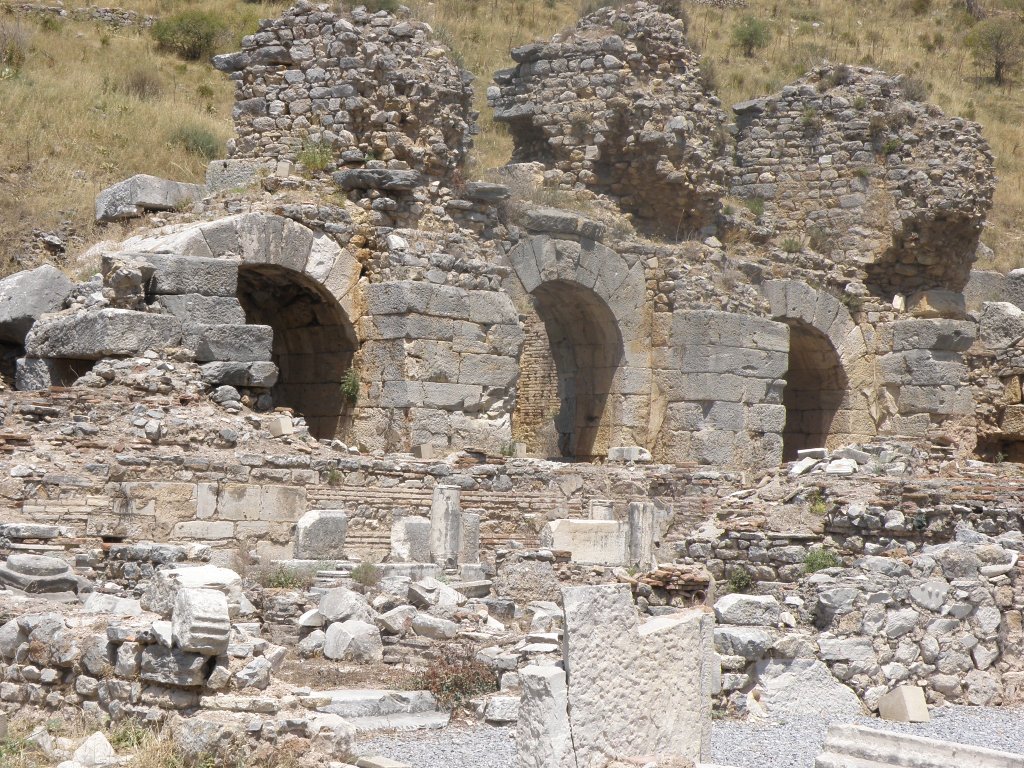
Baths at entry to third Ephesus

Every visitor to the city was required to enter the baths immediately upon arrival.  Entry to the city was forbidden until the bath had been attended to.  There were several reasons for this custom.  First, to see if the person had any weapons hidden in his clothing.  Second,  to prevent spread of disease.  They did not understand germs yet but they did understand the need for cleanliness.  Third, healers were in the baths to surreptitiously inspect the naked bodies of visitors for any sign of illness or disease. 

Thousands of intricate carvings at Ephesus


A major Temple of Artemis was built in Ephesus.  The guide explained several times about how the original religion from Anatolia region north to the Ephesus region was the worship of the mother goddess.  The main aspiration of mankind at that time was to procreate; more people meant greater chance of survival; so the worship of a fruitful woman resulted.  


The original mother goddess was replaced by Artemis, another form of mother goddess.  Artemis was replaced by Virgin Mary as the symbol of mother goddess to people of this region.  Frankly, I never considered the Virgin Mary to be a mother goddess, but why not.


Ephesus latrines


The main pedestrian road within the Ephesus drops 60 feet in a fairly short span.  So it is a steep road.  Several smaller roads lead off this main road; some to residential areas; some to the latrines; and many buildings which I don't remember.  


Ancient symbol for doctors and hospitals
Ancient symbol for pharmacy
Also along this road was the hospital or infirmary.  On the road in front of the hospital is a stone carved with the same symbol that is used to signify doctors and hospitals today.  Across the narrow road from the hospital is another carved stone with the same symbol used today for pharmacies.  Just shows how long these 2 symbols have been in use.

If a patient survived his stay at the hospital it was customary to leave a part of his body behind when he left.  Patients usually chose to cut off an ear and leave it as a symbol of gratitude.  And we think hospital bills are high today!


Gates of Hercules to keep chariots off the road

Near the hospital are 2 columns placed on either side of the road.  These 2 columns are called the Gate of Hercules, the carved images apparently representing Hercules.  These 2 columns effectively narrow the road so that chariots could not pass.  These columns insure that the roadway was used only by pedestrians.


Library of Celsus at Ephesus


Library of Celsus

More intricate carvings up high
The main pedestrian road ends at the Library of Celsus.  Then another road turns right through the Gate of Hadrian and leads to the large theater.   The library was very important.....there were only 2 libraries in the world at that time......in Alexandria Egypt and Ephesus.   It is unclear which was built first.   (I've read that there also was a library in China, but the guide did not mention that one.)  The Library of Celsus must have been a very impressive building during its heyday with all the statues and carvings.  Only the 3-story facade remains standing today and is well-weathered by time. 


Sign at the library
An unusual thing about the library is that it is constructed over large vaults where it is assumed some important dead people were buried.  The term for this construction escapes me at the moment, but it was unusual for the time.
A marble floor drainage tile near library


Largest theater of ancient world


Ephesus was also the location of the first known bank in the world.  The guide referred to it as the original Bank of Asia, supposedly because it was used to finance much trade into and from Asia.  


Drawing by Elisabeth of the advertising stones
Another 'first' for Ephesus was the the world's first known advertising was located here.  And what was advertised, you might ask.  Why, the world's oldest profession, of course.    Stones were embedded in the roadway down near the port entry.  On these stones would be engraved the image of a woman; her name; a heart that was shattered or broken; a circle representing coins or money; and a uniquely shaped footprint.  
Main road to port
The meaning was:  If your heart is broken and you have some money, choose a woman who appealed to you and follow the footprints to her home or brothel and her companionship could be purchased.  I'm sure those images really were accurately portrayed.  Truth in advertising.  Sure.


Elisabeth at Ephesus
Zachary at Ephesus
We were only at the Ephesus ruins for a few hours and that was plenty of time for us to see all we were interested in.   It was very hot; I was very glad to have brought a big umbrella.  The kids  quickly lost interest in old stone ruins.  We returned to the tour bus and they shuffled off everyone who had signed up for only the single day trip to Ephesus.  They would return to Marmaris on another bus.  People who had signed up for the 2-day trip shuffled off the Russian and Polish buses onto our bus to continue on to Pamukkale.  We arrived at the hotel in Pamukkale around 9 p.m. just before sunset.   
A very hot, sunny day at Ephesus