TRANSLATE, TRADUIRE, ÜBERSETZEN, TRADUCIR, 翻译

Saturday, November 7, 2015

Marrakesh--Days #3 and #4


One of many spice shops
By our third day in Marrakesh we felt fairly familiar with the plaza, souks and medina area.  Felt like we could find our way around with no problems.  Aziz, the manager of our riad, had warned us that if we hesitated or appeared lost or confused that someone would take charge and lead us supposedly to where we wanted to go.  Except that he more likely would lead us to a shopping area instead.  And then he might also demand a few dirham for his trouble.  If we bought anything, then he would be paid a commission by the vendors.  Ah...I think we know this trick.  Same thing happens in other places we have visited.  So Bill and I always thanked the men for their kind offers of assistance but kept on walking.


This shop wins.  He had the highest and most
pointed displays of all the spice shops.


This day we even shopped a tiny bit.  I wanted a set of dishes like the ones in our riad and we looked at several shops but never found exactly the design I wanted.  I don't know how I could have carried heavy dishes back on the train anyway, so maybe just as well that the pattern I wanted was not available in any of the shops we found.

The spice area of the souks was all it had been touted to be -- bins of vibrantly colored spices; arranged into impossibly pointed tops.  How do the vendors scoop off any of the spices when they make a sale?  Seems like those points would 'dissolve' down like falling loose sand when a scoop is inserted.  These displays were pretty.  And the smells were nice.  We did not buy any; I never buy spices in any open-air spice market.  


A more practical spice display, in my opinion
There is nothing protecting those spices from contamination from loose hairs or sneezes from passers-by.  And nothing to keep out insects.  Nope; not for me; does not matter how inexpensive the spices are or how good they smell.  I buy only spices and dried herbs which have been commercially prepared in nice sealed little containers.  I might be the only cruiser who prefers to pay a higher price.  The spice markets are an interesting experience but not for purchases for us.


Never figured out what kind of spices these are, but
there were many shops selling this type.


Waste now; want not.
Clothing, jewelry and flower vases
made from Pirelli tires.


Liked this little mirror in
our room.  


We also shopped a few stores looking for a small wall mirror similar to the one in our room in the riad, but did not find exactly what I wanted.  So...again...no purchases.


Saw a number of decorative items which would have been nice to have in our home someday but did not buy anything.  

Neither Bill nor I really enjoy shopping for anything.  I enjoy browsing but these Moroccan shop keepers do not understand that.  If they would have left me alone and let me look around at my own pace, there would have been a greater likelihood that I might actually purchase something.  But they kept after me: do you like this?; how much do you want to pay?; do you like this one better?; etc.  Takes only about 2 minutes of that and I am ready to flee the shop.  So...no purchases once again.


A small neighborhood open-air market


We took a different route through the souks this time and ended up in a small square where produce and odd items were being sold.  This was not like the more organized souks; this was a neighborhood small open-air market.  Cannot say much for the selection of goods or the quality of the produce available.  We did not hang around long.


Hand of Fatima door-knocker.
On a door near our riad.


We walked back through the souk following the route we knew best from the past 2 days. This time we noticed several displays of the metal hands.  Some of these metal hands are called Hamsa or khamsa and are palm-shaped amulets popular throughout the Middle East and North Africa, commonly used in jewelry and wall hangings.  
Hamsa are the flat type hand shapes at top left.
I liked the hand door-knockers.


The shops had many Hamsa but also had many of the little feminine hands which are used as door-knockers.  I wanted to buy one of these but Bill was not interested. 


Another Hand of Fatima
 These door-knocker hands are thought to symbolize the Hand of Fatima which protects the house from evil and also shows that the occupants of that house are followers of the Muslim faith. However, not all represent the Hand of Fatima.  There are different hand-shaped door-knockers, one male and one female, and these produce different sounds.  Visitors would use the knocker according to their gender.  If the male knocker were used, the woman of the home would know not to open the door because that would be inappropriate.  If the female knocker were used then the woman would know it was okay to open the door.  

Mint, mint, wonderful smelling mint
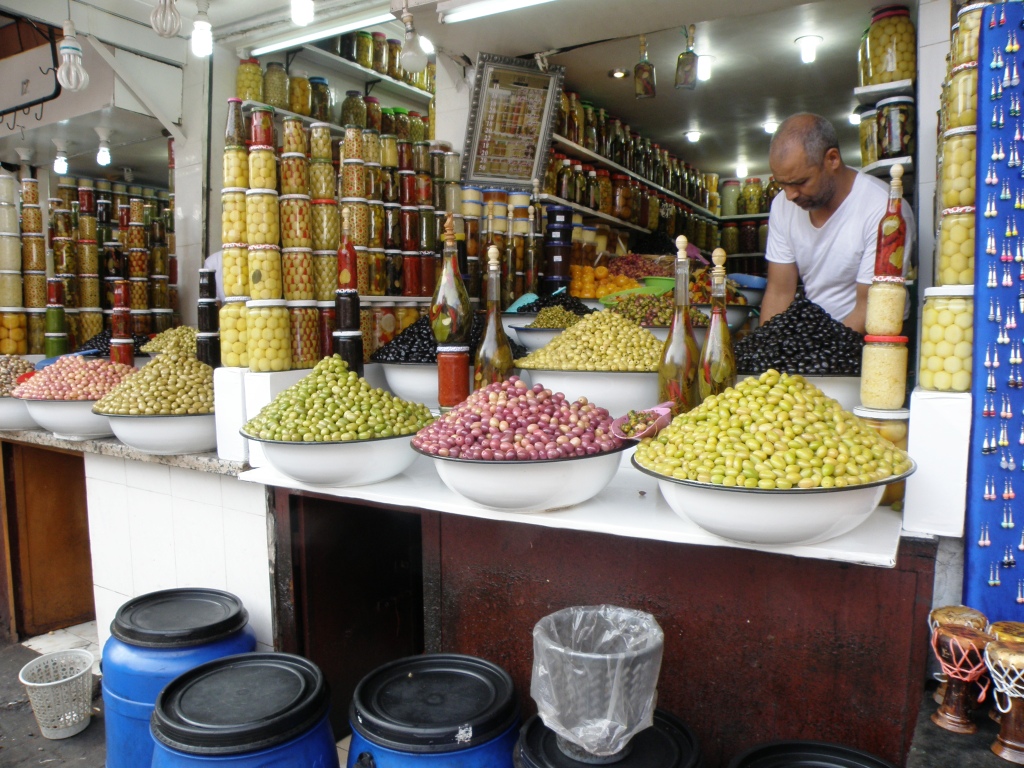
Olives, anyone?  All colors and types.
Instead of continuing straight for the final block or 2 and exiting into the Jemaa El-Fnaa plaza as we usually did, we took a hard left turn and checked out a different area of the souk where there were many displays of mint and olives and some foods which I did not recognize.  The mint smelled wonderful.  They use a great deal of mint here, both in cooking and for tea.  The favorite local drink is a hot mint tea and they drink it all day and night.  We liked this tea but did not need to buy any mint to haul back on a long train ride the following day.


Will miss all the olives from this part of the world.


These decorative plaster pieces are used by the
thousands as trim around ceilings; each hand made.


We wound back through the alleyways and found a small restaurant for lunch which had been recommended by Aziz.  This was the first lunch or dinner in Marrakesh when neither of us ate tajine.  All those tajines are very good but we were ready for simple familiar fare such as a sandwich and fresh-squeezed lemonade.


The mosque with the valuable gold
ball on top.


I was feeling a tad ill this day.  Voice getting lower and lower in tone and bronchial tubes felt irritated.  I think it was the ever-present dust in the air caused by all those motorcycles zipping so fast through the narrow alleyways.  And maybe contributed by those donkey carts too.  At any rate, whatever the cause, I was experiencing difficulty breathing and felt awful; so we did not do much this day.  After walking for about 4 hours and then the light lunch, we returned to the riad and I slept most of the afternoon while Bill read a book.  We did not even bother to go back out to eat dinner, just lazed in the room.  The next morning I felt much better so those hours of respite from the dust helped.


In center there are snakes all over the ground.  The guys in white
were snake charmers.  Pay to have your photo taken with the snakes.


Our train back to Rabat did not depart Marrakesh until mid-afternoon on day 4.  We had walked enough and seen enough of Marrakesh that we did not even leave the riad until time to head to the train station around noon.  Aziz called a cart guy to handle our luggage to the Jemaa el-Fnaa plaza where we easily found a taxi.  The taxi drove right through the plaza past the snake charmers and monkey handlers and other entertainers and vendors.  


This is a full drink.  Obviously, the machines are
calibrated to dispense the same liquid as for same
size drinks in the USA. Except here they use very
little ice.  At home you are getting mostly a cup of ice.


He dropped us off at the train station and we headed to McDonald's to wait.  Might as well enjoy Wi-Fi while waiting.  And that is when Bill discovered that he still had the riad keys in his pocket -- the keys to the riad front door and to the safe in our room.  He called the riad and Aziz came to the train station to collect the keys.  We felt bad about him having to make a trip to the station but he insisted that it was no problem because he needed to come to the station anyway to buy some tickets for other guests.  


Relaxing on comfortable train


The train trip back to Rabat took a different route than our trip down to Marrakesh, so we were treated to different scenic views on this return trip.  It felt great to get back 'home' on the boat.  


Thursday, November 5, 2015

Marrakesh, day 2 -- a long day with friends


These donkey carts run constantly all over the old
city of Marrakesh, delivering everything imaginable.
The drivers always sit sideways and most will not
allow photos to be taken of them.  This guy was nice.


After a hearty and healthy breakfast at the riad (included with the room) we walked to the Jemaa el Fnaa medina plaza to meet up with Dennis and Virginia (S/V Libertad).  They had gone to Casablanca for a couple of days and had arrived in Marrakesh a day prior to our arrival.  Today we would see the sights together; always more fun to share experiences with friends.  We had talked with our breakfast companions a bit too long and were late to meet Dennis and Virginia...again.  Bill and I must start wearing watches because this is too rude. 


This man is using a foot pedal to turn that long piece of
wood and manually moving a blade to carve it into
the decorative shape desired.  Not mass production.
Bill had sent Virginia a message telling her that we would arrive in the plaza in 10 minutes and they went walkabout; so while we were waiting for them to return to the appointed meeting place Bill and I took a few minutes to appreciate the nearby La Koutouta Mosque and minaret.  In Arabic the word minaret means beacon; it is the tower traditionally used by a muezzin to call the faithful to prayer 5 times each day.  Minarets are always connected with a mosque, sometimes by an elevated passageway.  The La Koutouta Mosque is the largest mosque in Marrakesh.  It also is known by several other names such as Jami' al-Kutubiyah, Kotoubia Mosque, Kutubiya Mosque, Kutubiyyin Mosque, and Mosque of the Booksellers.  The 5-storied minaret of this mosque is the highest building in all of Marrakesh because there is a law limiting buildings to 4 stories -- except for this mosque.  


Mosque of the Booksellers
with that valuable top golden ball


On top of the minaret there are 3 balls of varying sizes; this is typical of many minarets.  The largest ball at the bottom and smaller ball in the middle are made of brass.  The smallest upper ball supposedly is made of over 2 pounds of pure gold!  Legend is that one of the wives of an ancient Moroccan king consumed food during daytime in the holy month of Ramadan.  To avoid public punishment of the offending wife and thereby embarrassing the king because he did not control his wife, the iman (religious leader) decreed to the king that his wife would have her violation of the faith absolved in exchange for all her gold jewelry. That jewelry was made into the top ball on the minaret of this mosque.  At today's value of gold, that small ball is worth a little over $32,325.


This photo was taken in 1885.  I am very
impressed by its high quality.


Soon Dennis and Virginia returned and we set off through the souks and bazaars in search of the Museum of Photography, the proper name of which is the Maison de la Photographie de Marrakech.  This is a small museum of old photographs.  I was impressed with the high quality of these very old photographs, the oldest of which dated back to 1870.  Most were taken around 1885.  Many of these photos could have been taken today; the scenery and customary attire has not changed that much in all these years.  There were copies of many of the photographs for sale and I would have enjoyed having a couple for our home eventually, but did not buy any because did not want to deal with carrying them all day and then on the train back to Rabat.


There was a photo of a very old nautical chart which caught the eyes of all 4 of us sailors.  We asked a museum staff member some questions about it and he acted like we were the first people to ask about this photo. Our questions centered on the fact that the degrees of both latitude and longitude were incorrect, not just slightly in error but completely off.  The chart was drawn sideways rather than north being up, but even when turned either way those numbers were off.  Made us 4 sailors wonder how the hydrographer could have arrived at these numbers.  The answer provided to us was that this was a very old Portuguese chart, made before Greenwich, England became the demarcation line of longitude 0 separating western hemisphere from eastern hemisphere.  At the time this chart was drawn, that eastern/western hemisphere demarcation varied by the person drawing the chart as there was no firmly established starting point when going east-west, although everyone agreed on latitudes.

Dennis entering the very unassuming
entrance to the carpet museum.


Next Dennis led us through the winding alleyways to the Musee Boucharouite (the Berber carpet museum).  This was the highlight of our day!  Thanks to Dennis for researching and learning about this place because we otherwise would have missed it.  And, as luck would have it, the owner of the museum, Patrick, was present on this particular day and granted us the benefit of his time and knowledge.  Patrick gave us a most informative lesson about the Berber carpets and the meanings of different colors and patterns.  
Section of the courtyard in the carpet museum


Rooftop of the carpet museum building looking out
The women in the mountain villages who weave these carpets are artists.  There are several types of Berber carpets; and I think I liked the rag rug type the best.  The women make the carpets to tell stories of their lives using traditional colors and symbols for given meanings.  The carpets were never meant to be seen by anyone outside their families. During winters the Berber people are confined to the interior of their homes for the most part and the women used this solitary time to express their artistic talents via weaving rugs.


Looking down inside courtyard of carpet museum.
That is Patrick on the second floor walkway.


Patrick was a wonderful guide through his museum.  We were so fortunate to have happened upon this museum on a day when Patrick was present and not too busy.  The experience would have been so much less had we not chanced to meet Patrick.  I tried to take notes as Patrick explained the meaning of many of the carpets hanging on the walls...what the women who wove these wanted to express.   

Here are few of the notes:


  • When a 'frame' is woven into the pattern of a rug, that represents a home.  And always is brown in color.
  • A diamond shape represents a bed.
  • Red is the color for a female.
  • Yellow is the color for a male.
  • Green represents the desire to have a child; happiness.
  • Brown represents children (when not a frame shape).
  • Brown and green intermixed represents the female pregnancy; the joy of creating life.
  • Orange means joy.
  • Black means a problem in her life or an interruption or pain in her life.
  • White represents death.

Here is a link to the website for Patrick's museum:

http://www.lacollectionberbere.com/en   Once linked on that website, click on Collection and read the text which scrolls down left side of screen.


Here are a few photos of the carpets on display.  These are only a few; there were too many to include them all here.  I would dearly have loved to purchase some of these carpets.  We saw none outside this museum that were of particular quality but I would have loved a few of these for our future home.  But I did not even ask prices as figured these would be well outside any reasonable price for use in our little house in Galveston someday.
The brown frame is the home; red is 2 women; yellow is 1 man;
blue is the joy of this family (remember they can have multiple wives).
the spot of green and blue indicates joy when each woman delivered
a child.  The children are represented by the 2 brown lines to either side.
A happy home with 2 children, 2 mothers and 1 father.


Triangles represent beds.  
This rug tells a story about a woman who tried many
times to get pregnant.  Finally, through great pain and danger, because this was in the mountains with no doctors, she had twins.

One of my favorites


Can you decipher the story the weaver
wished to tell?


I think this one tells about a large family.


A lot of pain and a lot of joy in this one.
Triangles are beds.  Story?


Patrick did not tell us what circles represent.
This carpet museum probably was the highlight of our visit to Marrakesh in my opinion.  
I enjoyed it very much.

Judy, Virginia and Dennis at lunch.  Beautiful
tiles covered walls and vibrantly colored fabrics
completed the decorating touches.  Oh yeah,
this was definitely Marrakesh!

After pulling ourselves away from the carpet museum Dennis led us back through the alleyways to a restaurant next to the Museum of Photography which we had visited earlier this day.  Other friends who had visited Marrakesh the previous week had told us that this restaurant was the best they had found in the old city.  We each enjoyed a tajine of one kind or another, and it was good; but I thought the turkey tajine with the tiny grapes which had been served in our riad the previous evening had been better than the chicken tajine with preserved lemons at this restaurant.  Different strokes for different folks.


A somewhat disturbing display
of children's clothing for sale.
Hanging kids.
Coloring clay vases using watered
charcoal paste.  Don't get it wet
in your living room or your floor
will be stained black.


Dennis on left.  Those motorcycles zoomed throughout
the crowded narrow streets, zipping around pedestrians.
The guys on the cycle on the left behind Dennis yelled
at me that no photos were allowed.  Yeah; right.


After a leisurely and relaxing lunch we pushed onward.  Back through the souks.  Across the Jemaa el Fnaa plaza.  Down some more alleyways which were more familiar to us because this was the general direction of our riad.  Instead of turning left towards our riad, we continued ever onward to the next stop on Dennis' itinerary -- the Bahia Palace.


Bill in one of the doorways inside
the Bahia Palace


The Bahia Palace was constructed in the late 1800s and was supposed to be the nicest palace anywhere of its era.  There are some 160 rooms in the palace (we did not walk through all of them) and over 2 acres of gardens.  The ceilings and walls already have been restored in many of the rooms, and restoration work continues in many other rooms.


Upper wall showing decorative plaster work and the
very colorful ceiling of one of the restored rooms in
the Bahia Palace


Gorgeous ceilings, plaster and tile work.


Per Wikipedia:  "Set up at the end of 19th century by Si Moussa, grand vizier of the sultan, for his personal use, this palace would bear the name of one of his wives. Here, the harem, which includes a vast court decorated with a central basin and surrounded by rooms intended for the concubines. As the black slave Abu Ahmed rose to power and wealth towards the end of the 19th century, he had the Bahia palace built by bringing in craftsmen from Fez."  (I am disappointed in Wikipedia.  That center sentence is not a sentence and is unclear.)

YouTube video about Bahia Palace

Bill and Virginia having a laugh
while waiting for deserts.
Virginia, Bill and Dennis in a courtyard of the
Bahia Palace

Right on the main plaza.  Perfect for after-dinner
drinks and deserts.  And..they had belly dancers!
After less than an hour walking through this palace we declared that enough was enough. This was a vacation; not a forced march; and it was time for a rest.  We backtracked to the turn-off alleyway toward our riad and stopped for a beverage.  We all returned to our respective hotels for a needed hour or so of rest; then met again in the Jemaa el-Fnaa plaza before walking to a restaurant for dinner.  This time it was at an upstairs terrace restaurant a few blocks off the main plaza which had been recommended by Aziz at our riad.  This time I opted for a vegetarian tajine along with a plate of assorted grilled vegetables.  All quite good.
These Moroccan tajine meals are
delicious.  This veggie tajine was
topped with a date marmalade.
Perfectly complemented the dish.


One of the belly dancers...obviously.
After dinner with the view, we returned across the main plaza to the Marrakesh Restaurant where Dennis had made a reservation.  We enjoyed deserts and drinks with entertainment provided by 2 belly dancers.  This was an enjoyable way to end a fun-filled day.  Dennis and Virginia would return to Rabat the following day.  Bill and I would spend another day and night in Marrakesh.

The only place on our wishlist that we missed seeing this day was the Mellah section of the old city.  The Mellah section is where Jews live.  We were told that almost every city of any size in Morocco has a Jewish area and this section of town is always called the Mellah.  Yes, the Jews and the Muslims have lived together here for about 600 years apparently without serious problems.  Supposedly there also are Christians in Marrakesh but we did not learn about a special section of the city where the Christians might live together.  


Another of the belly dancers.  Can you imagine a
restaurant at home having open flame candles out in
public walkway areas.  Figured we could jump out the
window in case of fire since we were only up 1 floor.
The first Jews migrated to this area after the destruction of the First Temple in Jerusalem and they settled among the Berbers.  After the Christians regained control in Spain in the late 1400s, the Jews and Muslims living in Spain were given 3 options:  convert to Christianity (Roman Catholicism); leave Spain; or die.  Neither the Jews nor the Muslims were willing to convert to Christianity.  Over 300,000 Jews chose to migrate to Morocco and lived in harmony with the Muslims, although the Jews were not granted full citizenship rights as were the Muslims.  Shortly thereafter, even more Jews arrived in Morocco from Portugal as well.  This second immigration wave deeply modified the Moroccan Jewry.  This second wave largely embraced the Andalusian Sephardic liturgy, thus making the Moroccan Jews switch to a mostly Sephardic identity.

Today, there are only about 3,000 Jews living in Marrakesh; most having migrated to Israel. Thousands of Jews immigrated to Israel from Morocco during 1954-55 when Morocco was controlled by the French.  Upon the return of King Mohammed V and the consequent declaration of Morocco as an independent state in 1956, the Jews in Morocco received full rights of citizenship, same as the Muslims and Christians.  Regardless of now having full rights of citizenship, many thousands of Jews immigrated to Israel following the 6-Day War with Egypt in 1967.  These Sephardic Jews are considered by the other Jewish sects in Israel to be outsiders or not 'true' Jews.  It is not just Islam that has factions within the religion.  

Anyway, regret that we did not make it to see the Mellah section of Marrakesh.