TRANSLATE, TRADUIRE, ÜBERSETZEN, TRADUCIR, 翻译

Tuesday, December 8, 2015

Lots of Amels in the Canary Islands!

Marina Lanzarote was so nice and luxurious that we stayed there a full month.  This was a nice island and a great place to relax.  Although had we known how inexpensive were the marinas in Fuerteventura and Gran Canaria maybe we would have left a little sooner.  We were pleasantly surprised to find that the rate at Gran Tarajal Marina on Fuerteventura was only 20 euro per night for 16-meter BeBe.  And 3 nights at the Muelle Deportivo de Las Palmas on Gran Canaria cost only 48 euro!!  No wonder that marina stays so full!

Before departing Marina Lanzarote I walked the docks one day and took photos of all the Amels.  There were more Amels berthed there at one time than we have seen anywhere in the world except at the Amel service center in the Caribbean.  


Kandiba, an Amel 55


Docked next to BeBe was a beautiful USA flagged Amel 55 named Kandiba, owned by Hassan and Zehrya from Turkey.  Their lovely niece Fatma has joined them as crew and will cross the Atlantic with them next month. Fatma holds a degree in fashion design and is taking a year off to learn sailing before pursuing a career.  This is a great opportunity for her to travel; I wish her all good things in the coming years.


Seraphine, Super Maramu


Across the dock from BeBe was Seraphine, a Super Maramu hailing from Weisbaden, owned by Hajo and Julia.  We last met up with them in Fethiye, Turkey.  They had thought to cross to the Caribbean this season but have changed their minds and will return to the Med.  They have years of relaxed sailing to enjoy in the Med. 
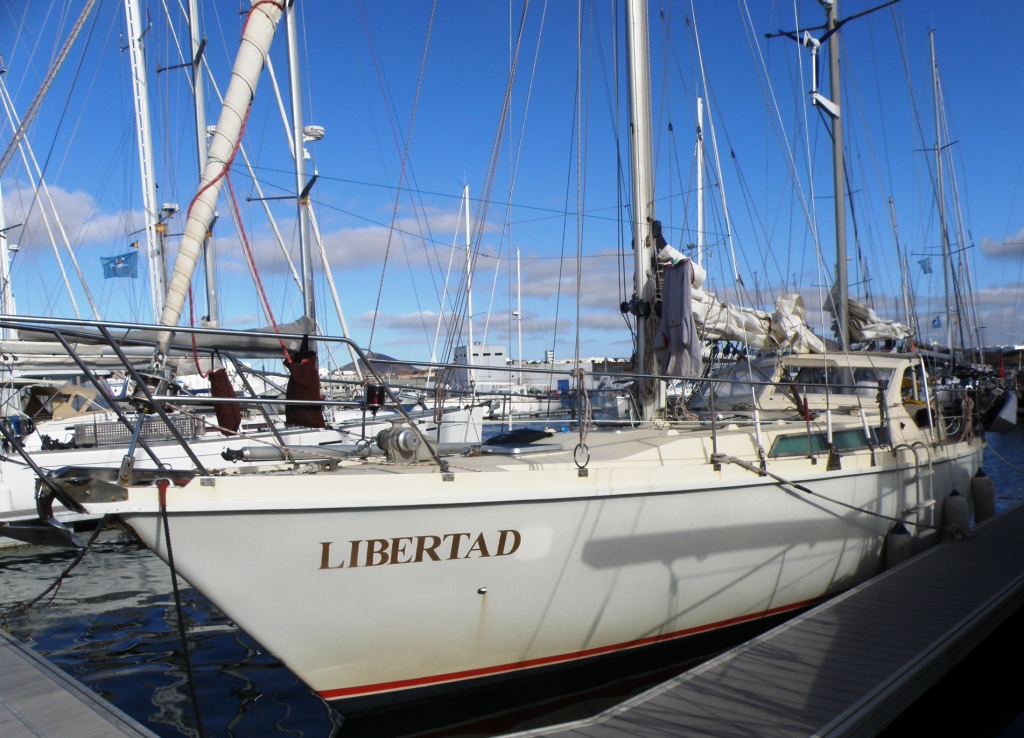


Libertad, a Maramu
Libertad, the oldest Amel lady present
Next to Seraphine was USA flagged Libertad, a 33-year-old Maramu owned by Dennis and Virginia from California.  Libertad was the oldest Amel there.  Libertad will be crossing the Atlantic in company with the Atlantic Odyssey II next month.


Rhumb Runner, a Super Maramu 2000


Near Libertad was docked another Super Maramu 2000 named Rhumb Runner hailing from Plymouth, Great Britain, owned by Chris.  Rhumb Runner is crossing the Atlantic right now but not participating in any of the crossing rallies.  


Rainbow, an Amel 55


Down the dock on the same side as BeBe were 2 more Amels: another Amel 55 named Rainbow, hailing from Hamburg.  This boat was in and out so quickly that we never had an opportunity to speak with the owners.  


Now or Ever (or Now or Never), an Amel 54


And near Rainbow was an Amel 54 named Now or Ever, another USA flagged vessel, owned by an Italian.  Gian will be returning to his boat next month and sailing her to Antigua where he has purchased a home.  Gian has stated that the name of his boat really is Now or Never but the company which made the vessel name apparently did not comprehend the word 'never' and produced the incorrect name.  First time I have heard of that happening. An Italian explaining to a Frenchman what he wanted in English.  Yeah, easy to make a mistake.


SM Kerpepere II, a Super Maramu


On another dock was another Super Maramu.  This vessel was named SM Kerpepere II, French flagged and hailing from Lo (wherever that is, never heard of it).  I did not speak with these owners as they always seemed busy with one thing or another on their boat.


Tzigane, sloop rigged Santorin
And, finally, several docks away was a French flagged Santorin named Tzigane.  The owners were away and we never met them.  This is a rare boat.  Tzigane is a sloop-rigged Santorin.  The Santorin model was produced from 1989 until 1997.  A total of 145 were built during those years and most of those boats were ketch-rigged.  There was an option to have it sloop-rigged but only a few were built that way.  Tzigane appeared to be in excellent condition.  


Kali Mera, Santorin ketch
Photo taken in Tenerife

We missed meeting up in Marina Lanzarote with Austrian friends Herbert and Teneta on their Santorin Kali Mera.  They had departed Rabat before us and were well ahead of us by this point.  We did later meet up with Herbert at the Santa Cruz marina on the island of Tenerife and enjoyed dinner with him right before he departed to Cape Verdes.  


Kali Mera, Santorin ketch
Photo taken in Tenerife

Kali Mera is the typical Amel ketch-rig and is in excellent condition.  She looks like the baby sister of BeBe.  The Santorin is 46-ft and the Super Maramu 2000 is ~53-ft and the 2 boats look identical, including electrical furling.  Although I think we have 2 more electric winches than was standard on the Santorin model.  The main saloon of the Santorin is a more comfortable living space than the saloon in a Super Maramu, but without all the storage space in a SM. If we did not own a SM2 then I would want a Santorin model.  


Running the wire for the hailer speaker.
He looks so comfortable perched way
up there.


Messenger line.  There were 2 of these lines
installed by Amel just in case an owner might
want to add something to the mast later.
Note those rubber spacers.  These were
tied about every 3 ft and kept the 2 lines
from twisting and entangling.


During the final days before departure of the Atlantic Odyysey I rally we took advantage of the communications expert that Cornell Sailing had flown in from Italy to make a presentation at the informative seminars.  He checked our SSB and VHF and found a couple of ways to tweak the SSB to optimize performance.  We have had no problems with the SSB all these years, but he knew a few tricks to produce even better reception and transmission.  What an invaluable service!  And......free!!  

Watching the wire being pulled through the mast
Bill decided to hire this company to run the wire through the mizzen mast so that we could install a hailer speaker, primary reason is to use this speaker as a fog horn via a feature of our VHF radio.  The messenger lines were already inside the mast, courtesy of Amel; and Bill could have done this work himself.  But since they had worked on our radios for free we felt like we should hire them for this simple job.  They ought to get some business out of their participation in the seminars and doing all those free radio checks for all the rally boats.


Bill, Zeyhra, Farma and Hassan;
dinner aboard BeBe
Hassan, Zeyhra and Fatma came for dinner aboard BeBe a few nights before we left Marina Lanzarote.  Zeyhra brought 2 Turkish vegetarian meze as appetizers and a traditional Turkish desert made from pumpkin.  All 3 dishes were simply delicious!  I need to take cooking lessons from Zehrya!  And Hassan gifted us with a bottle of red wine from the Anatolia region of Turkey that was divine; the best wine we have enjoyed in a long time. Wish we had discovered this particular wine when we were still in Turkey and could have stocked up.  The following morning Kandiba departed Lanzarote.  We would catch up with them again later.

Finally it was time for us to depart Lanzarote on 2 December.  We enjoyed a great 56 NM sail to Gran Tarajal Marina on the island of Fuerteventura where we stayed only overnight. 

At 04:00 the following morning we departed for Las Palmas de Gran Canaria.  This was 81 NM to Las Palmas and we wanted to arrive during daylight, so even though there was sufficient wind to sail we ended up motor-sailing in order to make high enough speed to arrive before the marina office closed.

NOTE:  Because of a cyber-stalker who is behaving very childishly, we have been forced to monitor comments left by our readers.  Disappointing to be forced into moderating comments after 10 years of blogging about our sailing and travel adventures.  Because a grown man insists on behaving like an 8-year-old child.  So, apologies to all of you who know how to act like adults.

Tuesday, December 1, 2015

Day tour of Lanzarote

 
One of several courtyards around exterior
of the palm grove home


Leaving the small town of Teguise we headed farther north in search of a home once owned by César Manrique.  César Manrique was a famous artist and architect from Lanzarote.  He was an eco-activist long before that term became popular.  His passion for the Canary Islands and for Lanzarote in particular made him loved by the local inhabitants.  He died in a car crash in 1992.  His sculptures and other art work are found all over this island.


A better view of rear patio and swimming pool


The roof lines intrigued us.  Everything was flat except
the vaulted roofs over the bathrooms.


Bill and Virginia.  Those palms
were huge!


An 'interest area' of the pool.
Artsy things everywhere.

Dennis has no problems driving right to Manrique's old home situated in a large palm grove near the town of Haria. This home is really something!  I could move in tomorrow and be quite happy with everything in the home remaining exactly as it is.  It is light and bright and airy.  Yet has dark and soothing spaces too.  It is obvious that this home belonged to an architect even more than the obvious displays of his artistic works.  No photography is allowed inside the home.


Behind the pink flowers is the master bath


One of the features in this home is that the bathrooms provide an open view to the outside, utilizing glass walls and a few glass panels angled as part of the ceilings and roof.  Yet exterior partial walls or high solid fences still provide privacy.  Some people might not like this concept but Bill and I do.  We once owned a home with something similar for the master bath.


His art studio.  Does not appear
clearly, but those steps went down
about 8 ft from ground level.

Adjacent to the spacious home stands Manrique's art studio.  Supposedly it is left exactly as it was when he died.  We watched a short video showing him working on a painting.  His technique employed for this particular painting was interesting as he used his entire body. The very large canvas was laid upon the floor and he walked around it applying paints.  At times he was stretched well over the canvas in a prone position while painting.  As I said, using his entire body to paint.  Dennis did not care for his work but I liked it.  


As we were leaving the site we noticed a brightly colored car displayed on a platform. Manrique had been commissioned to paint the Seat Ibiza model car on display at the Barcelona International Motor Show in 1987.  A number of these cars were given to celebrities.  This particular car belonged to César Manrique.  Bill checked the odometer and this car has been driven only about 16,500 kilometers (10,250 miles).


Looking at La Graciosa (national park island) from
the top of Mirador del Rio.  Look very closely and
see a sailboat down there.


Dennis drove the very narrow streets of Haria and headed farther northwest.  And to much higher elevation!  Our next destination was the Mirador del Rio.  This structure was built in 1973 and overlooks the neighboring small island of La Graciosa, which is a national park.   The views are spectacular and we were treated to the perfect clear day during this visit.  A sailboat was working its way west through the channel while we watched from high above. This view was worth the drive up there on that very, very narrow road. 


Maybe a slightly better view of that sailboat.


There was a snack cafe/coffee shop at the lookout point and we were all hungry by this time, but none of us wanted to settle for coffee shop type food.  We had seen a sidewalk cafe back in the town of Haria and we all voted to return there for lunch.  While there we ran into some folks who are participating in the Atlantic Odyssey I rally.  They were getting in a last-minute tour of the island before their departure in another day or 2.  We kept criss-crossing with them as we all toured the island.  We all were seeing the same things but in different order.

Looking westward down the northern side of Lanzarote


Another Manrique sculpture at
lookout point


Terraced mountainsides all around.
Making the most of whatever rain.
A surprise on the mountaintop.  Have not seen these
in a long time.  These are radomes -- protect large
radars from weather.  Look like air-defense radomes
that we used to have several decades ago.


Take a close look at these.
Semi-circular stone walls are
built around plants (mostly grapes)
to utilize the most of what little
moisture is available.
Ingenious.


A very large philodendron at the entrance/exit of the
cave.  We exited through that hole on the bottom right.
It was much large than appears in this photo; it was
down at least 25 feet from the philodendron.


Next we drove back southeast to the seaside main road and turned north for a few miles. Destination this time was the Cueva de los Verdes (the Green Caves)-- a very long cave which really is a lava tube.  But this lava tube was quite different from the lava tube we visited in the Galapagos Islands in 2008. The one in the Galapagos had a smooth interior; it looked like someone had made an enormous smooth black pipe and we were walking inside that pipe. This lava tube looked nothing like that.  The walls and ceiling and most areas of the floor were rough stones and rocks.  With lots of rock formations all through the center areas of the long cave.


Following Virginia inside the cave


Still following Virginia through the very long cave
This cave is about 5 miles long and runs from the cone of the La Corona Volcano down to the sea. This is the longest volcanic cave gallery in the world.  A lava tube is formed by the cooling and solidification of the superficial lava flow in contact with air while the liquid magma underneath continues flowing.  Particularly awesome in this cave are the color range adorning the vaults and walls of the cave.  The red colors are due to the oxidation of bassalts and iron content.  The different ochre shades come from the reflections of light on salt efflorescence caused by water seepage from the surface over millenia.  As little rainfall as this island gets, it would take hundreds of years to cause this effect.  The volcanic eruption and resulting lava flow which created this lava tube occurred over 3,000 years ago.

Seating left of stage
Seating to right of stage
There are 2 areas inside this long cave where cultural events are sometimes held.  One place in particular has a small stage and a few hundred chairs in place, along with amplifiers and speakers.  The guide informed us that this spot is excellent for chamber music performances as the acoustics are perfect.  There was a chant by monks playing on the sound system while we rested in the chairs before the walk back out of the cave and it did sound very pleasing.

The stage itself. 
Only about 2 kilometers of the cave/lava tube is open for visitors.  And that was enough, thank you. It was nice and the stories of how over 2,000 local people sought refuge inside this cave during the 17th century lent more interest to it.  Pirates and slave hunters attacked the island and the local inhabitants went into this long cave and stayed there for several months.  It was impossible for me to imagine over 2,000 people living down there for that long.  There is electrical lighting installed now; I cannot imagine being down there for months without that lighting.  And will such limited water availability for so many people. Guess you do what you must do.  Heartier folks back then.

A Manrique sculpture. Each piece twirls with the wind


After this cave we had wanted to see a couple of other sites but were running out of daylight.  There was time to see only 1 more place.  And only if we hurried.  We took a quick vote and opted to go see the first home built on Lanzarote by César Manrique and where he lived before moving out to his other home in the palm grove near Haria.  This first home was built utilizing what are called lava bubbles.  


Another Manrique sculpture.  Called Windmill.
It also twirls with the wind.


A lava bubble is similar to a lava tube, except that the bubbles are more or less round rather than a long tunnel.  This home now houses many art works of César Manrique.  It was kind of like a maze with hallways cut through the stone connecting many lava bubbles.  Each bubble was filled with sofas or built-in seating arrangements.  I assume those hallways were man-made because cannot imagine how the lava could have created all those bubble spaces and connected them with long narrow hallways.  Did not appear to be natural hallway formations.  


One of several hallways connecting
the lava bubbles

The first lava bubble room.  All white built-in seating
Note the live palm tree.


Outdoor seating area in shade of overhanging rock.
Next to the outdoor fireplace and grill.


Another lava bubble room


Much smaller pool than at his home in the palm grove.
This home certainly was different.  I could see an artist living here.  But the home in the palm grove was much, much nicer.

It was past sunset when we exited the home.  And only a short drive back to Arrecife and back to Marina Lanzarote.  Thanks to Dennis and Virginia for inviting us to accompany them on this little island tour.