TRANSLATE, TRADUIRE, ÜBERSETZEN, TRADUCIR, 翻译

Sunday, February 7, 2016

Crossing the Atlantic with 1 Sail and 20 Bimbos …and… OUR CIRCLE IS COMPLETE!

 2 February 2016


Rally boats departing Tenerife, BeBe on right.
All the ‘last minute’ things prepping BeBe for the Atlantic crossing were completed a couple of weeks  before the scheduled rally departure date.  Bill and our new crew member, Andrew, dropped the sails to remove a meter or so of the halyards to make sure there was no chafe.  They replaced the small lines attaching the heads of the sails to the halyards; nothing was wrong with the old lines but best to have new lines in place just before a long ocean crossing.  BeBe was as ready as she would ever be.  All that remained was for me to hit the supermarket for as many loaves of Bimbo as possible and to buy massive quantities of fresh produce at the very last minute in order to have the freshest possible at moment of departure. 

We did set the dual headsails but 90% of
the passage was under poled genoa only.


We have no idea what is in Bimbo breads (and do not want to know).  That stuff lasts for what seems like forever!  By the time I got to the supermarket the day before departure the supermarket shelves were nearly empty of Bimbo breads.  Seems like everyone knows this particular brand lasts for weeks (or months) and it was the brand purchased by all the sailors.  We ended up with 12 loaves of breads, plus 2 packages of hamburger buns and 4 packages of hot dog buns and 2 par-baked baguettes – all Bimbo brand and all with expiration dates well past our anticipated date of arrival.  About half-way through the crossing, Bill commented that someday he should write a book and entitle it, “How to Cross the Atlantic with 1 Sail and 20 Bimbos.”  Hence, the title of this blog posting.


Bill’s comment was based on the fact that the only sail we used most of the crossing was the genoa – poled out to port 90% of the time.  Take note that it is mandatory to have at least one spinnaker pole to cross this ocean unless you plan to gybe back and forth.  The wind was consistently from 180 degrees (directly astern) up to 150 degrees off starboard stern.  That wind angle requires a pole. 

The Atlantic Odyssey II rally departed Santa Cruz, Tenerife at noon UTC on Saturday, 9 January.  Jimmy Cornell had advised us at the skippers’ meeting the previous afternoon that he did not recommend taking either the rhumb line route which traditionally is the route used in January or the slightly longer ‘cautionary’ route to 20N 30W before turning westward.  Both of those routes normally used in January were not advisable this year because of a large tropical LOW which at the time of our rally departure was situated WSW of the Canary Islands.  He stressed that for liability reasons he was unable to provide any specific advice as to routing but he strongly suggested that we all head straight towards Mindelo, Cape Verde, before turning westward once reading the trade winds – the traditional ‘safe’ route.  Most skippers took Jimmy’s advice, I think.  We know of only 2 boats that opted to try the ‘cautionary’ route to 20N 30W – Jacqueline and ViVa – and both managed to avoid the increasing storm.  Lucky them!  ViVa later diverted farther southward while Jacqueline continued toward 20N 30W.  Jacqueline shaved at least 200 nautical miles off the total passage by going this route.  We took the longer route totaling 2960 NM.

Because that tropical LOW developed into Tropical Storm Alex and then increased to Hurricane Alex!   How about that!!  We had waited to cross in January rather than November because traditionally January is the better month for weather.  Jimmy Cornell was the founder of the ARC which has departed from the Canary Islands annually in mid-November for about 40 years.  He said that he never wanted the ARC to depart that early in the year; he has always felt that November is too early to cross the Atlantic.  It is possible for a late-season hurricane to develop in November.  Plus, the trade winds are rarely established in November; the trades usually do not fill in until after Christmas.  These reasons traditionally make January the better weather time for crossing.  But the ARC departs in November because so many people want to be in the Caribbean before Christmas.  However, due to our changing climate, this particular year a hurricane developed in January!  There have been recorded hurricanes (or, at least one) in January.  But this phenomenon is very, very rare. 

That LOW just west of BeBe is the one that turned
into Hurricane Alex.
Those 2 boats were very lucky Alex stopped tracking ESE and then began to move northward toward the Azores.   I had checked windyty.com before we departed Tenerife and saw that the LOW was predicted to follow the exact path that Alex did track; but the hurricane could just as easily have continued another 100NM to ESE before making that stop and change of direction.  Both boats arrived safely and never encountered any heavy weather, so no harm done; but it was rather ballsy in our opinions to chance possible intersection with a growing storm.  We instead opted to head straight toward Mindelo, Cape Verde.  After being sucked up into that storm in the Bay of Bengal in early 2011 and spending 5 days circling the eye, we were taking absolutely no chances of going anywhere near the tropical LOW, much less near a hurricane.

A mid-Atlantic full rainbow, left side.
We were plagued with frequent inability to obtain weather reports and emails during this crossing.  Even using both Winlink and Sailmail there were many days when we could connect with neither.  Bill pulled only one weatherfax file and that was for Tuesday, 12 January.  It verified that the LOW was still following the prediction we had seen on 9 January on windyty.com.  So we felt safely east of the storm.  Still…we were shocked when on 15 January we received a weather report from rally control stating that the LOW was now the first hurricane of 2016 and was named Alex.  In January!!!   Thankfully, Hurricane Alex was headed away from us at this time.

A mid-Atlantic full rainbow, right side.


We continued south toward Mindelo, postponing the decision whether to stop or not until we got there.  We did not need fuel and had no equipment failures or medical issues, so why stop if the trade winds had filled in by the time we got down there?  The passage between Tenerife and Cape Verdes seemed to take forever.  It was a very slow passage and I think we averaged only about 135NM daily.  Our slowest times…ever.


One day out of Mindelo we experienced wind squalls for the first time.  These were strange.  They were light gray and did not show up on radar at all.  These contained no rain but were packed with strong winds.  We could see these during daylight but had no idea where they were after dark since these were undetectable by radar.  We were lucky and had no bad experiences with these wind squalls, but 2 other boats were caught in a few.  Amakora got hit by several, the highest winds being gusts of 69 knots!  Kandiba saw 44 knots.  We never saw anything over 30 knots gusts and were very glad to leave those behind us.

Cape Verde westernmost island, 10 miles distant.


We sailed within 10 NM north of Mindelo in the Cape Verdes and found the westerly trade winds.   The 3 of us immediately decided to keep on trucking.  We were into the rhythm of the passage watches and saw no reason to stop.  Bill joked that we should stop for African pizza and beer but I said instead we could have Caribbean pizza and beer in a couple of weeks. 


Seaweed dinner.  Better catch a fish on the next cast!


As we finally changed course headed west, Andrew started trolling our first fishing line.  There was so much seaweed floating in large clumps which fouled the fishing line and lure that this effort was soon abandoned.  Others reported on the VHF radio that they were catching fish but we did not have the right kind of gear to weight the lures down low enough in the water to avoid all that floating seaweed.

Andrew with the only mahi-mahi caught across the
entire ocean.  Big enough for 1 meal for 3 people.

A few days later Andrew caught a small mahi-mahi.  It was the perfect size for dinner for the 3 of us.  The next day he caught a much larger mahi-mahi but it managed to spit the lure just as it came up to the boat and Bill was unable to reach it with the gaff in time.  That one would have fed all 3 of us both lunch and dinner for at least 3 days!  What a shame he got away!  The next day the same lure caught a small tuna but it also managed to spit the lure before being gaffed.  We were really liking this particular lure!  It was one that was designed to dive 15 feet and it avoided most of the seaweed and the fish seemed to like it.  

Put out the line; reel it in because fouled with seaweed.
That got old quickly.


Unfortunately, soon after something really large took that lure.  Awwwhhh….it was our favorite!  We had no more lures that would dive deep enough to avoid the seaweed and we had no weights to keep the line deep enough down, so that was the end of our fishing.  We are going to search for another of those type lures in Martinique; I saved the package and want to find on identical one.

A synopsis of our Atlantic crossing is short and simple:  way too much motion but needed only 1 sail and those 20 Bimbos.

We ate hearty meals on passage.  Meatloaf, mashed
potatoes with demi-glace gravy and steamed
broccoli was a typical meal.
We experienced no squalls; in fact, no rain whatsoever.  The nearest rain shower across the entire ocean tracked 7 NM north of us. And how we would have enjoyed having that fresh water rinse to wash off some of the heavy slimy salt which covered the entire boat!
The typical daily weather forecast from rally control included statements such as:
“24 hour forecast weakening cold front in a line south of XX and west of XX.  NE to E winds 20 to 25 KT.  Seas 9 to 11 ft in mixed N-NE and SE swell.  48 hour forecast E of a line from XX to XX winds 20 KT or less.  Seas 10 ft. in mixed N and S swell.”


If one eats those hearty meals and wants to maintain
physique, exercise is required.  100 push-ups.
Perfect form.


Don't know how he was able to maintain perfect
form push-ups on that rolling deck, but he did.


We still do not understand how swell can come from both north and south at the same time, but it does.  When converging swell would occur at our stern, BeBe would slide down those 3-meter turbulent swells at a 45-degree angle.  The trusty Autohelm ST7001+ autopilot handled it beautifully and recovered quickly to keep us on course.  We occasionally switched to the chain drive as a precautionary measure – to allow the linear drive to cool off.  The linear drive always worked perfectly but we did not want to over-task it.  The chain drive did not steer as easily and effectively as the linear drive in the heavier stern waves.


Having a third crew member aboard is really the only way to go.  We now strongly recommend having a minimum of 3 crew members for ocean crossings.  Those extra hands do come in handy.  Bill and I could have easily handled the crossing with just the 2 of us but it was nice to have Andrew’s assistance which allowed each person more sleep.  Having 1 additional person aboard required no additional work for meals or housekeeping and Andrew was a big help.  Having that crew member be of the same nationality, in our case all Texans from the same general area of Texas, contributed to the congeniality on board.

First glimpse of Martinique, a most welcome sight.
The first rally boat to arrive in Le Marin was Jacqueline on 28 January, one of the boats which had taken a more direct course rather than go so far to Cape Verdes.  The captain said they were about 195 miles NW of Cape Verde when they turned westward.  The following day 3 Amels arrived near the same time.  The first to arrive that day was Kandiba, an Amel 55 owned by friends Hassan and Zehrya who were accompanied by their niece Fatma and darling little dog Carlos Santana.  Next was BeBe and minutes behind us was ViVa.  BeBe and ViVa are sister-ships, Amel Super Maramu 2000 model.  There also was another Amel Super Maramu that arrived at the same time but that boat was not part of the Atlantic Odyssey rally.  Three identical Amels arriving at the same time kind of filled up the fairway near the fuel dock where boats are instructed to drift until the captainerie (marineros) arrive to assist docking each boat.

BeBe arriving Martinique near rally finish line.

Arrival at Le Marin completes the circle for us.  Our longest passage was 3,024.2 NM between Galapagos Islands and Hiva Oa, Marquesas.  That one took 19 days and 23 hours.  Crossing the Atlantic from Tenerife to Martinique was the second longest passage at 2,960 NM and took 20 days 5 hours.  The Atlantic took 6 hours longer and covered 64.2 fewer miles. 


Judy, Bill and Andrew with welcoming rum punch
on dock at arrival Martinique.
Over the past 9 years 9 months we have sailed a total of 34,989 nautical miles around the world.  That number does not include tacking back and forth as all sailboats do; it is the point-to-point miles of our sailing destinations.  We did not keep records of actual miles sailed but rather focused on the distances between anchorages or ports.  BeBe was transported aboard a cargo ship through the Somali pirates and Arab Spring violence during early 2011 for a total of 3,866 NM.  (We later sailed back south and farther east in the Med, so at least 500 of those miles transported were later sailed by us anyway.)  Including that transported distance, the total BeBe has covered is 38,855 nautical miles (plus all that tacking and gybing).  I have not yet counted all the countries visited but guess the total is around 53 or 56 or so.  We know this is not a mariner’s definition for a circumnavigation but we truly do not care what anyone wants to calls our round-the-world adventure.  Call it whatever you like: we have circled the world -- mostly via boat and a minor distance via airplane.  It has been a fantastic 10 years!

Time to relax and enjoy.  Rum punch was delightful.
Judy drank 4, and she never drinks rum punch.


And now very pleased to be back in the Caribbean where we will relax and enjoy the cruising life for several more years.  No plans and happy to have no plans for a change.

Monday, February 1, 2016

A month in Tenerife

31 January 2016

December and early January were slightly busy times and I was remiss in keeping this blog current.  Too much socializing and a bit of sight-seeing kept us occupied, plus a very enjoyable visit by a longtime friend…left us living life rather than writing about it.  Time to catch up.  I am writing this posting; however, we have no internet connection so publishing this posting must wait until we find a bar or restaurant with wifi.  The wifi in our current location is barely sufficient to access basic email.  I cannot remember where I left off at the last blog posting, so bear with me if things are repeated.

Herbert and Bill in Santa Cruz

We arrived in Santa Cruz on the island of Tenerife on 6 December, escorted for a short time by a short-finned pilot whale.  An Austrian friend, Herbert, was on his beautiful Santorin docked just down from BeBe.  Herbert joined us for a celebratory dinner the following evening for my 67th birthday.  The next day he set off for Cape Verde.  His plans are to visit Brazil and we are headed to Martinique, so who knows when or where we again will meet up..
                     

Glenn and Judy on Christmas morning.  Lox on toasted
slices baguette with capers and champagne.

We walked around Santa Cruz most days to acquaint ourselves with the city but we saved sight-seeing for later in the month when our friend, Glenn Martin, planned to visit during the Christmas holidays.  We last saw Glenn when he visited us in Cyprus around November 2011 and we were looking forward to catching up once again.  A few more of the rally boats arrived at the marina.  And people on other rally boats flew back to their respective countries to celebrate Christmas.  I do not think any of us mentally could get into ‘crossing’ mode until after 1 January.


Our only Christmas decoration,
courtesy of Glenn.


On Christmas night the Puertos de Tenerife presented a free symphony concierto with opera and holiday music.  The stage was erected near our berth so we enjoyed the music from the comfort of our cockpit rather than deal with the 25,000 people seated in the stands..  It was very nice.  Fireworks at midnight completed the festivities.


Glenn and Bill on one of the pedestrian streets of
La Laguna
The following day Bill, Glenn and I found the ‘tram’ (light rail) and visited La Laguna.  La Laguna is the original capital of Tenerife; today the capital is Santa Cruz.  The light rail is extremely inexpensive and makes a trip up the mountain easy for tourists to visit the historic town.  It was quite blustery on the day of our visit and too cool for us to eat outdoors.  These Europeans are a heartier bunch than we of the more southern climes.  We found a nice restaurant and enjoyed a delicious indoor lunch.  Took us a few minutes to realize that we were eating in a Turkish restaurant!  Did not expect to find a Turkish restaurant in La Laguna.  It was great.

This Bethelem/nativity display covered an entire room.
While walking in Santa Cruz that day we visited the parliament building for the Canary Islands to see an exhibit presented on  the ground floor and open to the public.  This was a huge nativity scene.  It encompassed Bethlehem and included everything one might think of regarding the biblical story of Christ’s birth.  It was refreshing to see this common sense approach by a governmental entity regarding religion.  What a difference from the contentiousness in the USA regarding displays of religious significance in public spaces.  The Spanish approach is that the majority of the country is Christian so it is most appropriate to display Christian displays in public spaces.  Displays of other religions are also allowed; those are just not as common.  Presenting a display of acknowledgment of one religious belief does not diminish any other religion nor does it impose a connection between government and any religion.  We are so overly sensitive about this in the USA and it was refreshing to see this common sense approach here.

Bill and our temporary crew member for the Atlantic
crossing, Andrew Blum.
Our crew member for the upcoming Atlantic crossing arrived on 27 December.  Let me introduce Andrew Blum, a young fellow Texan from Huffman who wanted to add an Atlantic crossing to his sailing resume.  Andrew contacted us while he was still working at a yacht charter company in Thailand last summer.  At first Bill and I were not interested in taking a crew member; we have enjoyed our ocean crossings with just the two of us.  But upon further reflection we decided that two people nearing age 70 probably should have another person along.  If one of us became incapacitated for any reason, the other person would be left to single hand and neither of us is up to that task.  Therefore, we agreed that Andrew could join us for the crossing.  His arrival overlapped four days before Glenn’s departure and we decided to see the island together.

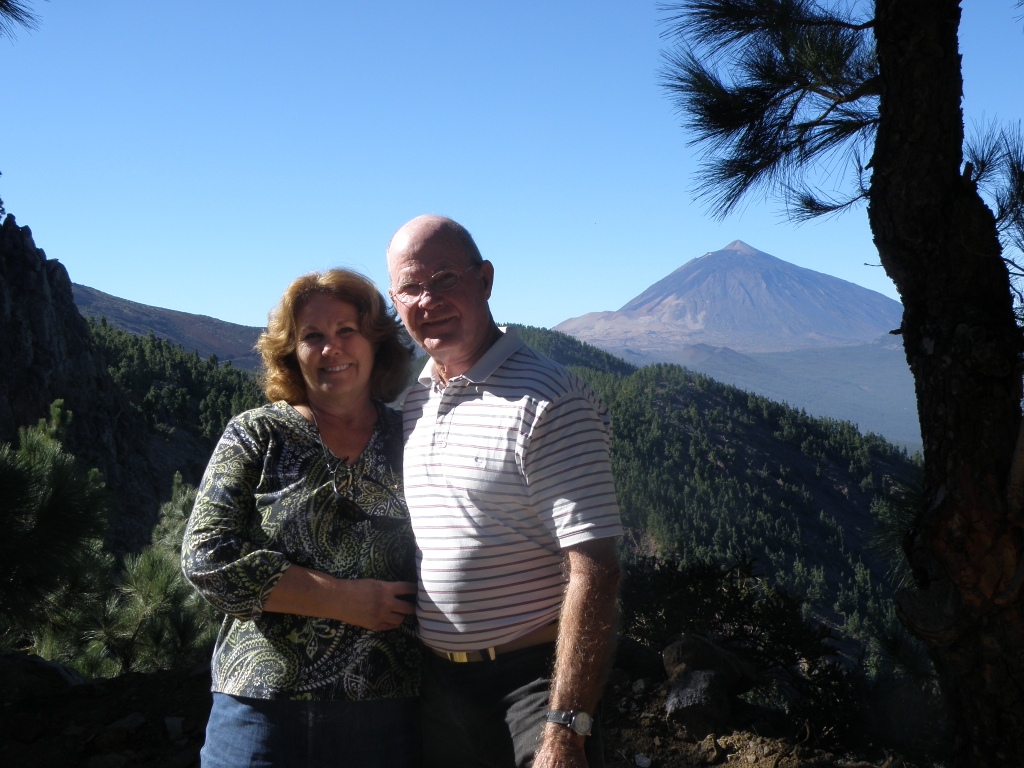
El Teide in background
We had been trying unsuccessfully to rent a car for a couple of weeks.  Finally we scored a car for two days only.  The first day we drove to the Teide volcano near the center of the island.  The landscape was unworldly!  Driving up through the national forest was so very different from the other Canary Islands we visited.  Views were spectacular!  Nearly an hour from the cable car we passed the observatory that friends had suggested we visit, but we continued onward.  Figured we would not see much at an observatory during bright sunlight hours.


Those little things are cars.  Looked small from this
elevation.  This 'valley' resembled a smaller version
of the Grand Canyon.


Turned out to be an excellent decision!  We arrived at the cable car parking areas and decided since it was so late in the day that we would drive past the outlying parking areas and try our luck right at the entrance.  Another car pulled out and we parked right at the entrance.  What luck!  We rushed to get in queue to purchase tickets.  The attendant closed the line right behind us!  Had we parked farther down the mountain and walked up then we would not have arrived in time to catch the last cable car of the day.


View from our cable car when headed up.


Teide is the second or third largest volcano in the world.  As previously mentioned, I do not have internet access at the moment and do not remember any specifics about Teide.  What I do remember is that it looked like we were driving on a narrow twisting road on the planet Mars.  Or maybe on the moon.  As I stated, it was unworldly.  I developed much respect for the guys who built that road through that terrain; it had to have been a most difficult job.  


Another volcano crater down lower.

The tippy-top of El Teide.


Bill at uppermost point that we visited.  Had patches
of ice and snow in crevices up there.  Very cold!


Each of us said that this was a place to which we would like to return for another visit someday.  Few places strike us like that, but this was so unique that it would deserve a second visit.

The top cable car platform sits at elevation of 11,388 feet.  Consider that for a moment.  That is almost 1,000 feet ABOVE two miles above sea level.  That famous Colorado ‘mile high city’ has nothing on Teide!  And was it ever cold!  It was shorts and tee shirt weather down at sea level and it was winter coat weather up here!  We had debated whether to bring jackets or not because it was so warm and still at the marina that morning.  Thankfully, common sense prevailed and we had jackets because it was very cold even wearing those jackets.  Temperature was 32F or 0C and wind was blowing about 20-knots.

Another lower section of El Teide which we visited
with the bus tour.
For those more physically fit (and probably younger), it is possible to obtain a special permit from the national park service of Spain to hike to the very top of Teide.  I had looked into these permits when we first arrived at Tenerife but they were booked through 15 January.  I was glad that we had been unable to obtain the hiking permits because there was no way I would have been able to hike up there.  I found it difficult to breathe when merely walking level, no way I could have managed that steep incline to the top.  We stayed at the upper level for about an hour soaking up the cold.  


The observatory
Glenn and Andrew walked out a path but Bill and I stayed at the beginning of that path.  I was leery of walking very far because did not think I would be able to walk back.  Breathing was difficult and reminded me of our visit to Cusco, Peru and those high altitudes.  People with any cardiovascular ailments are warned not to venture up this high, and I could understand why.  My faulty mitral valve was causing my heart to pound just standing; any physical exertion (even walking on flat level) caused slight chest pain.  Take care visiting heights like this.

My favorite photo of the day.  The setting sun caused the shadow
of El Teide to cover part of the 'valley' below.  Loved the lighting
of the area at that time of day.

Our cable car ride back down the mountain was right at sunset.  The lighting over the scenery below was gorgeous.  It looked very different than it had in full sunlight and we were glad to have had the opportunity to see the area in both conditions.


Los Gigantes


The following day we drove the main highway to the southern end of the island and then up the northwest coastline to see Los Gigantes. Los Gigantes are very high cliffs that go straight down to the sea.  The views are gorgeous.   

After lunch in the seaside town we visited a Lidl supermarket to stock up on junk foods for the upcoming Atlantic crossing.   And found a dark rum that was manufactured by the Ron family which is branded only for distribution to Lidl.  It was wonderful!  Love the convenience of a rental car every once and awhile. We wished later that we had bought several cases of this particular rum, but without a car that was impossible since it is sold only at Lidl and the nearest Lidl was half-way down the island from our marina.

The western coast of Tenerife just south of Los Gigantes.
A somewhat rough 'beach'
The Ron family rum (the name of which I have forgotten) led us to research sugar cane and the production of rum in the Canary Islands.  We got curious because we had seen no sugar cane growing on any of the islands we visited. Turns out that sugar cane is not native to the Caribbean or the Americas.  Sugar originated in India and remained locally until the Arabs brought it to Europe, where it spread rapidly thanks to the normal human desire for sweet tastes.  Sugar cane arrived in the Canary Islands from Madeira, also thanks to the Arabs.  Columbus brought sugar cane from the Canary Islands to the Caribbean (Cuba to be specific) on his second voyage to the new world.  That sugar cane came either from Gran Canaria or La Gomera rather than from Tenerife.  Anyway, all that sugar cane in the Caribbean and the Americas originated from the Canary Islands.  Odd that this was never mentioned in our history lessons.

Glenn departed on 1 January.  We enjoyed his visit very much and look forward to him visiting BeBe again somewhere in the Caribbean.

Very different weather conditions on the day of the bus
tour than on the day we visited El Teide in the rent car.
Marina level was cloudy and drizzling rain.  Up above the
clouds, beautiful sunshine weather.


Cornell Sailing opened their offices at the marina for the rally festivities on 4 January.  The Port of Tenerife hosted participants for a cocktail lunch (fabulous!) and the Real Club Nautico hosted participants for cocktails again that evening.  They served the most delicious octopus we have ever tasted; many other delicacies too, but the grilled octopus was fantastic.  The local wine also was pretty darn good.  So good that we went out and bought a few bottles of that label.


The island of La Palma in distance.  Above cloud level.

Another day a bus tour was organized by Cornell Sailing for a trip to Teide for participants of the Atlantic Odyssey II.  Great!  We would get our second opportunity to see this unique landscape.  The tour guide stated that there are over 200 volcanoes on Tenerife.  I suspect that something got lost in the translation.  It is more likely that there are over 200 vents that can erupt from the single enormous volcano.  But we are not geologists and have no special education on volcanoes, so maybe the guide was correct.


Top of El Teide.  That tiny structure on the right is
the upper cable car station.  No way I could hike up
to that top!


Bill with El Teide and clouds
in background.


This area of Teide national park was called the Wedding
Cake.  This shows a small sample of the varying soils
and rocks in this area.


The Atlantic Odyssey II departed Santa Cruz, Tenerife on 9 January in very light winds due to a tropical LOW situated southwest of the Canary Islands.  Another blog posting will cover the crossing.


Friday, January 8, 2016

Busy, busy.

We really have not dropped off the planet!

We have been enjoying Tenerife for over a month, keeping busy and becoming negligent in making blog postings.  Tomorrow we depart with the Atlantic Odyssey II rally for the crossing to Martinique.

Winds are unseasonably light so we likely will sail (motor) down to Cape Verde, buy more diesel  and wait a few days for better weather before continuing onward to Martinique. There are several systems in the North Atlantic which are causing light winds down here, combined with higher waves and swell.  It is going to be a rolling passage!

Saturday, December 12, 2015

Gran Canaria

 After only 1 night in the Gran Tarajal Marina on the island of Fuerteventura we slipped the dock lines at 04:00 the following morning for the 81 NM passage to Las Palmas on the island of Gran Canaria.  Winds (abnormally) were from the SE and veering to the ESE and swell was from SSE at 2 meters.  Wind was strong enough to sail but only at 5 knots SOG and the large swell was not comfortable.  We were determined to arrive at Las Palmas during daylight, so ended up motor-sailing in order to make about 7 knots SOG to arrive before the marina office closed.

The Muelle Deportivo de Las Palmas is one of the government operated marinas.  Getting a reservation here is darn near impossible.  It is a complicated process whereby one emails or faxes a reservation request, but never receive a response so do not know if you have a reservation or not.  Telephoning is a joke; they do not answer the phones.  We had been a little concerned about this because there is only a small anchorage nearby and that usually is full.  What do you do if you arrive and there is no space in either the marina or the anchorage?  Press on overnight, I suppose.  At any rate, we really lucked out!  


Dolphin
As commodores in the SSCA (Seven Seas Cruising Association), the resources of the SSCA are available to us.  One of those resources are station hosts at various destinations worldwide.  We had contacted the SSCA station host for Gran Canaria, Augustin Martin; and he had gone way above the call of duty and obtained a marina reservation for us.  Like us, he had been unable to contact this marina by telephone; calls never answered.  He actually drove from the southern tip of this island all the way to Las Palmas and personally visited the marina in order to get us a reservation.  Like everyone who visits that marina office, he had to take a number and wait his turn to speak with the management.  He waited 2 hours!!!  And he was successful in obtaining a reservation for BeBe!  It was a great relief for us to know that there would be a space for us to dock on day of scheduled arrival.  We would stay there 3 nights before moving onward to the island of Tenerife.  


A few of the ~200 dolphin that came to play
Thanks very, very much to Augustin!  We certainly did not expect him to go to so much trouble assisting us.

About 3 NM out from arrival at Las Palmas the dolphin found us.  Bill whistled loudly and dolphin came jumping out of the water towards us from every direction!  They kept coming and coming!  There had to have been at least 200 dolphin!  The largest pod we have seen since the Indian Ocean.  It was fun watching them play with our bow wave and jump and flip all around us.  I tried to get some photos but with the large swell still running the sea was too active to get good photos.   I did get 3 videos of a few of the dolphin and if I can find a way to shrink those videos they will be added to the bottom of this blog posting.


Moonshadow's wall painting


Upon arrival at the marina entrance we were advised by VHF radio to circle outside the entrance for at least half-hour and call back again as the reception dock was full.  Bill inquired if it was possible for us to go to the fuel dock and take on fuel instead; so that is what we did.  After filling the tank, Bill walked over to the reception office and cleared us in. As we backed into our berthing spot along the east wall the first thing I saw was the name of a boat we have followed for many years.  I continue to follow this boat today with new owners.  This boat is Moonshadow, one of only 10 boats built of that model.  Moonshadow is Deerfoot 2; a 62-ft cutter designed by "cruising guru" Steve Dashew.  She was built in Finland by Scandi Yachts and Launched in 1986.  We followed George and Merima on Moonshadow as they circumnavigated.  And now I follow John and Deb, the current owners of Moonshadow, as they are beginning their circumnavigation, heading out soon from Mexico.  Small world.


Just part of the wall with all the boat names painted on

Each year boat owners and crew paint the names of their boats and sometimes crew names on the walls of certain places before they depart to cross the Atlantic.  It is a tradition in Madeira and also here in Las Palmas, Gran Canaria, where the ARC departs each November.  The wall in this marina is covered in boat names.  Moonshadow participated in the ARC in her first year, 1986, and then again in 2010.  I would not be surprised if she won her class in both rallies as these are fast boats, but that is not something I follow.  What a surprise it was to look up from tossing our stern line to the marinero and see the sign for Moonshadow right behind us!  We did not know any of the other boat names painted on that wall except for Moonshadow, and the marina berthed us right in front of her name.  (For what it is worth, this painted wall tradition also continues at the Santa Cruz marina on Tenerife island; not sure if we will paint BeBe's name on the wall there or not. Neither of us is artistic.)

The first Moonshadow blog of George and Merima:  http://sailmoonshadow.com/about/

The current Moonshadow blog of John and Deb: http://saillegacy.blogspot.com.es/2015/11/forces-invade-moonshadow.html


Augustin Martin, Judy & Bill in Las Palmas


The day after our arrival Augustin and his friend, Sonia, again drove up to Las Palmas and visited us aboard BeBe.  It was a pleasure meeting them.  They provided many insider tips about Gran Canaria.  We wanted to treat them to lunch but they had other plans.  We mentioned that we planned to rent a car to see the island and they suggested we drive down the the southern tip of the island and we could have lunch down there.  Fabulous!


Sonia, Judy & Bill in Las Palmas
After they left, Bill and I walked around in search of lunch.  After a nice lunch of ropa vieja (old clothes; Google it if you are not familiar with ropa vieja; delicious), we decided to find a car rental company to reserve a car for the following day.  And we walked. And walked.  And walked.  Another cruiser had told us where he thought 2 tourist information offices were located; we found neither.  Bill used the iPhone to search out car rental companies but that proved useless for the first 2 listed; never found those places. When I had reached the point of not caring if we managed to see this island or not, we finally found a car rental agency -- in the basement level of a parking garage beneath a high-rise office building.  Talk about difficult to find!  We made arrangements to pick up the car the following morning and walked back to the boat.  Now with blistered feet.  We had walked well over 5 miles.

The next morning we walked back and picked up the car.  Easy once you know where to find that place; only 1 1/2 mile walk.  Augustin had told us that it should take only 45 minutes to drive from Las Palmas on the NE side of the island down to Pasito Blanco on the southern tip of the island; but we wanted to allow plenty of time since we had no idea of the road conditions or knew anything of the areas to be visited.  Well...he was correct.  There is an excellent freeway down the eastern side of Gran Canaria.  This freeway continues westward along the southern coastline until the town of Mogan, where it ends.  A much smaller typical mountain road continues past Mogan up towards the mountainous center of the island.  The western side of Gran Canaria is very rugged and there are no north/south roads trans-versing that side of the island.  The good roads and most habitation is on the eastern side of the island.


Alguineguin port


We arrived at Pasito Blanco much too early to meet Augustin and Sonia for lunch, so we continued driving westward on a narrow coastal road to the old fishing village of Arguineguin.  We stopped and strolled through this quaint little village.  Walked the docks where the fishing boats sell their catch.  Stopped for coffee at a small outside cafe. Enjoyed this little picturesque village.  


Section of the beach at Meloneras

Then we drove back eastward past Pasito Blanco and visited a resort area known as Meloneras.  Lots of shopping there and a pretty beach.  
Meloneras


View of Pasito Blanco marina entrance


From the upper level of the shopping area there was a nice view of the entrance to the marina at Pasito Blanco.  Suddenly we realized that it was later than we thought and had to hurry back to Pasito Blanco or we would be late for our appointed time to meet up with Augustin.


Entrance into Pasito Blanco marina


Airstream, patiently awaiting
Atlantic crossing


Augustin was waiting at the guard entrance to get us into Pasito Blanco.  This is a private gated community and is very nice.  The marina is well protected and there even is a small boat yard.  In fact, our friends, Bill and Janet Wickham, had left their boat Airstream on the hard here!  Bill will be returning early next month for the Atlantic crossing; we might be crossing at about the same time.


One GREAT beach seafood restaurant!

Augustin took us to his home and Sonia joined the group and we headed off for lunch at their favorite beachside restaurant at nearby El Pajar.  This restaurant is called El Boya and is family owned and operated. I think all the employees are members of the same extended family.  It is a casual place and exactly the kind of seafood restaurant that Bill and I prefer.  Plastic chairs and great food!  At great prices, too!


Don't we all look like we are having a wonderful time!
Augustin Martin and his friend, Sonia, with Judy


El Boya started when the family had a single small fishing boat called Jocefa.  Business has grown a lot since then!  Bill and I each ordered a small plate of chunks of some kind of fried fish; it was delicious.  Sonia ordered grilled octopus and we shared; again, delicious.  There also were a couple of plates of the Papas Arrugadas (wrinkled potatoes), the delicacy of the Canary Islands which is served with a green and a red mojo sauce.  Augustin ordered fried sardines or small whole fish.  He and Sonia enjoyed those; Bill and I abstained as we had more than we could eat of the fried fish pieces.  


Sample of the seafood available that day.


Augustin also introduced Bill to an alcohol-free beer, which Bill thought was wonderful.  The law here is DUI at blood alcohol level of .025 rather than the far more lenient level at home of .08.  They take drunk driving very seriously here (as they should).  Since we planned to drive a lot that afternoon Bill did not want to drink any alcohol.  He enjoyed the non-alcohol beer very much.  I forgot the brand name.


Augustin, Judy & Bill at El Boya lunch


After lunch we returned to Augustin's home for coffee.  We very much enjoyed this short visit and lunch with Augustin and Sonia.  Next, off for a long drive.  The roads we followed to the mountainous interior of the island were not like the divided multi-lane freeway which runs along the eastern coast.  There were typical mountain roads, twisting and turning and climbing ever upward.  

The highland interior of the island has more vegetation and trees.  Quite different from the almost barren coastal areas.  We did not stop so did not take any photos.  Sonia had warned us that there is no street lighting or highway lighting up on these mountain roads and that we should leave the area at least 1 hour 15 minutes before dark to allow sufficient time to get back down to the lighted roads in the more inhabited areas.  She was right. Thanks for that advice! 


We dropped the car off and walked back to the marina.  It felt perfectly safe walking the streets in the early evening.  I love the Spanish habit of families taking children to the plazas and squares and playgrounds between the hours of 8 pm and 11 pm.  Would never see that at home!  Yet here those places seem perfectly safe during dark hours as these are filled with playing children.  A different world.

The following morning we departed Las Palmas at first daybreak for the 56 NM passage westward to Santa Cruz on the island of Tenerife.