This has been the week for boat projects.
First there was a new dinghy cover; custom made from heat welded UV resistant vinyl. This is to cover the bottom of the dinghy when it is stored upside down on deck during long passages. Or when berthed for the winter. Whenever the dinghy won't be used for weeks or months. We had a cover that was purchased from West Marine less than 2 years ago and it was well past worn out. The new one should last 10 years and didn't cost much more than the original one from West Marine.
Next was recovering the nav station seat. That has presented a problem because of the color of the leather. All the suppliers want to sell a full hide or half-hide only, especially in this particular color. We need only a small piece of leather to recover this small seat bottom only. It is like a bar stool. We need only about 57cm X 55cm. Small pieces of leather are available in other colors but not in the color we need. So that project continues. We aren't giving up on it yet.
Next was the search for a dehumidifier. West Marine no longer sells these machines. And we cannot find one of any kind in any store in Marmaris. That search also continues. And we really, really, really must find one before the winter season. The condensation inside the aft cabin was horrible last winter. We caught it just in time before mold set in. I don't want to fight that all winter.
Next was a new grill -- just wanted to replace the Magma gas grill that clamps onto the rail. That has turned into a major problem. West Marine does not sell gas grills in Marmaris. Not surprising since it is illegal to grill or cook outside on a boat in the Mugla and Anatolia regions of Turkey. Might also be illegal farther north, but I know it is illegal here. The logic behind this law is to prevent the wooden gulets from catching on fire. Makes no sense for private fiberglass yachts like ours or for steel or aluminum yachts. We like grilled foods and will continue to grill at anchor until stopped by officials. I really don't think they care how I cook on my own boat; they are just trying to protect the tour boat customers on the wooden gulets. We have searched all the known stores in town and cannot locate a grill. Yesterday we finally found the 'stainless steel district' of Marmaris -- where you can get literally ANYTHING fabricated. We inquired about having a gas grill fabricated. Sorry; the recommended guy said he made one once and prefers not to make another. Guess we will buy more Magma parts on Ebay and nurse the old grill along a little longer. There is one small Magma grill for sale in the chandlery here at Yat Marin but the price is absurdly high. I'll give up eating grilled foods before paying that high price.
This SS guy has built rail mount enclosures for life rafts for several Amels. Two other Amel owners recommended him for the quality of his work. This is something we are toying with the idea of having made next April. First we need to find out if our valise style liferaft can be changed into a hard case. Although once we get back to the Caribbean I honestly don't see the point in having a liferaft any more. A good sized dinghy and an EPIRB should suffice in the Caribbean.
We walked all over Marmaris yesterday. Literally all over. Really.....all over. My legs were so tired by the time we got back to the marina that it was a struggle to make it back to the dock. Discovered several new areas of Marmaris that we had not heard of before. Lots of work shops. Some retail shops. And finally found the little tool Bill needed to adjust the tension on the hinge of the forward deck hatch. It was so loose that it would stay up only about 4-5 inches. Now it stays upright where you want it. Now that should stay open correctly to scoop in breeze when at anchor.
Today we ordered a new custom made shade awning. This one will be exactly like our old awning that covers the boat from mainmast to rear of cockpit, with zippered side panels and rear panels that roll up. The old one was all white. The new one will be a dark taupe color with white trim. During our next haul-out we plan to change the orange boot stripe to a light taupe color, so this new awing will match the color scheme on the boat. It cost 50% more than we estimated but is being constructed from real Sunbrella fabric and top-of-the-line quality zippers and vinyl trim and reinforcements. Could have cut the price almost in half and used less quality components but this is one of those things that you really want to last years. We had hoped the prices here would be good enough to justify also making awnings for the foremast deck area and for the aft deck area. Maybe later for those 2 pieces. There should be enough fabric left over to also make a cover for the outboard engine. I am concerned that the shop will not use UV resistant thread but there is nothing I can do about that here. I'm sure there will be lots of re-sewing as the sun rots the threads. If it just lasts until we get to St. Martin, I'm pretty sure we can find shops with UV resistant thread there to re-stitch as needed.
And the last project for this week is a new mattress pad for the bed in the aft cabin. We have custom made bed linens for every berth on the boat, including mattress pads. Everything is still in fine condition except for the mattress pad for the aft cabin bed. I have tried contacting the person in Florida who made the originals. I know she is still in business and, in fact, is measuring another Amel this week which is just like ours. Her business must be good because she has not responded to my email inquiry. Today we found a local shop that makes custom bed linens and all sorts of other things. Ramadan ends tonight or tomorrow night and everyone takes a 3-day holiday (or longer). Shops started closing at noon today (Friday) and will reopen next Wednesday. The shop owner said to bring in the old mattress pad on Wednesday and he will duplicate it. The work should take 1 day. The shop also has exactly the fabric I want to make a bed covering, like a duvet but not filled; something light for summer use. I have been looking for for 6 years and this is the first shop that has exactly what I want. So if the price is anywhere near reasonable then we will have a new 'topper' made for the bed. Only problem is that this fabric is pure white and I would prefer a pale yellow. Guess I will take what I can get!
Meeting friends for dinner tonight. Very much looking forward to catching up and hearing about their recent 3 months in Israel.

Friday, August 17, 2012


Thursday, August 16, 2012
The sailing vacation that never left the dock
 |
| Fishing behind our boat in Serce Limani |
 |
| Underway to Marmaris in dead calm. No wind and very hot in the cockpit. Sun was on deck so we put up the mainsail so they could lay in the shade & catch breeze created as we motored. |
 |
| Saw this motor yacht in Serce Limani. Think they would trade even? This should be our next boat. We will eventually get too old to sail. |
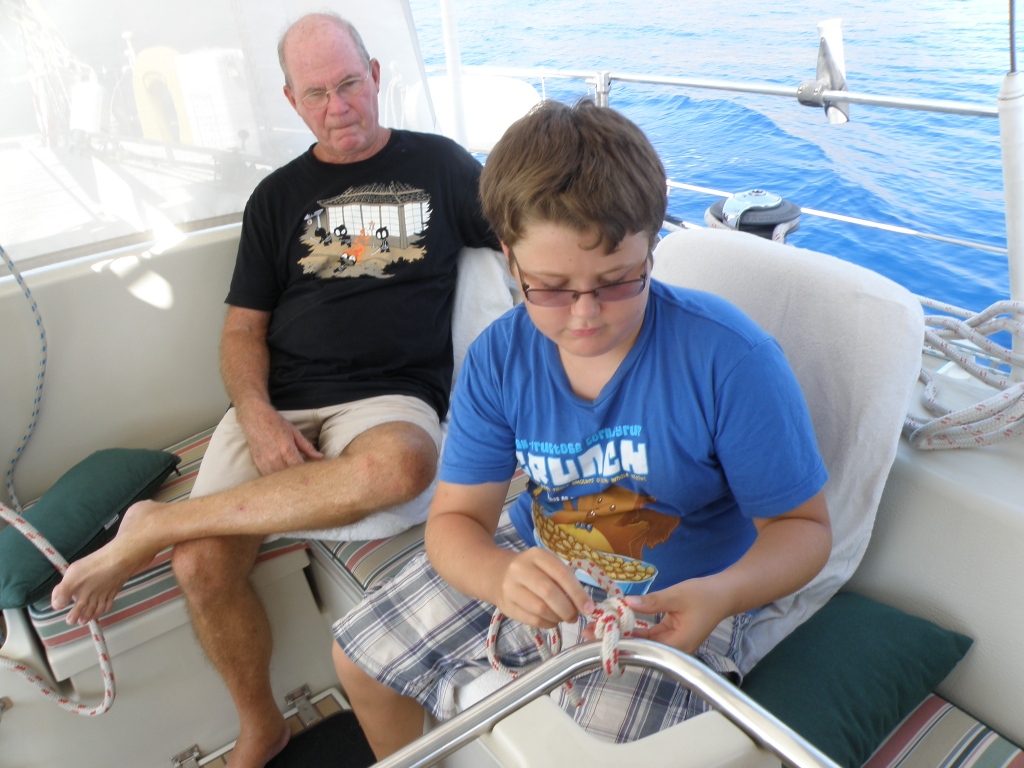 |
| Practicing knots during calm sailing |
 |
| A perfect square knot on his first attempt! |
 |
| And a less-than-perfect spaghetti-line mess on her attempt to tie a square knot |
While anchored in Serce Limani late that afternoon I watched a local man in a skiff go shooting out of the pass suddenly. A short time later he returned trailing a dinghy covered in burgundy chaps. It looked from a distance like a very nice dinghy and not very old. He obviously had seen it floating free on the sea and had salvaged it. Whoever lost it must not have put 2 and 2 together regarding where the lost dinghy might have floated off to when it became untied from their sailing boat. Because no one showed up in Serce Limani looking for their lost dinghy during the 36 hours we were anchored there.
After a single night in Serce we motored to Marmaris and anchored outside Yat Marin. The next morning, 1 August, we moved into the marina to ready the boat for arriving family guests. After much discussion with our son and daughter-in-law, it was decided to just stay at Yat Marin for the duration of their stay. The weather was still very hot and several people just could not take the heat. It would not have been pleasant out at anchor without shore power to run the air-conditioners. The marina has a lovely large pool to enjoy daily. Aaron and Lynn took a day-tour to Ephesus while we baby-sat. Another day they took Elisabeth and Zach on a Jeep Safari Tour while 3-yr-old Damien stayed with us on the boat. Another day they rented a car and drove to Fethiye and up to Saklikent Gorge and some ancient ruins nearby.
Info on Saklikent Gorge
 |
| Bonaire 2007--6th birthday |
 |
| Turkey 2012--11th birthday Grown a bit, hasn't she! |
 |
| BeBe's 11th birthday |
 |
| Belly Dancing BeBe |
 |
| Damien just turned 3. Has a new nickname: Bacon Boy, because that about the only thing he would eat while visiting this trip. Good thing I stocked up with a freezer full when in south Cyprus |
Saturday, July 21, 2012
Selimiye
 |
| Really wide beach, isn't it! |
 |
| Sardenyu Restaurant, were we first docked |
 |
| BeBe is the boat in the middle. Remember, Bebe's draft is 2.1 meters. That water is deeper than it looks. Amazingly clear! |
Unfortunately, the shore power on this dock was insufficient to operate the air conditioner during the day. It ranged 196v to 208v during the day. But we could run one unit at night when the power draw on the grid was less. So Bill and I slept in the aft cabin bed with Elisabeth sleeping on the settee next to our bed, and Zachary slept in the passageway berth. We closed off the passageway from the main saloon with the curtain and placed a fan at the opposite end of the passageway to suck the cooler air from the aft air conditioner and disperse it into the passageway. This enabled all 4 of us to sleep comfortably.
 |
| Swim area at end of the dock at Sardenyu Restaurant. |
We took the kids to meet the Captain Osman, the 'gold toothed man' we met last year when we visited Selimiye by rental car. He claims he brought all his money with him when he moved from Greece to Turkey years ago -- in the form of gold filling his mouth.
 |
| Captain Osman, the man with the gold teeth; keeps his fortune in his mouth. Serves delicious traditional Turkish casseroles in his sidewalk restaurant on the main harbor shore. |
 |
| Walked around the bay searching for a restaurant recommended by a friend. Missed it while admiring their wine grapes hanging over the walkway. |
 |
| The restaurant we were looking for was Girit. Found it on our way back---beneath the grapes. |
There are places to swim and Zach can kayak when boat traffic isn't active. And plenty of restaurants to enjoy. Even a few small stores to buy basic groceries. And a bakery that bakes the best bread we have found so far in Turkey. No reason to get in a hurry to leave this wonderful place.
 |
| Care to eat lunch seated around a tree? Literally around it. |
Switching to a completely different topic, since the country of Turkey did not come to be until 1922 (previously the Ottoman Empire), I have wondered exactly where the Turkish people originated. After all, even though the country of Turkey did not exist, there are many references to the Turks many hundreds of years prior to the formation of the country named Turkey. Here is a link to a very brief explanation about the origins of the Turkish people:
Origins of Turkish people
 |
| Feeding ducks on our walk around the bay |
According to our Lonely Planet guidebook the Selimiye area is filled with caves and people at one time lived in these caves. Selimiye is situated on the Bozburun peninsula about an hour's drive northwest from Marmaris. This peninsula is the southernmost known boundary of where the ancient Phrygians lived.
The following is taken from the Lonely Planet:
 |
| Elisabeth's Aflak moment |
The Phrygians immigrated from Thrace to central Antolia region around 2000 B.C. They spoke an Indo-European language and used an alphabet similar to Greek. They established a kingdom with its capital well east of here, roughly 60 miles west of Ankara. Their small empire flourished under a successive line of Midas and Gordias kings, until it was overrun by the Cimmerians in the 7th century B.C. The Cimmerians sacked and burned the capital and murdered many Phrygian leaders. Yet the Phrygian culture continued to flourish under the new leaders and subsequent Lydian overtakers.
Considering they lived in rock dwellings, the Phrygians were a sophisticated people with a dedication to the arts. Phrygian culture was based on Greek culture, but with strong neo-Hittite and Urartian influences. They are credited with inventing the frieze, embroidery and numerous musical instruments, including the double clarinet, flute, lyre, syrinx (pan pipes), triangle and cymbals. The Phrygian civilization was at its most vigorous around 585 to 550 B.C. Study of the Phrygians has provided anthropologists with fascinating insights into a culture that bridged the gap between primitive and advanced in central Turkey.
 |
| That looks like a small castle on top of the hilltop. Our Lonely Planet travel guides does not identify this structure and there are no signs visible. Not walking all the way up there without some incentive. |
Left Marmaris and worked our way to Knidos
 |
| Being a girl |
 |
| Presenting my award |
On the first night in Serce Elisabeth dressed up and acted like a diva and presented us with 'awards.'
 |
| Presenting Bill's award |
 |
| The expert charterers |
 |
| Charter boat; beware! |
We were not adrift and our anchor had not budged. They had anchored inside our swing range. Freaking experts did not know what they were doing. This problem was really our own fault because we should have asked them to move rather than let them anchor so close. Now we needed to move and it was almost dark. We took in 11 meters of chain; swung the stern to the opposite side of the narrow bay; let back out that 11 meters of chain plus 6 more meters; and tied a stern line ashore. We did it this way to help keep the chain from curving around boulders on the sea bed.
The next morning these expert charterers attempted to leave and discovered their anchor was wrapped around boulders. I feared that would happen when I watched them do that big half-circle backing to shore the previous afternoon. Took over an hour to free their anchor chain. Then we weighed anchor with no problems and also left the bay. Checked our electronic chart when we pulled anchor and confirmed that our anchor had not budged from where we had set it 2 days prior.
 |
| Needs a daylight viewable DS. Good thing this girl never gets seasick. This is what she does while sailing. |
We motored to the bay at end of peninsula because there was supposed to be an ancient fortress to climb up to. But we could see from the cockpit that the fortress was not impressive -- just walls. So we continued on toward Datca. The wind changed direction numerous times, always on our bow. Finally we changed destinations and sailed towards Bozburun. We encountered difficulty tying the stern line ashore in the small bay where we first attempted to anchor. The current was too strong and kept turning the boat parallel to the side of the bay and we needed the boat stern-to towards the side of the bay. We declared it not worth the trouble and motored on to the main anchorage at Bozburun, which thankfully is a lovely swing anchorage. Total mileage for the day was only 24 NM.
 |
| Knidos merchant bay. Can see stone breakwater on right side of bay entrance. Left side of breakwater is sunken. Beware during entry! |
After a couple of nights in Bozburun we motored 21 NM (and actually sailed for awhile!) to Kargi Koyu, where we stayed for only 1 night. We liked this anchorage very much. It would be untenable during southerlies, but was wonderful while we were there. The water was so cold and felt wonderful on that hot afternoon --- 104F and 72% humidity. The kids and I got into the water for a couple of hours. Zachary swam much of that time while Elisabeth and I floated in the shade next to the boat.
Then on to Knidos, only 18.2 NM (on Sunday 15 July 2012). The weather had become exceptionally hot and we figured if there were any cooling breeze anywhere, it should be at Knidos way out on the very tip of the Datca peninsula. Maybe some wind would pass over the sea and be a bit cooler. The plan was to arrive shortly before noon in hopes that charter boats would have left by that time and more charter boats would not be arriving until later in the day. We wanted to be on the restaurant dock because too many people we know have dragged anchor in the notorious bad holding of this tiny ancient harbor.
Our plan worked well. We stopped well outside the sunken rock breakwater wall and lowered the dinghy. Bill and Zachary went to the restaurant dock and inquired about available docking space, cost and electricity. It was extremely hot and we desperately wanted air-conditioning! Docking space was available as long as we didn't mind allowing 2 or 3 boats to raft up on our side as more boats would arrive later. That was okay with us. Cost was 45 TL per night. Bill and Zachary returned to BeBe and we entered the harbor and docked. Piece of cake.
And THEN the dockmaster told us that the shore power was for using battery charger only. For 45 TL!!! That was not good news. But the power was insufficient voltage to allow us to use air-conditioning anyway. We continued to watch the voltage and when it climbed high enough (as the evening cooled down) Bill moved our dinghy against the water discharge on our hull; we shut off the forward cabin and turned on the air-conditioning for a couple of hours. We really needed to cool down. My blood pressure got up to 212/96 which is an unprecedented high! The only reason had to be the extreme heat. This little heat wave is causing temperatures 12 degrees Fahrenheit higher than the normally hot temps for this time of year. 104F with 72% humidity is too hot! That kind of heat is dangerous....especially for us old folks. So, the dockmaster would have to live with us cheating on the air-conditioning for a few hours. Once cooled off we were all happier with the world. But we decided to stay in Knidos for only that 1 night and would search out a dock with shore power the next day.
The restaurant had plenty of large fish for dinner that night. The price was 120TL per kilo and you pay for the entire fish. That would have made a fish dinner cost around 600 TL ($335 USD). That is way, way, way too much for a fish dinner. The Med is over-fished and as a result fish usually is quite expensive. We will pass, thank you very much. Berthing at the dock does not require eating in the restaurant. When we were here last year the berthing cost only 25 TL but did require eating at the restaurant. Now he charges 45 TL but does not require eating at the restaurant.
The kids were not really impressed with Knidos. They walked around a little bit once the sun had gone down. And I made them read the guide literature about this site. Sooner or later they each will write a blog about what they saw and what they remember about the history of this place.
Bill and I had visited Knidos in late May last year when on our way to Samos, so there was nothing new for us to see here. Visited Knidos 30 May 2011 I won't write again about Knidos except to say that this is not the location of the original ancient Knidos. The original ancient Knidos was situated on the northeastern outskirts of present-day Datca. Knidos was moved to this peninsula tip location because this was considered a superior port location for trading. Plus, marble was a big trade item to Egypt at the time. The marble was in the ground near the peninsula tip. Why bring heavy marble all the way to Datca area; it was much easier to bring the olive oil and wine to the peninsula tip and all 3 major exports could be shipped easily from this location. Plus, the northern small bay here was the military bay; and the southern bay was for merchant ships. The military was already here and would provide protection for the merchants.
The next day we motored 40 NM to Selimiye in hopes of finding shore power for air-conditioning. The little heat wave continues. Local people say these little heat waves typically last about 2 weeks so we can expect abnormally high temps for another 10 days or so.
 |
| Knidos theater and city ruins as seen from our docked boat. |
Then on to Knidos, only 18.2 NM (on Sunday 15 July 2012). The weather had become exceptionally hot and we figured if there were any cooling breeze anywhere, it should be at Knidos way out on the very tip of the Datca peninsula. Maybe some wind would pass over the sea and be a bit cooler. The plan was to arrive shortly before noon in hopes that charter boats would have left by that time and more charter boats would not be arriving until later in the day. We wanted to be on the restaurant dock because too many people we know have dragged anchor in the notorious bad holding of this tiny ancient harbor.
 |
| The Camel Hump at Knidos. This was the bit of land (almost like an island except for the narrow bridge of land connecting it to the peninsula) on the southwestern side of both the military harbor and the merchant harbor. It was directly across from the theater. The city was built on both the Camel Hump and on the mainland peninsula. Supposed to have been a very beautiful city. It would have been spectacular sitting in the theater and watching the stage with the Camel Hump in the background across the tiny harbor filled with ships. The buildings house researchers and archaeologists working at the site today. |
Our plan worked well. We stopped well outside the sunken rock breakwater wall and lowered the dinghy. Bill and Zachary went to the restaurant dock and inquired about available docking space, cost and electricity. It was extremely hot and we desperately wanted air-conditioning! Docking space was available as long as we didn't mind allowing 2 or 3 boats to raft up on our side as more boats would arrive later. That was okay with us. Cost was 45 TL per night. Bill and Zachary returned to BeBe and we entered the harbor and docked. Piece of cake.
 |
| The water is so clear. Knidos ancient merchant harbor. |
 |
| Mainland side of the tiny military harbor. The first nude statue of a female was located on the right side background of this photo. It was beautiful Aphrodite. The statue was carved by a Greek artist and intended to go to Kos. But the people of Kos were appalled by the idea of a nude female statue, so it remained in Knidos and became a huge tourist attraction in ancient times. Had a door on the rear side of the mounting so tourists could view her beautiful posterior. |
The kids were not really impressed with Knidos. They walked around a little bit once the sun had gone down. And I made them read the guide literature about this site. Sooner or later they each will write a blog about what they saw and what they remember about the history of this place.
 |
| Mainland section of ancient Knidos. It was a large city built up far around the hillside and also on the opposite Camel Hump too. Our boat is docked on the opposite side of that dock. Restaurant beneath the trees. |
 |
| Ancient tiny military harbor on north side at Knidos |
The next day we motored 40 NM to Selimiye in hopes of finding shore power for air-conditioning. The little heat wave continues. Local people say these little heat waves typically last about 2 weeks so we can expect abnormally high temps for another 10 days or so.
Friday, July 20, 2012
Cleopatra's Pool, Hierapolis and Pamukkale
 |
| Hierapolis theater ruins in background |
 |
| Right side exterior of theater |
Hierapolis was an ancient city in the mountains that was naturally well protected on 3 sides. The remaining side overlooked a fertile valley. It was the perfect location for a city; not high enough altitude to get snow but high enough to provide relief from the notoriously hot summers of this part of the world. Visitors came from the areas now known as Africa, the Middle East, Europe and the Black Sea countries to partake of the healing qualities of the 17 thermal springs in Hierapolis.
 |
| Partially excavated ancient road; probably really an agora judging by the columns along either side. There would have been merchant shops along each side of this city roadway. |
Rather than write about this ancient city that we were not particularly interested in, I will provide a couple of links in case any reader wants more information.
Everything you might want to know about Hierapolis: Wikipedia -- Hierapolis Hierapolis tour
 |
| Elisabeth, Zachary and Judy in Cleopatra's Pool |
 |
| Exploring Cleopatra's Pool |
Since then an earthquake destroyed the bathing complex and toppled Ionic columns into the pool, but the natural spring thermal waters continue to supply the naturally formed pool. The damaging earthquake supposedly occurred in 2nd century A.D., but there have been many earthquakes in this region so who knows for certain exactly when all these columns and cornices toppled into the pool. Once source cites 2nd century and another source cites 7th century.
 |
| Maneuvering over toppled columns |
 |
| Warm spring water filling the pool |
The technical specs are that the water in the thermal pool is 36 - 57 degrees Celcius (96.8 to 134.6 degrees Fahrenheit). The pH value is 5.8 and radon value is 1480 pCi/l.
 |
| Gingerly finding our way around broken marble things |
The water contains bicarbonate, sulphate, carbon dioxide, partly with iron and radioactive combination. The water in this spring is suitable for bathing, swimming, showering and drinking cures; and has 2430 MG/liter melt metal value. (Whatever all that means)
It is considered a healing thermal spring.
 |
| Attempting to stand on broken column |
The day we visited the pool temperature felt about 38 Celsius or 100 Farhenheit. The water feels silky on your skin and leaves no residue. After soaking in the pool one feels relaxed.
 |
| And she made it! (briefly) |
 |
| Toppled Ionic column |
 |
| No kids under age 16 allowed in roped off section |
 |
| Excellent photo showing the toppled columns and cornices in the pool. Our tour group was one of the first to arrive. The pool very quickly became crowded with tourists. |
 |
| Pamukkale pools at top of mountain; Pamukkale town and artificial pools at bottom |
Next we walked over to the top of the pools of Pamukkale. Technically, I believe that Pamukkale is the town down at the bottom of this small mountain. But the pools at the top are commonly known as Pamukkale.
 |
| Pools near top at Pamukkale |
These are shallow pools formed by deposits of calcium carbonate that naturally occurs in the thermal springs that constantly fill these pools. Down by the town there are several artificial pools that looks just like the real pools at the top.
 |
| Fill trench |
Bill stayed in the shade on the wooden deck at the top of the mountain while Zachary, Elisabeth and I walked through almost all of the pools.....along with at least a thousand other tourists. Man! Did that place get crowded!
 |
| Looks cold; but it isn't |
The guide explained that some 5-star resorts had been built some time in the past that had diverted water from the natural springs that feed the Pamukkale pools. My limited research indicates that since Pamukkale has been named a UNESCO World Heritage Site that this water is no longer being diverted. The guide disagrees with that and insisted that the water is still being diverted today. As a result of this diversion (and probably also due to natural depletion reasons), the spring-fed waters of Pamukkale will dry up in about 150 years.
 |
| Looks like a wall of ice but is really just calcium carbonate deposits over very many years |
 |
| We all enjoyed Pamukkale very much |
 |
| Isn't this a special place! |
The pools of Pamukkale will no longer exist in 150 years.
 |
| No shoes allowed when walking on the pool area |
 |
| Zachary at Pamukkale |
 |
| Elisabeth at the fill source to the Pamukkale pools. There was a trench to carry the spring water to fill all pools |
 |
| Russian tourist near Cleopatra's Pool complex. Wonder where she found that swimsuit. |
BTW, it is common to talk about the fat American tourists. Believe me, some of the Russian tourists have us beat....hands down!
Subscribe to:
Posts (Atom)