TRANSLATE, TRADUIRE, ÜBERSETZEN, TRADUCIR, 翻译

Friday, September 14, 2012

Finally out cruising

As always, click on images for larger views.
Mountains as far as the eye can see
We finally left Yat Marin marina in Marmaris on Saturday, 1 September.  Predictions were for light winds, which they were.  Always on the nose, of course, since this is the Med.  Every time we neared a change in course which should have put the wind at a good angle for sailing, the contour of the land and mountains caused the wind to change direction too, always putting it right back on the pointy end of the boat.  In the afternoon when we made the turn north around the peninsula to head toward Datca (pronounced DAH-cha), the wind was almost on an angle that we could sail.  Not quite, but almost.


Bosburun as seen from our anchored boat


So we changed destinations to a direction that allowed us to sail, and headed toward Bozburun instead of Datca.  Those fabulous sailing conditions lasted a whopping 15 minutes!   Wind died to basically nothing; we furled the sails; and motored up to Bozburun.  Total mileage for the day was an easy 40 NM.  Dropped the hook at 36.41.365N  028.02.563E for those readers with either electronic charts or Google Earth.  


Bosburun anchorage---Turkish girl learning to sail


This is a great place!  Swing anchorage; small town with decent small markets for fresh produce and basic provisioning items.  And even a limited selection of chandlery items.  A small sailing charter company bases out of Bozburun so there are plenty of quayside restaurants, as well as several resort hotels along the shoreside.  Boats can go inside the small harbor to dock wherever space is available, but we prefer to swing anchor.  We stayed there 4 nights.


Near Bosburun is a wooden boat building yard.  Inside
this gigantic building they are building the largest
wooden boat in the world for a very rich Arabian man.


A group of cruisers in Marmaris were planning a lunch outing at a bayside restaurant in Keci Buku (a/k/a Goat Bay -- pronounced KETCH-ee BOO-koo) near Oranthiye on 6 September.  We decided it would be fun to join them.  They would arrive by bus; we would arrive by boat. 
Leaving Bosburun anchorages


So, on Wednesday 5 Sept we motored 18 NM farther north to the very lovely bay with the sand spit down the center.  We had seen the Keci Buku bay from the mountain road last year when we shared a rental car one day with Jackie & Brian on S/V Songster and drove out Datca peninsula.  This was our first time to visit this bay by boat.  There are several choices of anchorage in this bay, plus several catwalk docks in front of small restaurants at the head of the bay behind that sand spit.  As we motored past Marti Marina we noticed 3 boats anchored just west of there.  That looked like just a good a spot to anchor as any other place, so we dropped hook at 36.45.922N  028.07.659E in 10 meters depth.  We would have a longer dinghy ride into the restaurant, but we were happy out there.  Good breezes; not crowded; and had a lovely view of the tiny island with the ancient fortress on top.


Trying to plan the rest of our time in the Med.  This is incredibly
 frustrating because of the 90-day Schengen Treaty visa limitation --
90-in then 90-out.  Not sure the Med is worth this much worrying.
We also had wanted a closer look at Marti Marina.   After that closer look, we continue to be baffled as to why this particular marina is so expensive.  What is the attraction to warrant the high prices?  We had emailed the marina in late July to inquire about berthing space for a few days.  Price for our 16-meter (53-ft) boat was $1,046.25 USD for one week.  We responded; thanks, but no thanks.  Bill told them their rate was too expensive for us.  We think the marinas will continue to increase pricing to whatever the market will bear.  Someone has to tell them when they have reached the price that exceeds what the market will bear.  Obviously, many people are willing to pay that high price because the marina appeared to be full.  But we are not paying that!!  Especially with so many anchorages nearby.

BTW, while motoring from Bozburun to Keci Buku we passed a fjord-like bay on the left that is called Bencik.  There is an interesting little story about this place.  At the head of the long Bencik bay the Dorian Peninsula is at its narrowest point.  Knidos is situated on the western tip of that long peninsula.  The 5th century B.C. historian Herodotus wrote that when the ancient Knidians who inhabited this area were threatened by the Persians, they set to work to dig a canal across the peninsula as a defensive measure (really....as a means of escape if attacked).  The red rock was evidently hard going; and, upon consulting the oracle at Delphi they heard what they wanted to hear:  that if the peninsula had been meant to be an island then Zeus would have made it so.  Work was then abandoned; and when the Persians invaded, the Knidians were forced to surrender.  Herodotus does not mention what the Knidians had to say about the oracle after that.  During a survey of this region in 1844, traces of the ancient cuttings of the rock were discovered, believed to be the work begun on the ancient canal reported by Herodotus some 2500 years ago.

What I found interesting in that little story is that the oracle of Delphi was a very long way from here.  Seems like a lot of effort was expended to go to the oracle in mainland Greece on the Ionian Sea; consult with her; and return to here.  There were several oracles but the one in Delphi was considered the highest and most important.  


Oranthiye Bay looking out from restaurant

The next day we met the cruising group that drove up from Marmaris, organized by Gwen on the boat KW in Netsel.  And S/V Songster was docked at the restaurant dock!  Jackie and Brian also joined the Marmaris crowd for lunch.  The 4 smokers sat together at a small table well away from the rest of us; and 16 of us sat together at a long table.  Later, 5 more people arrived well after we had finished eating and joined us around the long table.  


Ersoy's Restaurant


Ersoy's Restaurant is known for their shrimp (or prawns as the rest of the world outside Texas and Louisiana call shrimp).  The shrimp are caught locally, although we have seen no shrimping boats of any description anywhere in Turkey or Greece .  In fact, we have seen no nets of any kind in use by any fisherman in Turkey or Greece.  Not saying they aren't here somewhere; but we have not seen them.  Most of us ordered shrimp (prawns) since that was the restaurant specialty but a few people varied with lamb shish kepab or whole sea bass.  


Ruth's whole grilled squid.  I think she was
expecting something more like fried calamari as
it is served in the USA.
Ruth on M/V Dora Mac order grilled calamari.  Gwen asked Ruth if she knew what she was ordering.  Ruth said later she should have taken that as a warning sign because she was not expecting what she was served --- a whole grilled squid.  I thought the whole grilled squid looked delicious; it looked very similar to the grilled squid I had eaten in Japan.  In Japan the squid had been scored very well, which I think helps tenderize it.  I don't think Ruth really enjoyed her squid.  I enjoyed my shrimp but would have been happy to trade meals with Ruth if we had been sitting next to one another.


Celebrating our 43rd wedding anniversary

BTW, besides wanting to enjoy the camaraderie of friends and fellow cruisers, Bill and I also were celebrating our 43rd wedding anniversary.  It was very nice to share the day with old and new friends.  Our lunch lasted over 4 hours.  Guess you can tell by that we had a good time.  

On the dinghy ride back to our boat Bill noticed an American boat flying an SSCA Commodore burgee.  Being fellow commodores, we stopped by to say hello and met Steve on S/V Threshold.  His wife, Karen, was off swimming around the little island with the ancient fortress on top of it.  BTW, others tell us that island is home to hundreds of black and white rabbits.  The local people bring water out to the island for the rabbits since there is no water source on that very rocky island.  As we motored past the island Bill spotted several rabbits and numerous large buckets, presumably filled with water.
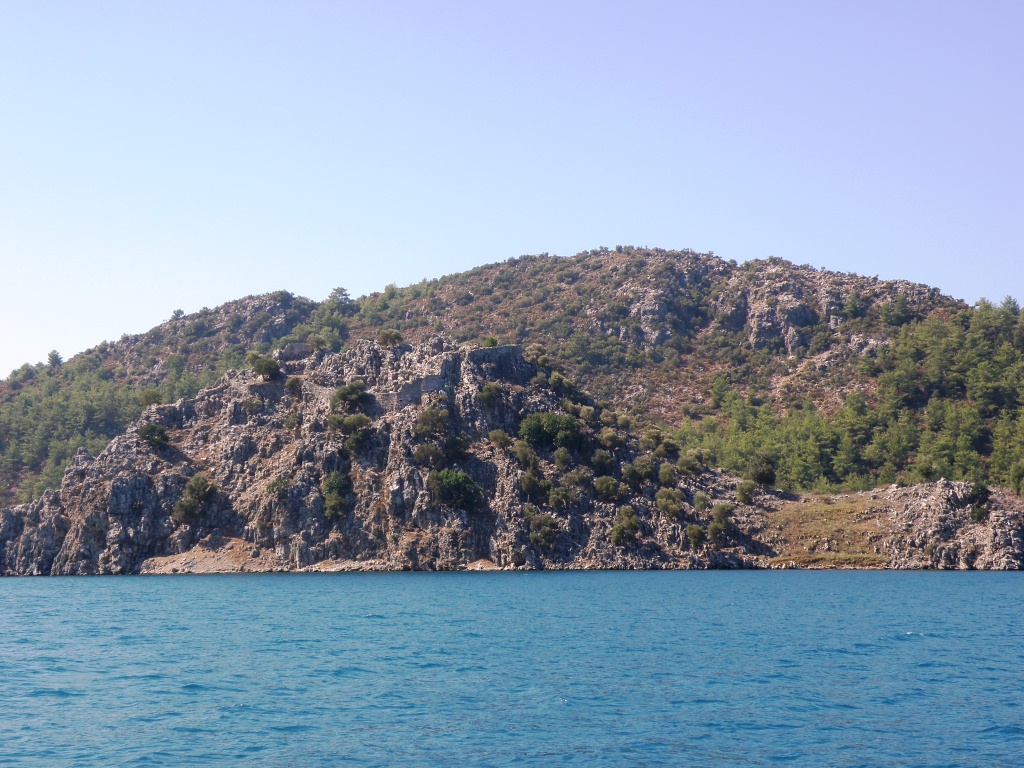

Fortress on top of tiny island in Keci Buku
Keci Buku is off the far-northeastern section of Hisaronu Lumani, the very large bay or gulf between the peninsula off Marmaris and the Datca peninsula, a/k/a the Dorian Penninsula......the huge bay in which the large Greek island of Simi is located.  Slightly north of Keci Buku is the small village of Hisaronu, from which the gulf takes its name.  In antiquity it was called Bybassus.  On a rocky outcrop nearby the remains of an acropolis can be seen; little else remains.  Bybassus was part of the Rhodian Peraea and was important for its association with a temple complex at the east end of Keci Buku.  It is likely that Keci Buku was utilized as the harbor for Bybassus as there is no harbor at the actual location of that ancient city.

Fortress at Keci Buku.  What were they protecting?  Nothing inside
there except lots of rocks.  Guess the villagers hid inside if attacked.

The temple at Keci Buku was dedicated to Hemithea, literally the 'demi-goddess' who was revered for her healing powers, particularly for women in childbirth.   She practiced a method called incubation, which also was practiced by Hippocrates in Kos.  Incubation was a method whereby the goddess stood over the sick woman and cured her in her sleep, or over a woman in childbirth and helped alleviate her pain.  It is pure speculation today, but some people assume this incubation method was hypnosis.  Hypnosis supposedly can be used to alleviate pain.  Who knows what the demi-goddess did.  However the 'cures' were effected, this temple was popular for some 200 years from the 4th to the 2nd centuries B.C.

On Saturday, 8 September, we sailed to Kuruca Buku (a/k/a Kochina Bay) and dropped anchor at 36.45.228N  027.53.809E.  On this 13.3 NM trip west we actually were able to sail!!  For about 1 1/2 hours!  That might be a record for our sailing in 2011 or 2012 northbound or westbound in Turkey.  This short sail involved 2 long tacks, pinched as tight to the wind as we could handle---which is 54 degrees TRUE wind angle.  That is as tight to the wind as our Amel can sail.  Anything closer and we begin to lose power.  We were sailing in company with 2 American boats:  Steve and Karen on S/V Threshold, and Fred and Jane on S/V Escape Key.

Escape Key has been cruising Turkey for about 10 years.  They know all the bays and coves and the best anchoring spots.  We followed their lead and anchored nearby in Kuruca Buku.  Karen invited all of us over for sundowners aboard S/V Threshold that evening.  OMG!! Have we finally caught up with real cruisers!!!

The last time we enjoyed sundowners with fellow cruisers was when we met up with Marc and Jane (and kids) on S/V Imagine at Kythnos island in the Aegean Sea of Greece in June 2011.  In general, the people cruising in the Med are not friendly and do not socialize like cruisers in the Caribbean (or in the South Pacific).  In anchorages we never see dinghies going to other boats to visit.  Everyone seems to be quite stand-offish and keep to themselves.  Oh, they sometimes gather in small groups at restaurants and bars.  But the casual socializing that comes so freely in the Caribbean and all other cruising areas we have visited is very noticeably absent in the Med.  At least that is true in the eastern Med.  This lack of socializing is not because we are American or because of us personally; we have noticed the missing socialization regardless of nationality or personality, although sometimes German boats stick together and socialize occasionally together.   During our past 16 months here in the Med we have been invited to a couple of boats for very proper entertaining (crystal glasses and fine china), both of which were quite lovely and enjoyable.  But the only casual entertainment between boats has been when we invited people to our boat or a few times aboard M/V Dora Mac with fellow Americans Randal and Ruth.  Only once have we been invited to a non-American boat for casual drinks, and that was a British boat who had spent years cruising the Caribbean.  They told us how much they also miss this type of cruiser camaraderie but that people in the Med simply don't do that.  

We thoroughly enjoyed the evening visiting aboard S/V Threshold last night.  As so often happens, sundowners lasted well past sundown and late into the night.  Some function was happening on the tiny dock at the harbor village and belly-dancing music blasted the harbor until almost midnight.  But the cockpit where we were chatting was on the opposite side of the bay, so we could talk over the music.  Exotic music reminded us of where we are and made the experience more enjoyable.  We 3 boats moved on our separate ways the next morning.  Sure enjoyed meeting these folks and sharing their company for a few hours.

The next day we backtracked eastward to Selimye.  Winds were predicted to change to SE in 3 days and we would wait for those winds to help push us NNW to Bodrum.   We positively love Selimye.  I think it is our favorite place in all of Turkey.  We anchored and stayed there 3 nights. Unfortunately, those SE winds never happened.  While in Selimye a boat caught our attention.  Poor woman hand-cranked over 200 feet of anchor chain with that manual windlass while her husband sat in the cockpit doing nothing!  I will never understand why some men make their wives or girlfriends handle the anchor.  That should be left to the person with the most muscles, which normally is not a female.


 Yesterday we moved back to Kuruca Buku, enjoying several hours of great upwind sailing.   At sunrise this morning we weighed anchor and ended up motoring the entire 50 miles to Bodrum, arriving this afternoon.    We are now anchored in the shadow of the Castle of St. Peter at 37.01.704N  027.26.005E.  Tomorrow we will visit the castle and the accompanying museums.  That is why we came here.
Castle of St. Peter in Bodrum, Turkey


Saturday, August 25, 2012

Stratonikeia -- a seldom visited ancient city

(As always, click on any image for larger view.)
Ancient olive tree.  Imagine the
furniture that could be made with
olive burl veneer.  Gorgeous!

After the city of Muğla we drove farther inland to Yatagan and turned northwest towards Bodrum.  Our destination was a tiny mountain village occupied today by only 5 families.


Ruth outside Turkish Baths


The name of this tiny village is Stratonikeia.  Wikipedia identifies the village as Eskihisar, although the road signs were labeled Stratonikeia.  The tourism pamphlet states that the village of Eskihisar has moved to a new area nearby, but that 5 families remain at ancient Stratonikeia.  I suspect that the tourist pamphlet prepared locally is correct and that online information by Wikipedia is incorrect on this little matter.


Inside Turkish Bath, lower level.

Inside Turkish Baths, upper level.


The first scientific excavations at this site began in 1977 when digging was underway during the construction of a large nearby power plant.  Probably the village residents had no idea they were living atop ancient ruins.  (Where does all this dirt come from?  All ancient sites are buried under 4 to 20 feet of dirt.  Where does it come from when up at the top of a mountain?)   Researching, excavating and restoration are in progress today ......... at a snail's pace, but still on-going.  Judging by what we saw and the sketch of the original city walls, less than 10% of the site has undergone any excavation thus far.  
Today's mosque for this tiny village of 5 families


I cannot imagine being part of the 5 families that live in this village.  Talk about isolation in antiquity!  To call it a slow pace of life would be a gross understatement.
Wooden shade area over
entry to mosque


Thus far, the archaeologists have identified the city wall, city gate, gymnasium, temple, bouleuterion (Greek assembly place for council or public body), theater, Turkish bath, Big Tower, and the Roman Bath.  Outside the city walls are found a water foundation (structure of unknown use but obviously Roman; visible alongside the main highway on the southern side) and a tomb.  I found no information about the Big Tower or the tomb.  We know where these 2 things are physically located, but don't know the who, what, why or when.


Ruins of the gymnasium looking one direction


Too little is yet known from the archaeologists to identify with certainty when this city was first built.  The oldest item found on the site thus far dates back to the 12th century B.C.  It is a stirrup cup, buff in color with red stripes.  A stirrup cup was a small cup presented as a gift when a guest departed.  A parting gift.


Ruins of gymnasium facing opposite direction


In researching online about this site, I found this article about an item excavated there just this year.  Also learned that items from this site have been brought to the Museum in Mugla, so maybe we should not have skipped that museum.  But you can only see just so much in a single day trip.              January 2012 discovery at Stratonikeia


Any ideas what these shaped stones might have been
used for?  Many, many piles of odd stones everywhere

This city was first known as Idrias and then Chysaoris and is pre-Hellenistic in origin.  The name was then changed to Stratonikeia, which was sometimes spelled Stratoniceia.  It was one of the most important cities in the interior of Caria.  (Remember, the Carian people were those who bridged the gap between primitive peoples and modern peoples; lived in caves and then stone buildings; invented embroidery and numerous musical instruments.)  


Purpose of this?  Circle was about 2-ft diameter.

 King Seleucis of Syria transferred control of the city to his son Antiochus in 294 B.C.  King Seleucis was married to a woman named Stratonice.  Later, Antiochos married his stepmother and he renamed the city for his wife/lady stepmother.    King Antiochos I changed the name of the city from Chysaoris to Stratonikeia in 281 B.C. 


This stone looked like it might have been used for
sacrifices.  There was a groove chiseled out that would
have drained blood off the end.


According to the tourist pamphlet, "under the Prohibited Degrees a man may not marry his stepmother; but in the Hellenistic royal families this matters were otherwise regulated."  By my research this does not appear to be true. 
Underside of the stone that looked
like a sacrificial place was
intricately carved.  What was
this?

Roman civil law prohibited marriages within four degrees of consanguinity (blood relationship).  This was calculated by counting up from one prospective partner to the common ancestor, then down to the other prospective partner.  
The first prohibited degree of consanguinity was a parent-child relationship; a second degree would be a sibling relationship.  A third degree would be an uncle/aunt with a niece/nephew; while the fourth degree was between first cousins.  As there was no blood relationship (consanguinity) between the step-son and step-mother, there should have been no legal objections with this marriage per the Prohibited Degrees.

Billa House.  I have no idea what the Billa House is or
why it is important, but it was mentioned in all the tourist
literature and on most websites I checked.
Roman Emperor Hadrian (76 A.D. - 138 A.D.) took the town under his special protection and named it Hadrianopolis.  The name later reverted back to Stratonikeia.  Menippus, one of the most distinguished orators of his time according to Cicero, was a native of Stratonikeia.

Little is known with certainty about this city except for the location of the city wall.  Based on the sketch in the pamphlet, we walked only a tiny percentage of this site.  The city appears to have been laid out in a grid plan.  

A very tall column.  Note how deep is the
base -- buried  over time about 6-ft.
Where does all this dirt come from.
Couldn't be silting because this is at top
of a mountain with no water source nearby.


One of the first things excavated in 1977 was the gymnasium.  The narrow side is 105 meters wide.  The long side was 180 meters in length.  It is the largest known gymnasium in antiquity.  Finds at the site indicate that the gymnasium was built circa 125 B.C.  There were so many stone pieces tumbled about in the gymnasium area.  We spent much of our time investigating this area.  


The agora (wide plaza area with columns on either side and merchant/vendor shops on either side) was partially excavated.
Intricately carved posts--must have been entryway
for a street leading to something or someone important.


Gate to Boulerion (not to temple area as originally thought)


Out in an open field stood a 'gate' -- which means carved stones placed to resemble a doorway opening.   It was first thought that this gate was the entrance to the penbolus or precinct surrounding the temple, an enclosure over 100 yards square, of which very little else has been located to date.   We saw no evidence of digging in that general direction.  Farther past that area is the temple.  The Serapeum, or a temple dedicated to the cult of Serapis, was built around 200 A.D. and is full of inscriptions and invocations to the gods.  This period was right on the cusp of the Romans' conversion to Christianity.  The location of the very much older temple of Zeus Chrysaoreus is known to be on the site somewhere but its locations remains unknown. 


The Boulerion
Today, after further excavation, it has been confirmed that this lone gate did not lead to the area surrounding the temple.  This gate was the entry to the Bouleuterion (assembly meeting place).  On the northern external wall of the Bouleuterion, the price list of Diocletianus and the introduction part relating to the application of it are engraved in Latin.  Diocletianus was a Roman emperor  who attempted to control inflation via price controls and he ordered a list to be published setting the maximum prices of many items.  Diocletianus and his price control attempt  


Pomegranates and figs grew
by the thousands all over the
site.  Continual growth since
antiquity?


That must have been one huge
column!  Waist high diameter.
Relatively close to the old temple is the theater.  This theater seated 15,000 people.  We did not walk out to see this temple.  I think all 4 of us have seen enough Roman temples.


Wandering ancient walkways


We're the Fugari. (Sound it out)


We also did not linger at the Roman baths.  Nor the Turkish baths.  Although the very first thing one encounters upon entry to this site from the parking area are the Turkish baths.  Right next to the current mosque.  Very close to the current little 'village square' and across from the 'village coffee shop' that was recently restored by the Young Men's Business League in the nearby city of Yatagan.  We did stop there for drinks and snacks before departing.


The colonaded street.

We wound around through rock walls and paths and eventually found the colonnaded street and monuments.  Randal wanted to see some mosaics that were in this area.  
Plastic covered mosaics

Unfortunately, most of the mosaic areas were covered by plastic sheeting for protection from the elements.  The archaeologists had placed barrier tapes to discourage visitors from disturbing the mosaic areas.  So we didn't really get to see much of the mosaics.


Overlooking towards valley.  The Necropolis was located
down that way.  Someday will be a lake.

The view down to the valley was breathtaking.  This must have been a beautiful place.

The road outside the city wall leading up to the Northern City Gate was called the Holy Road.  It also led down to the city's Necropolis.  The Necropolis is gone today, destroyed in recent years by coal mining for the nearby Yatagan Power Plant.  When all the coal has been depleted, the low-lying areas will be submerged when a man-made lake is created.  That will really nice for this area --a large mountain lake.


The North Gate as it stands today


At the end of the colonnaded street stood the northern City Gate and Fountain. 


The fountain pool.  Floor is covered in mosaics.

Clay water pipes visible in many places.  These led to
the fountain pool beside the North Gate.
The pamphlet illustrates an image of what this would have looked like during the city's heyday.  The reality today is somewhat different.  But your mind's eye can envision what this must have looked like.


The North Gate as it looked during ancient times (per the tourist brochure).  Wouldn't it be great to see this
fully reconstructed.

Mosaic pattern in floor of fountain pool.
Long before German Nazis.  We have seen this same
symbol used by Kuna natives in Panama and on a couple
of South Pacific islands.  Wonder how this symbol
became used worldwide before global travel was possible.

Mosaic pattern in floor of pool.
Tridents.


Mosaic pattern in floor of pool.
Pomegranates.


Outside mosque entry, below ground level.  This looked like water would
flow through.  Appeared a perfect place for early Christian baptisms,
although nothing in our tourist literature mentions Christians ever
inhabiting this area.  

When I researched Stratonikeia (after we visited), I was shocked to learn about its Christian history.  According to Wikipedia, Stratonikeia was Christianized early.  It was a Titular See.  The Notitae Episcopatuum mention the See up to the 13th century among the suffragans of Stauropolis.  Only 3 of its bishops are known, by their signatures at councils:  Eupeithus, at the Council of Chalcedon in 451 A.D.; Theopemptus at the Council of Constantinople in 692 A.D.; and Gregory at the Council of Nicaea in 787 A.D.  

(Now, THIS is what shocked me.)  

Stratonikeia remains a Titular See of the Roman Catholic Church, Latinized as Stratonicensis in Caria.  The Seat has been vacant since the death of the last bishop in 1977.

In a secular country that is 99% Muslim.  And in a village inhabited with only 5 families, all of whom are Muslim.  Think it might be time for the Catholic Church to update their records?

Village Coffee Shop restored by the Young Businessmen
in nearby larger city of Yatagan.


Ruth was hungry and the rest of us were hot and thirsty by the time we finished exploring the North Gate area and trekking the long way back to the entrance.  So we stopped in the village coffee shop/cafe to see what could be purchased in the way of libation and nourishment. 
Randal and Bill


Ruth waiting for her Tost


Ruth ordered a Tost; I gulped down 2 bottles of water; and Bill and Randal enjoyed cold beer.  (Tost is a popular sandwich, found literally everywhere in Turkey.  Usually has a slice of cheese, a slice or 2 of tomato, and maybe a slice or 2 of some kind of beef deli meat.  Placed between 2 slices of bread and placed on a grill with a weight on top to squish it down.  No butter or oil; cooked dry.  This is pronounced just like our normal toast.)
We shared the coffee shop with one of the local chickens.


Friday, August 24, 2012

Day trip to Muğla

As always, click on any image for larger view.
Mom and daughters at weekly market


I feel like a Chatty Kathy today so this posting is probably much longer than it should be.  Yesterday we shared a rental car with friends Ruth and Randal on M/V DORA MAC and set out for a day of sightseeing in the nearby mountains.  Our first stop was the city of Muğla (pronounced MOO-lah), which was is the capital of the province and region also called  Muğla. 


Saw 2 Porsche Panameras in Mugla -- diesel!

This was a great destination for a day trip.  Muğla is situated at medium elevation in the mountains about 50 kilometers from Marmaris.  The drive up is mostly on newly constructed smooth wide highways and the views are splendid.  We had no idea what to expect to see but had looked forward to enjoying a day away from touristy Marmaris and away from the marina.  We were tired of seeing bare bellies and tattoos on fat 'down-market' British tourists that fill Marmaris. 


Many women wear these beige coats
over their clothing, even in this heat!
I do not know how they can stand it.
They wear leggings to the ankle, skirt
to the ankle, blouse to wrist, vest
over blouse; and then top it off
with a belted coat to mid-calf.
I would positively die in this heat.


And  Muğla did not disappoint.  Muğla was originally called Alinda and dates back as a city to 1200 B.C.  I'm not going to relate the history of this place, other than to mention than Tamerlane tore through here in 1402 and restored it to the emir of that time.  The Vakiflar Hamami (Turkish bath) located here dates back to 1258 and will still give you a steam, wash, dry and nap if that is something that appeals.  (We are not interested in having a Turkish bath anywhere.)

Found the store where those
"he-she' guys must shop.
We saw transvestites on bus in
Marmaris, which surprised us
considering Turkey is 99%
Muslim.
There were very few tourists (if any, except for us, of course).  Randal managed to drive right to where we wanted to start checking out this city -- at the Ataturk statue in the main road round-about.  From there we sort of got lost for a few minutes but enjoyed driving the extremely narrow old streets and soon ended up back at the Ataturk statue.  This time we turned an opposite direction and followed sign for the Otopark (See; you too can read Turkish!  Otopark obviously means 'auto park' or a parking place for vehicles.)  Then we set off trekking in search of the tourist office.  That turned out to be a much farther walk than indicated in the Lonely Planet guide.  
Lead domed mosque
When we got there, this office appeared to be a tourism office to arrange conventions or business venues or something.  We abandoned Ruth to attempt to talk to the man in charge in the far rear office.  Ruth knows some Turkish and we figured the fewer people in the room, the better.  She soon emerged with a few maps and a couple of pamphlets for a tiny village some 40 kilometers distant.  Supposedly 5 families still live in this village.  And it is the site of some ancient city.  Sure; that sounded interesting to visit after we finished  Muğla .  (will be next posting)


Ceiling inside lead domed mosque

Next we walked back to the ultra-narrow street area that we had earlier driven through.  Searching for some particular old Ottoman homes and a certain mosque that we had read about.    As we stood in a little park-like square trying to decipher maps I noticed a small mosque right next to us that had a dull-finished nondescript dome.  Uhhhh........could that be lead on that roof?  One of the mosques listed in the tourist brochure is commonly referred to as the lead domed mosque.  The real name for this mosque is the Kurşunlu Mosque (pronounced kur-SHOON-loo).  It was built in 1493 and originally had 2 smaller domes on either side of the larger lead covered dome. 
Inside lead domed mosque

 The other 2 domes were removed during a renovation.  In 1900, during another renovation, a narthex was added to the mosque.  There used to be a 30-roomed Muslim Theological School inside the mosque.  But judging from the size of this mosque today, that theological school must have been prior to a renovation that apparently made the mosque complex smaller.


Mosque upper side.
Why a boat?

Upper corner inside mosque.
Why a boat?
We walked over to check it out and there was a tiny old man walking around carrying something and yelling at another man who was sitting on the ground in a corner of the mosque grounds.  No idea what that was all about.  But the little old man noticed us looking around with lost expressions on our faces and he came to our rescue.  He did not speak a word of English but could tell we were interested in seeing the interior of this mosque.   And he had the keys to the mosque!  He very kindly opened the doors; we removed our shoes and walked inside.  


The other 2 upper corners had images of vases of
flowers.

We really were violating the Islamic traditions by entering the mosque as were were dressed.  Neither Ruth nor I had our hair covered (had no scarves with us) and Bill  and Randal were wearing shorts that did not cover their knees (which is a big no-no with Muslim men).  I'm sure we insulted the old man but he was very gracious about it.  


Prayer mats stacked in corner in
case you forgot to bring your own.

There are many mosques in this city; the oldest having been constructed in 1334 A.D.; but the lead domed mosque was the only one that interested us.  What luck to have just happened upon it so easily!   The interior of the lead-domed mosque is painted bright white.  Vividly colored paintings contrast on the bright white background.  This is very different from any other mosque that we have seen anywhere.  Unique.


Women's prayer area 

Outdoor ablution area for the mosque.  Notice the 2
women enjoying a picnic lunch in the corner.

Back outside the main domed area is the woman's prayer area.  Just a curtained off corner.  Gotta keep those women in their proper place.

Ruth gave the little old man a few lira as a donation to the mosque.  Not sure that the message got through and maybe the little man thought the donation was for him.  Whatever.  It didn't matter.


Outdoor clothing market.  Just like Mexico.

We walked through a small remote section of the Thursday Market areas.  First was the clothing for sale.  Vendors were set up for a couple of blocks near the mosque and took up most of the street area.  Ruth and I each found a couple of items that were bargains.
This was the tiniest woman imaginable.


Men socializing playing a domino game of some sort

We continued wandering the tiny old narrow streets.  The weather was mountain cool, as compared to the sea level Marmaris extremely hot; and we all enjoyed walking around.  On one narrow street we chanced upon several groups of tables occupied by men playing domino games of some sort.  And some playing a card game of some kind.  
Men socializing.  Women not
welcome.

There were no women present on that street and I felt a bit uncomfortable walking through there because it appeared to be a male gathering place for socializing.  Women are not usually welcomed.  No one gave me any dirty looks but no one gave any welcoming looks either.


Tiny blacksmith shop


Except the blacksmith was really
a cooper.

One of the places was like a tiny blacksmith shop.  Something that you might have found several hundred years ago.  Outside the tiny shop the blacksmith had placed shiny pots, pans and metal bowls that he had made.  Oh!  So he isn't a blacksmith.  He is a cooper.  Like stepping back in time.


Husky crossed our paths several times.
Notice the unique chimney tops
We continued to wander and encountered several more mosques.  Gosh!  I can only imagine what the competing muezzins must sound like during calls to prayers with so many mosques situated so closely together.


Figuring out the map in old Ottoman section


Winding narrow streets in old Ottoman housing area
A black Siberian Husky also was walking these narrow streets but every time I attempted to snap his photo he moved away too quickly.  


A couple of women with a little girl came to their doorstep to smile and wave to us as we walked by.  I motioned if it would be okay to take their photo.  They nodded but one woman motioned for me to wait while she re-arranged her headscarf.  They seemed friendly and as if they rarely saw tourists walking past their door.
Women waving to us as we walked through their neighborhood


Ruth in front of Lamb's Doors.  These open into a
courtyard behind this wall.  Then the house is farther in.


Public community water source.  These spigots are
seen all over Turkey.  The water is safe to drink.


Back down the little hill we wound and happened upon the intersection where the old clock tower was situated.  The clock tower was built by a Greek craftsman named Filivari Usta in 1895.  It is near the old quarter.
Old Clock Tower

The old quarter slopes around and consists of about 400 registered old houses dated from the 18th and 19th centuries, many of which are restored.  These houses are mainly in the Turkish/Ottoman style and are characterized by hayat (courtyard) sections accessed through double-shuttered doors called kuzulu kapi (lamb doors) and dotted with chimneys typical of Mugla.  There are also a number of Greek style houses, white washed and angular.


Held the camera up over a wall and snapped this shot.
Turned out to be an old cemetery.

The chimneys typical of  Muğla  are constructed of brick and have little huts on top on all 4 sides. We have seen a few of these around Marmaris, but this style is peculiar to  Muğla.  We saw these all over the city and also in the village in the old ruins that we visited later in the afternoon.


Massage your head

Massaging Bill's head.
It really tickled!
Ruth and Randal happened upon a novelty shop and bought some 'head massagers.'  We each tried the head massager and it felt like ants crawling on your scalp.  Bill was the only of of us who could stand it longer than 2 seconds.


Baker making snacks

While Ruth and Randal shopped in the novelty shop I entertained myself watching a baker make some of the little snacks that are popular in this area of Turkey. 
Finished product.  Yumm!
He rolled out dough into a small oblong shape (like a very thick flour tortilla, but oblong instead of round).  Topped that with some kind of finely chopped fresh greens and drizzled a small amount of dry crumbled cheese on top.  Folded up the sides to leave a thin line of green visible on the top.  Baked these in a wood-fired stone oven.  Cooled slightly and cut into bite sized strips.  Bill bought a few for the 4 of us to share.  Quite tasty when warm.  Not sure how good these would be served cold.
Window shopping for guns.  Very unusual guns.


Examples of how to modernize the female headscarves


After snacking on these (whatever they are called) we decided that we really needed a bit more to call it lunch.  So we found a short block with tables set in the center beneath trees.   Small cafes or restaurants lined each side.  We opted for a table in front of a tiny cafe that served nothing but Turkish meatballs.  These are called kofte and are like a small meatball that is flattened before cooking on a flat grill.   Remember, no one here speaks English.  Bill asked the waiter:  meatballs; moo?  meatballs; baa?  The waiter nodded and said:  meatballs; moo.  Okay, we will try 2 servings of beef Turkish meatballs and share.  
The little kofte cafe that serves meals in the street
Randal and Ruth at lunch

These were served with finely sliced greens of some kind tossed with finely sliced onions; about 70% onions and 30% greens.  Topped with 3-4 slices of fresh tomato.  Topped with 2 grilled very hot long thin green peppers.  And thick bread slices that had been heated on the grill in the residue from cooking the meatballs.  Very simple meal. 

 Perfect after snacking on the greens/cheese/tortilla things.


Weekly Thursday Market


Walking back toward the otopark we sought out the big Thursday Market.  This was the largest weekly market we have ever seen.  It went on for blocks.  There were a few clothing vendors in one section, but mostly it was produce of all kinds.  Table after table, vendor after vendor, for blocks.  It was covered and quite comfortable walking through there.

Bill found a vendor with a small amount of broccoli and I bought slightly more than 1/2 kilo (about 1.4 pounds) for a whopping 50 cents.   
Little kids sleeping while mom sells veggies
Americans cannot relate to this, but supermarkets here do not sell everything year round.  Produce is rarely imported.  It is all grown locally and very fresh.  Which means only what is in season HERE can be purchased here.  Everything is totally seasonal.  And, as most people know, broccoli is a cool weather crop.  It can't be grown in the high heat of summer in this part of the world.  This broccoli must have been grown at very high altitude for it to be harvest-ready in August.  Each head was pretty small.  I feel very lucky to have found it.


Brown figs!!  Wish I had bought a few more.
Bill also noticed a few vendors with brown figs.  Wow!  I have seen and bought a few green figs in Marmaris.  But this is the first time we have seen brown figs in Turkey.  I like figs; Bill detests figs.  I bought a small bag full -- 7 large, plump and perfect.  A real treat for me to enjoy over the next few days.  When I was a child each year we would go to an aunt's house to pick figs and my mother would put up several dozen jars of fig preserves.  My mother did not excel as a cook and freely admitted that she could make only a few things consistently perfectly -- cornbread dressing, shrimp & green rice, dewberry jelly and fig preserves.   She taught me how to cook these dishes; there are no written recipes; each is prepared by smell and appearance.   It is rare to find really good fig preserves and hers were always perfect.  I would have loved to buy a whole crate of these perfect brown figs and make fig preserves.  But, as I said, Bill detests figs.  Ruth has never tasted figs and she bought a few to sample later.  Told her it is an acquired taste and that she probably will hate them as much as Bill. 


Girl eating a fig.  Her mom on left wanted me to pay the
girl for taking her photo.
There were numerous small children waiting inside the market area while their parents sold the harvested produce.  One little girl about 12 was eating a piece of fruit and I motioned if it would be okay to take her photo.  She nodded yes.  I clicked and then showed her the image on the camera display and she was delighted.  Then her mother walked up and tried to get me to pay the girl for taking her photo.  Once her meaning was clearly understood, I just laughed and shook my head.  Nope; not doing that.  The girl said it was okay to take her photo.  She had not asked for any money.  Mom should take lessons from her daughter.  You don't ask for money after the fact.


I love the expression on this little girl.
 Notice that those are very full dropped crotch pants that she is wearing, not a skirt. 

Friendly women and children at the market

Farther down the way we found a few more little girls sitting on a Turkish carpet.  They were really cute and Ruth started to snap their photo.  One of the little girls ran to her mom the retrieve her baby sister.  Everyone was friendly and smiling and no one asked for money for taking their photo.  I hope this expecting payment for photos does not become the norm for this area.  For now, most of the locals don't mind if tourists take their photos, as long as one asks first.


Bill loves these peppers!
Think he found a large enough bag?

When we reached the fish section of the Thursday Market, we all decided we had seen enough.
They sell millions of these large
red peppers.  Not hot.


Can you identify the green veggies for sale?  Hint: okra on right
and chard on left.

 If they also had a wet market section, I wanted to skip that part.  Don't need to see or smell any hanging meat today.  We exited the market area and soon found our parked car. 


Wish I knew what this is.  It is sold everywhere and
often served in cafes and restaurants.

Next on the day's  itinerary would be a small village some 40+ kilometers distant.  A place none of us had ever heard of before going to the tourist office in  Muğla.  The tourist offices in Fethiye and Marmaris did not have information or pamphlets for this place.   We were headed to Stratonikeia.  That will be a separate posting.
Peppers are very popular in Turkish cuisine.  Here is a selection spread
on a table at the weekly market.  A very popular dish is to stuff the
small very thin-skinned bell peppers and serve cold as a starter to a meal.